
South Korea's Dried Seaweed Exports Hit Record $281 Million in Q1 2025
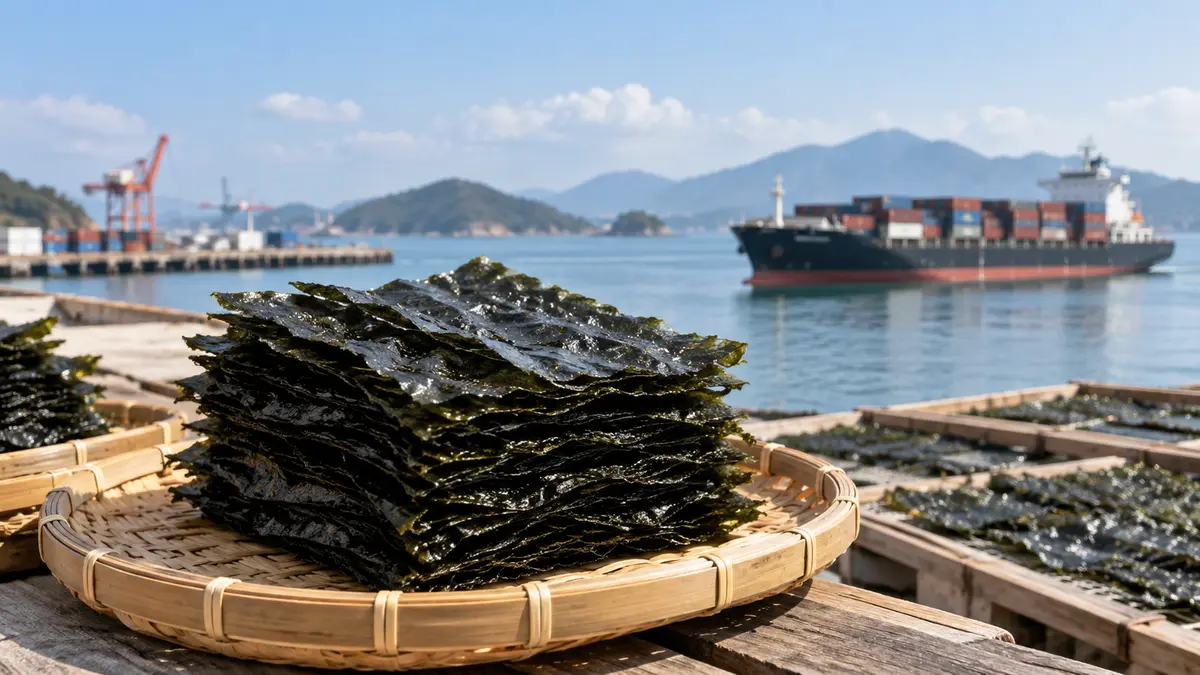
South Korea's exports of dried seaweed products, known as gim in Korean, reached an all-time high in the first quarter of 2025, driven by growing global demand for the food, data compiled by the Korea Agro-Fisheries & Food Trade Corp. showed on April 21, 2025, with the oceans ministry projecting more than $1 billion of gim exports for the full year.
The record quarter
Outbound shipments of gim reached $281 million in the first three months of the year, up 21.1 percent from a year earlier, and the figure is the highest for any first quarter. The volume of gim exports increased 7.5 percent on-year to 10,161 tons in the January-March period, which means value grew almost three times faster than tonnage: the world is paying more per tonne for Korean seaweed, not merely buying more of it.
We expect to export more than $1 billion worth of gim products this year as the volume and value of outbound shipments are both on the rise, an official from the oceans ministry said. The government earlier sought to reach the $1 billion mark by 2027, and South Korea exported $997 million of gim products last year, so the 2025 target arrives at least two years ahead of the official schedule if the first-quarter pace holds.
Where the demand came from
The ministry attributed the strong exports to the popularity of Korean gim products in the United States and China, the world's two largest markets. Gim exports to the US rose 21.6 percent on-year to $57.9 million in the first quarter on robust demand for seasoned gim products, while shipments to China spiked 86.5 percent to $51.1 million over the same period as gimbap, a Korean dish made from cooked rice and various fillings rolled in dried seaweed, gained popularity in the country.
The gimbap effect in China
The Chinese line is the most striking of the quarter: an 86.5 percent jump is a demand event, not a trade-flow adjustment, and its driver is a dish rather than a tariff. Gimbap's spread through Chinese convenience retail and social media converts seaweed from an ingredient into a branded consumer good, and the seasoned formats that lead the US line perform the same trick in North America.
Exports to Thailand and Japan also gained 15.9 percent and 7.2 percent to $34.2 million and $34.4 million, respectively, showing that the record quarter was broad-based across four different consumer cultures rather than dependent on a single market's restocking.
The road to one billion

The structure of the record explains why the ministry's $1 billion projection is credible. Last year's $997 million was achieved without a first quarter of this quality; adding a 21.1 percent value increase on the strongest quarter of the year to a product line whose two largest markets are growing at 21.6 percent and 86.5 percent leaves little room for a full-year miss. The volume side confirms that the value growth is not pure price: 10,161 tons in one quarter is a physical expansion of the category.
- Q1 2025 gim exports: $281 million, up 21.1 percent, the highest first quarter on record.
- Volume: 10,161 tons, up 7.5 percent year on year.
- United States: $57.9 million, up 21.6 percent, led by seasoned gim.
- China: $51.1 million, up 86.5 percent, driven by gimbap popularity.
- Thailand: $34.2 million, up 15.9 percent; Japan: $34.4 million, up 7.2 percent.
- Full-year context: $997 million exported in 2024, with the $1 billion goal originally set for 2027.
For a country whose seafood trade is usually discussed in terms of tuna fleets and fishmeal, the gim line is a reminder that the fastest growing marine export can be a sheet of dried algae: low weight, high brand value, and a demand curve set by kitchens rather than by commodity cycles.
Just Published

European housing prices and rents

Schneider–PTC: the industrial data integration test behind the deal

Avio USA starts work on its Virginia manufacturing site

One equity market, two currency measures

Russia’s draft budget raises spending and borrowing plans

Russia Sets the 2027 Minimum Wage at 28,935 Rubles, Up 6.8%, on the Way to 35,000 by 2030
Partner news digest
 Qatar LNG expansion: readiness, financing and the production test
 Pennon’s capital plan: turning finance into better water outcomes
 Italy’s diesel relief gap: taxes, price ceilings and implementation
 EU–China hybrid trade: from understanding to measurable implementation
 Schneider–PTC: the industrial data integration test behind the deal
 IKEA’s hybrid resale model: buyback, marketplace liquidity and furniture logistics
 Banking AI beyond the ranking: capability, execution and evidence of value
 Fishing labour beyond the product label: practical protection
 Rhenus and the Middle Corridor: terminals need coordinated connections
 Royal Mail restructuring: the test is reliable delivery
 Fuel Finder on Google Maps: when price transparency becomes useful competition
 Samsung’s memory profit surge: what the preliminary record explains
Leave a comment