
Schneider–PTC: the industrial data integration test behind the deal

The acquisition thesis is a data connection
Industrial software becomes useful when it connects information to a decision that changes work in the physical world. A product design describes what should be built. A manufacturing record describes what was built. An operating record describes how it behaves. Connecting those views can help a business find the cause of a failure or improve the next design. The proposed combination of Schneider Electric and PTC is therefore best assessed through the practical difficulty of making those connections reliable.
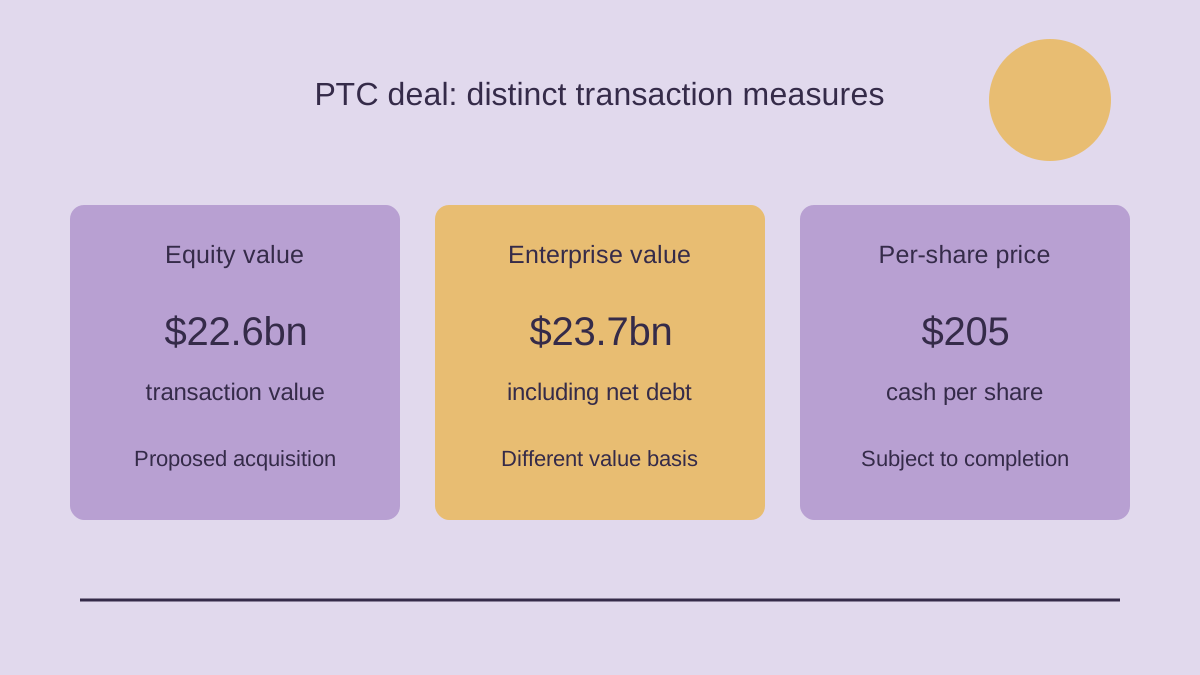
On 5 October 2026, Schneider Electric of France agreed to acquire PTC of the United States for $205 per share in cash: $22.6 billion equity value and $23.7 billion enterprise value, a 42.3% closing-price premium. CEOs Olivier Blum and Neil Barua presented the plan; closing is anticipated by Q3 2027, subject to shareholder and regulatory approval.
A signed agreement is an important transaction milestone, but it is not a completed integration. The ownership change itself would also be only the beginning of the operating task. Customers will judge the combination through the products, interfaces and support they receive. A convincing industrial AI proposition needs to demonstrate that the resulting information is trustworthy enough to guide real engineering and operational decisions.
Keep transaction values distinct
Equity value describes the value assigned to shareholders' ownership. Enterprise value describes a broader valuation basis that includes debt and related adjustments. Neither should be treated as a separate pot of money to add to the other. The two figures answer different questions about the same transaction. A chart that shows them together should preserve those definitions instead of implying two independent acquisition costs.
The per-share cash offer is another distinct measure. It describes the announced consideration for an eligible share, subject to completion of the transaction. The premium compares that offer with a specified market-price reference. It does not measure the future operating return on the acquisition. A large premium can indicate the price of obtaining control, but the economic justification must come from the capabilities and cash flows the buyer expects to obtain.
Using a consistent currency and a labelled valuation basis makes the numbers easier to understand. Converting values into several currencies may be useful for a particular audience, but it can obscure comparisons if exchange rates or dates differ. The essential first step is to retain the original transaction terms and explain what each number measures.
Cost savings and revenue are different benefits
Euronews reported planned financing of up to €17 billion in debt and €6 billion in new shares. Schneider forecasts €250 million in annual cost savings by year three and approximately €800 million in revenue synergies. These are management expectations, not achieved results.
A cost saving can improve earnings when an expense is removed without damaging the business. Additional revenue requires delivery costs and can carry a different margin from existing sales. Adding a revenue forecast directly to a cost-saving forecast would therefore create a misleading measure of profit. The two expectations need separate monitoring, with clear periods and a description of the costs needed to realise them.
Integration can itself require expenditure. Systems must be connected, products supported and teams coordinated. The available headline forecasts do not reveal every implementation cost. An evaluation should ask whether the eventual net benefit accounts for the necessary investment and whether savings preserve the capabilities that support customer value. A reduction in expense is not automatically a successful integration if it weakens the product or the service.
Capital allocation changes the surrounding choices
The report also described an expected pause in buybacks during 2027–2028, followed by acceleration to complete the existing €2.5–€3.5 billion programme by the end of 2030. It recorded a share-price decline exceeding 9% in morning trading after the announcement.
The financing plan changes the choices available around the transaction. New debt creates obligations whose cost and timing matter. New equity changes the ownership base. A pause in repurchases reallocates a planned use of capital. These effects should be evaluated together, while avoiding unsupported assumptions about final borrowing rates, issuance prices or the eventual number of shares. Planned funding ranges are not the same as completed issuance.
The market reaction is an observation rather than a complete explanation. It cannot identify a precise investor motive on its own. Participants may differ in their views of price, funding, integration and future growth. A falling share price does not prove the acquisition will fail, just as a positive reaction would not prove it will succeed. Operational evidence must eventually carry the argument.
The engineering record needs context
A drawing or a model is useful only when the reader knows which product version it describes. Engineering changes can alter a component, a material, a manufacturing step or a service instruction. A connected information system must preserve those relationships. Otherwise, a technically correct document can be applied to the wrong configuration and produce an incorrect operational decision.
Consider a hypothetical manufacturer investigating repeated failures in an installed machine. It needs to identify the design revision, the parts actually installed, the conditions of operation and the maintenance performed. A shared interface may make those records easier to find, but it does not establish that they are consistent. The value comes from reliable identity and history, not merely from placing different files behind the same login.
This example illustrates the implementation test rather than a claim about a particular customer. A successful product connection should reduce the effort required to establish the relevant facts and make unresolved differences visible. If it hides a mismatch behind a confident summary, it can make a decision faster while making it less reliable.
Operating data needs its own interpretation
A sensor reading describes an observation under particular conditions. Its interpretation can depend on measurement quality, calibration, operating mode and the state of the asset. Connecting it to a design record adds useful context, but the connection must be checked. A measurement from one machine should not quietly become evidence about another configuration because the records share a broad product name.
For an industrial customer, useful integration should preserve the chain from observation to decision. The user needs to see what was measured, which equipment it belongs to and what assumptions support the interpretation. An AI-generated recommendation should not erase that chain. Where the information is incomplete, the system should make the gap visible rather than construct a plausible answer without adequate support.
The commercial benefit is therefore closely tied to information quality. Faster access to unreliable records is a limited achievement. Faster access to verified context can support a better maintenance plan, a more focused engineering review or a clearer explanation of a production issue. Each benefit should be measured in the workflow where it is expected to occur.
Interoperability must survive ordinary work
The announcement's stated ambition is an open, interoperable industrial software and AI portfolio connecting design, manufacture, operation and maintenance. That description sets a customer-facing objective. It does not establish that every existing product and third-party system already works together.
An interoperability claim becomes meaningful when a customer can exchange the required information without losing its identity, meaning or history. Passing a file between systems is only one part of the task. Units, product versions, permissions and update rules also have to remain understandable. An integration that works once in a demonstration may still need substantial work to operate reliably across repeated changes.
Customers should therefore test ordinary situations, including a design revision, a supplier change and a corrected operating record. The important question is whether the connected system updates the appropriate relationships and preserves the audit trail. Openness also concerns the practical ability to work with other vendors. Public statements should eventually be supported by documented interfaces and repeatable customer experience.
AI assistance requires a boundary around authority
An assistant can help locate records, summarise a change or suggest an investigation. Those activities differ from approving a design or changing an operating setting. A deployment should make the boundary explicit. The user needs to know which actions require accountable human review and which can be performed automatically under a defined procedure. The appropriate boundary depends on the decision and its consequences.
A useful assessment tests the assistant under difficult conditions, not only when the answer is clearly documented. Conflicting revisions, incomplete records and unusual operating situations reveal whether the system preserves uncertainty. A confident response is not sufficient evidence of correctness. The customer needs a way to inspect the supporting material and challenge the conclusion.
These are proposed evaluation criteria, not allegations that an existing product fails them. They explain why ownership of more industrial data does not automatically produce trustworthy AI. Access, context, verification and accountability remain separate requirements. The acquisition thesis becomes stronger if the resulting tools make those requirements easier for customers to satisfy.
Cross-selling depends on a useful workflow
Combining customer relationships can create an opportunity to offer more products. A customer will still ask whether the additional product solves a problem and fits its environment. Cross-selling is therefore not simply a count of customers on a combined list. It depends on technical compatibility, procurement priorities, implementation capacity and a demonstrable benefit to the buyer.
A proposal may be commercially attractive when it reduces duplicated work or connects a missing part of an existing process. It may be less attractive when it requires a large migration before any benefit appears. The relevant evidence includes deployment effort, the time needed to reach useful operation and the cost of maintaining the integration. Those factors help explain why a revenue opportunity should remain a forecast until customers commit and use the product.
The acquisition announcement describes PTC as serving more than 30,000 customers. That is a company-reported customer count, not a count of committed buyers for a combined offering.
The distinction preserves the difference between reach and realised demand. A larger sales channel can improve access to prospects, but it cannot replace a convincing customer outcome. The strongest growth evidence would connect new sales with functioning deployments and repeatable benefits.
Recurring revenue depends on continuing value
A recurring commercial model can support predictability when customers continue to receive value and renew their relationship. It should not be treated as an automatic guarantee. Customers may reconsider the cost of software, the effort of maintaining it and the availability of alternatives. Integration must therefore preserve the capabilities they rely on while making new benefits credible.
Industrial customers also care about support continuity. Engineering and operating records may remain important for a long period. A change in product ownership should not make those records inaccessible or leave a customer uncertain about the future of an essential tool. Clear road maps, dependable support and understandable migration options can matter as much as a new feature.
The acquisition's operating case should therefore examine retention as well as expansion. Winning a new product sale while disrupting an existing customer relationship would provide an incomplete picture of progress. A balanced review would ask what improves, what becomes more complicated and whether the customer can make an informed choice about the transition.
Integration needs measurable stages
A large transaction can produce a long list of strategic objectives. A manageable integration programme converts them into stages that customers and investors can assess. A stage might concern a working interface, a supported migration or a verified workflow improvement. It should identify the responsible team, the evidence of completion and the remaining dependencies.
Success should be defined before a demonstration or deployment. If the objective is to reduce the time required to investigate a fault, the measurement should include the full investigation rather than only the time needed to generate a summary. If the objective is to improve change control, the test should examine whether affected records are updated correctly. Choosing the measure in advance reduces the temptation to declare success using whatever result looks favourable.
The same discipline applies to financial forecasts. Cost savings need a consistent baseline and a clear period. Revenue synergies need evidence of additional business attributable to the combination. Integration expenditure and customer retention should remain visible alongside them. This makes the operating programme reviewable rather than a collection of ambitions that cannot be tested.
Questions for the next disclosure
The following questions provide a practical assessment framework. They are proposed checks, not a list of completed transaction conditions:
- Which shareholder and regulatory steps remain before closing, and which have been completed?
- How will the financing be issued, and what are its final cost and ownership effects?
- Which customer workflows demonstrate reliable connections between engineering and operational data?
- How are openness, data permissions and continuity of support preserved across products?
- What evidence separates realised cost savings, additional revenue and integration expenditure?
Answers should carry dates and identify whether a result is planned, tested or commercially deployed. That status is particularly important when demonstrations attract more attention than ordinary operation. A customer needs to know whether an illustrated capability is available in its environment, under what conditions and with what support. A dated evidence record makes progress easier to assess without confusing a roadmap with an installed product.
The operating case must earn the valuation
The proposed transaction offers a coherent idea: connect product and engineering knowledge with operational context. The difficult part is making that connection dependable across real customer systems and repeated changes. The announced price and forecast benefits establish the scale of the ambition. They do not establish that the integration has already delivered it.
As of 5 October, the appropriate test is therefore forward-looking but specific. Follow the closing conditions, funding and customer-facing integration milestones separately. Ask whether the combined tools improve decisions while preserving context and accountability. The strongest evidence for the acquisition would be useful workflows, retained customer trust and financial benefits measured on a consistent basis. Those outcomes must be demonstrated through execution rather than inferred from the size of the deal.
Source documents: the joint acquisition announcement and the dated Euronews report.
Just Published

European housing prices and rents
Schneider–PTC: the industrial data integration test behind the deal

Avio USA starts work on its Virginia manufacturing site

One equity market, two currency measures

Russia’s draft budget raises spending and borrowing plans

Russia Sets the 2027 Minimum Wage at 28,935 Rubles, Up 6.8%, on the Way to 35,000 by 2030
Partner news digest
 Qatar LNG expansion: readiness, financing and the production test
 Pennon’s capital plan: turning finance into better water outcomes
 Italy’s diesel relief gap: taxes, price ceilings and implementation
 EU–China hybrid trade: from understanding to measurable implementation
 Schneider–PTC: the industrial data integration test behind the deal
 IKEA’s hybrid resale model: buyback, marketplace liquidity and furniture logistics
 Banking AI beyond the ranking: capability, execution and evidence of value
 Fishing labour beyond the product label: practical protection
 Rhenus and the Middle Corridor: terminals need coordinated connections
 Royal Mail restructuring: the test is reliable delivery
 Fuel Finder on Google Maps: when price transparency becomes useful competition
 Samsung’s memory profit surge: what the preliminary record explains
Leave a comment