
Russia's Egg Market Turns Again: Wholesale Prices Rise 5-12% After a Summer of Losses
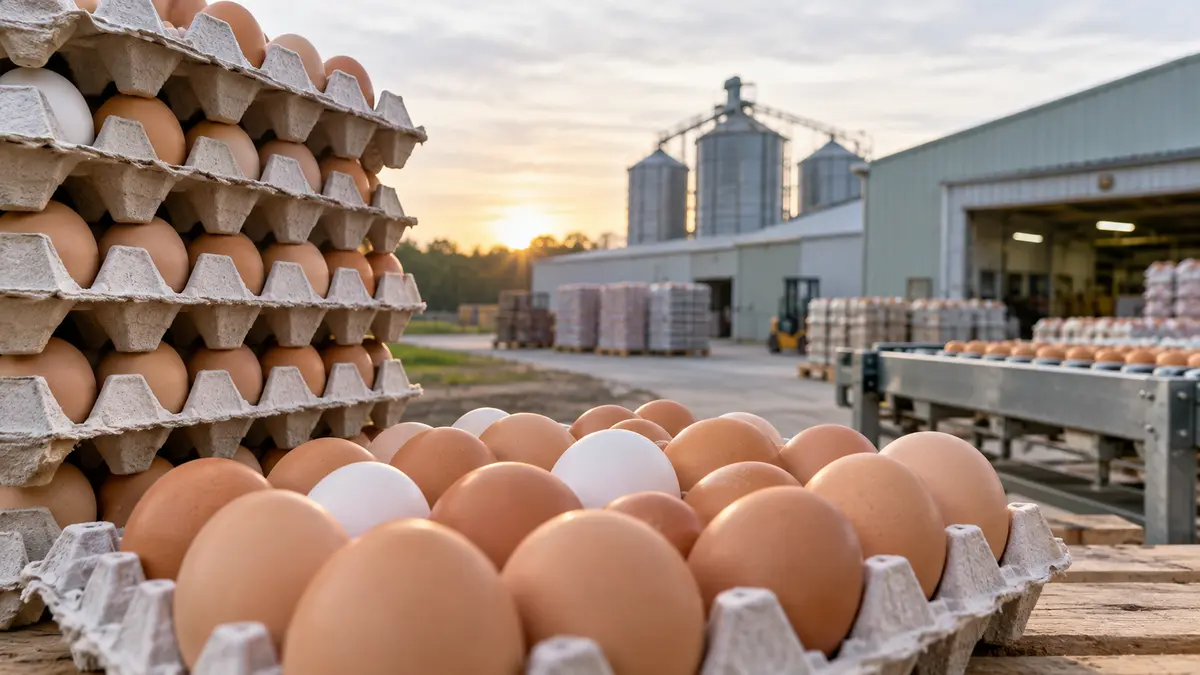
After a first half of 2024 in which Russian egg prices fell by a fifth from their crisis peak, the market turned in autumn: the largest poultry farms — Varaksino, Volzhanin, Okskaya and the Praxis distributor — notified retail chains of wholesale increases of 5-12% from October and November, citing a cost stack that kept climbing through the year.
The autumn turn
The signals arrived as letters to retail chains. Varaksino, one of the two largest producers, told networks that prices for its Varaksino and Selo zelenoe brands would rise 8% from the beginning of November, according to a source close to one of the producers and two retail sources who spoke to Vedomosti; the newspaper saw the correspondence. Volzhanin raised procurement prices for retailers by 5% at the start of October. Earlier it became known that the Okskaya farm would add 5% from November. The distributor Praxis-ovo, which sells eggs produced by Varaksino under the Praxis brand, warned chains of increases of up to 12% from November 5 depending on the assortment category.
Experts stress that the wholesale turn will not immediately show on the shelf: retail prices react with a lag, and the summer base was low. But the direction of travel reversed within a single quarter, from a market where producers traded at a loss to one where the largest players announce increases almost in unison.
What sits inside the cost
The Praxis-ovo letter, seen by Vedomosti, itemizes the 2024 cost stack: between August and October, corrugated packaging grew 13% more expensive, packaging films 10%, veterinary preparations 25%, feed 20%, and the wage fund rose 30% because of personnel deficit. The document attributes the pressure to the continued difficult geopolitical situation. For a product whose unit price is measured in single rubles, a 30% jump in labour cost and a quarter in veterinary inputs is not a rounding error; it is the entire margin.
How deep the summer fall was

To measure the autumn turn one has to remember the spring collapse. By June 26, 2024, producer prices had fallen 20.8% for the first category and 22.2% for the second since the end of 2023, to 74.9 and 64.7 rubles per dozen respectively, the Agriculture Ministry told Vedomosti. X5 Group, which operates Pyaterochka, Perekrestok and Chizhik, saw its procurement prices drop 21.5% between January and June. AKORT put the average procurement price at the end of June at 92 rubles per dozen — 18% below January but still 38% above the first half of 2023. Rosstat's reading for January-May was milder: producer prices down 5% to 101.76 rubles per dozen including VAT, retail down 4% to 125.44 rubles.
Retailers absorbed part of the fall themselves. According to AKORT chairman Igor Karavaev (Игорь Караваев), the largest chains — X5, Magnit and Lenta — kept negative markups of minus 4% to minus 6.5% on the socially significant C1 category, selling it at a loss. Production, meanwhile, ran below the previous year: 13.8 billion eggs in January-May 2024 against 14.4 billion a year earlier, per Rosstat.
Bird flu, imports and the restart
The 2023 crisis that made eggs a national story — retail prices up more than 60% for the year, a FAS review in November, and a question to President Vladimir Putin on his December direct line about why the government had not opened imports in time — was resolved in 2024 by three levers. The duty-free import regime ran from January 1 to June 30: in January alone Russia brought in 60.7 million eggs, of which 54 million from Belarus and 6.7 million from Turkey and Azerbaijan. The epizootic situation normalized: no new highly pathogenic bird flu outbreaks were registered, according to the Rosptitsesoyuz union. And the farms hit in 2023 — Bashkirskaya and Vladimirovskaya — were expected to restart production from August.
What the market watches next
- Whether the autumn wholesale increases reach the shelf before the New Year peak, the traditional season of maximum demand.
- Logistics costs, which experts name as a second driver of the second-half rise alongside seasonality.
- Processing capacity: Albert Davleev (Альберт Давлеев) of Agrifood Strategies notes that summer surpluses cannot be absorbed because Russia lacks equipment to process eggs into other products, forcing farms to trade at a loss.
- The duty-free regime for chicken fillet, which, per Yulia Panferova (Юлия Панферова) of the National Union of Meat Processors, holds fillet prices flat and indirectly supports adjacent categories.
- Bird flu risk: Rosptitsesoyuz warns that the probability of the pathogen entering farms and household plots remains high despite the current calm.
The seasonal machine
The egg market runs on a calendar. Ilya Bereznyuk (Илья Березнюк) of Agro & Food Communications reminds that spring and summer demand is traditionally lower than winter demand, and that the summer price fall is partly seasonal on top of being cyclical. The autumn letters are the same calendar working in reverse: producers who sold below cost in June price the New Year season into their invoices in October. The question for retail is not whether prices rise into the peak — they always do — but whether the 2024 rise starts from a base that households still remember as a crisis.
Just Published

European housing prices and rents

Schneider–PTC: the industrial data integration test behind the deal

Avio USA starts work on its Virginia manufacturing site

One equity market, two currency measures

Russia’s draft budget raises spending and borrowing plans

Russia Sets the 2027 Minimum Wage at 28,935 Rubles, Up 6.8%, on the Way to 35,000 by 2030
Partner news digest
 Qatar LNG expansion: readiness, financing and the production test
 Pennon’s capital plan: turning finance into better water outcomes
 Italy’s diesel relief gap: taxes, price ceilings and implementation
 EU–China hybrid trade: from understanding to measurable implementation
 Schneider–PTC: the industrial data integration test behind the deal
 IKEA’s hybrid resale model: buyback, marketplace liquidity and furniture logistics
 Banking AI beyond the ranking: capability, execution and evidence of value
 Fishing labour beyond the product label: practical protection
 Rhenus and the Middle Corridor: terminals need coordinated connections
 Royal Mail restructuring: the test is reliable delivery
 Fuel Finder on Google Maps: when price transparency becomes useful competition
 Samsung’s memory profit surge: what the preliminary record explains
Leave a comment