
Palladium's 2024 Deficit Ballooned Past a Million Ounces as Supply Disappoints
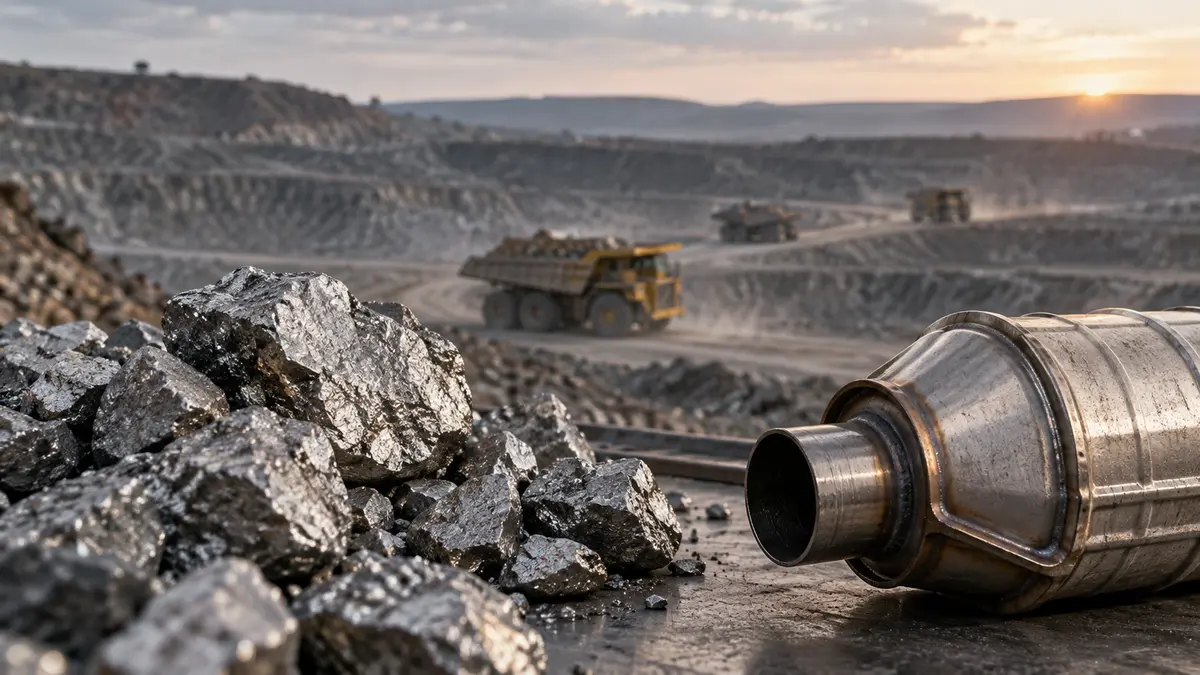
The world palladium market will run a deficit of 1.281 million ounces in 2024, more than a million ounces above the original forecast of 106,000 ounces, the World Platinum Investment Council (WPIC) said in its Platinum Essentials review. The expected surplus has been pushed from 2025 to 2026, and both revisions are driven by supply rather than demand.
Supply is where the problem sits
Mined palladium output is shrinking because of restructuring and maintenance at producing operations, and secondary metal is not reaching refiners in the volumes the council had assumed. WPIC now sees recycled supply growing only around 2028, by roughly 1.3 million ounces, when cars with high platinum-group metal loadings built during the tightening of emissions standards reach the end of their lives. The council itself flags the risk in its assumptions: very few such vehicles are being scrapped so far, even though regulations require their use.
For Russia, WPIC calculates platinum-group supply from the production plan of Nornickel, the world's largest palladium producer, because smaller players either do not report, like Russian Platinum, or have stopped mining while awaiting the sale of assets, like Eurasia Mining at the Zapadny Kytyl deposit.
Three forecasts, one direction
The major estimates differ in scale but agree on the sign of the 2024 balance:
- WPIC: a deficit of 1.281 million ounces, with the surplus moved to 2026.
- Johnson Matthey: a more modest deficit of 358,000 ounces, almost three times smaller than the 1.017 million of 2023, with total demand down 6% year on year to 9.7 million ounces, the lowest since 2016; automotive use falls to 8.1 million ounces, an eight-year low, as gasoline car production shrinks 4% in favour of electric vehicles.
- Nornickel's Quintessentially PGMs review: a deficit of 900,000 ounces, up from its previous 400,000-ounce estimate, mainly because less secondary metal arrives than expected; recycling growth in 2025 would narrow the gap to roughly 300,000 ounces.
Refined output and the scrap squeeze
Nornickel expects refined palladium production to fall 4% year on year in 2024, with planned declines in Russia and South Africa only partly offset by slightly higher scrap supply. Recyclers, the company notes, remain squeezed by low prices that leave scrap collectors little incentive to deliver material, and newly expanded refining capacity stays underused.
Demand: two uncertainties in opposite directions

Johnson Matthey names two factors that will decide the 2024 balance. The first is car production: falling new orders, rising finished-vehicle inventories and Red Sea shipping disruption are headwinds, but delays in automakers' electric-vehicle programmes mean internal-combustion output may beat expectations. If gasoline car production stabilises at the 2023 level, that alone would add about 200,000 ounces to the palladium demand forecast.
The second uncertainty is scrappage. The market distortions of the past four years have left an unusually large fleet of old cars in use that would normally have been retired; the cost of living keeps owners driving them longer, which delays the return of recycling flows to normal. Nornickel, for its part, sees the electrification trend itself shifting from pure battery electrics toward hybrids and extended-range electric vehicles, which carry a combustion engine and a catalyst and typically use more platinum-group metals than conventional cars.
What could move the market
The gold rally driven by macro factors such as the United States Federal Reserve's rate path barely touches palladium, and the geopolitical premium of 2022 has disappeared: after US and European sanctions, Russian metal flows were rerouted to the market through other countries. Platinum-group markets need new triggers. Today's low prices benefit mainly automakers, which can switch between the metals in catalysts while they sit close in price, but new-car demand itself is not buoyant.
The restructuring under way in South Africa could support prices in the near term, since cost-cutting programmes may be followed by mine closures, layoffs and possibly strikes affecting tens of thousands of workers. And the expected growth of secondary supply will materialise only if world prices rise enough for every link of the chain — the used-car seller, the scrap collector and the refiner — to earn its margin. WPIC, founded in November 2014 by six leading platinum producers including Anglo American Platinum, Impala Platinum Holdings and Northam Platinum, expects the deficit regime to persist well beyond 2024.
Just Published

European housing prices and rents
Schneider–PTC: the industrial data integration test behind the deal
Avio USA starts work on its Virginia manufacturing site

One equity market, two currency measures

Russia’s draft budget raises spending and borrowing plans

Russia Sets the 2027 Minimum Wage at 28,935 Rubles, Up 6.8%, on the Way to 35,000 by 2030
Partner news digest
 Qatar LNG expansion: readiness, financing and the production test
 Pennon’s capital plan: turning finance into better water outcomes
 Italy’s diesel relief gap: taxes, price ceilings and implementation
 EU–China hybrid trade: from understanding to measurable implementation
 Schneider–PTC: the industrial data integration test behind the deal
 IKEA’s hybrid resale model: buyback, marketplace liquidity and furniture logistics
 Banking AI beyond the ranking: capability, execution and evidence of value
 Fishing labour beyond the product label: practical protection
 Rhenus and the Middle Corridor: terminals need coordinated connections
 Royal Mail restructuring: the test is reliable delivery
 Fuel Finder on Google Maps: when price transparency becomes useful competition
 Samsung’s memory profit surge: what the preliminary record explains
Leave a comment