
The Eco-Fee Coefficient: How Russia's 2026 EPR Rules Split One Packaging Market in Two
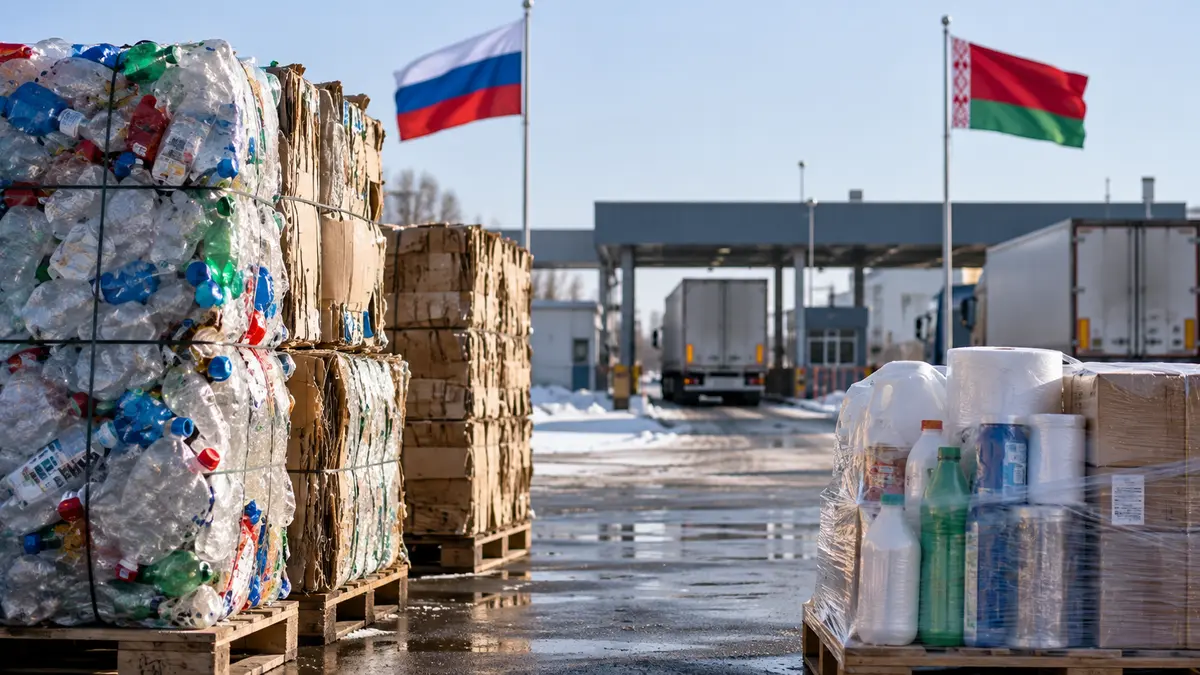
From 2026 Russia applies reducing coefficients to its environmental fee for packaging, rewarding producers who use Russian secondary raw material inside the country. The same rule leaves importers from Belarus paying the fee in full, and a dispute that began as a letter from a Gomel packaging maker has grown into a test of how far Russia's circular-economy reform can stretch before it starts taxing the shared market it belongs to.
A letter from Gomel
The dispute entered the public record through a letter that Multipak, a polymer packaging producer from Gomel, sent to the Russian Union of Plastic Processors (SPP) and which Kommersant reviewed in March 2026. The company's starting point is simple: in 2025 Belarusian and Russian suppliers of plastic products paid the environmental fee in equal amounts. From 2026 that equality ends, because residents of the Russian Federation may apply reducing coefficients that cut their fee, while importers cannot.
The coefficients depend on how much secondary raw material was used in producing the packaging, and they apply only when two conditions hold at once: the secondary raw material is of Russian origin, and the packaging made with it was produced on the territory of Russia. As a result, importers of Belarusian packaging or of goods in packaging will always pay the eco-fee for utilization at 100 percent, even if the Belarusian company uses secondary raw material from Russia, Multipak wrote. The company estimates that Belarusian packaging will end up at least 25 to 30 percent more expensive than Russian packaging, and that goods packed in Belarus, dairy products among them, will rise in price on the Russian market more than their local counterparts.
How the 2026 mechanism works
Russia's extended producer responsibility regime makes packaging producers responsible for the subsequent utilization of what they put on the market. A company can organize utilization itself or pay the environmental fee, which is channeled into building processing capacity. The mandatory utilization norm for packaging is scheduled to rise gradually to 100 percent by 2027, and in 2025 companies paid almost 20 billion rubles of the fee. Against that backdrop the Ministry of Natural Resources proposed raising fee rates several-fold from 2026; the initiative did not find support in the government, as Kommersant reported in October 2025.
The reducing coefficients are the newest layer of this construction. They convert the fee from a flat charge into an instrument of industrial policy: the more Russian secondary raw material a producer uses inside Russia, the lower the effective fee. The logic is circular-economy logic, paying less to those who close the loop domestically. The side effect is territorial: a Belarusian plant using Russian recyclate in Belarus earns no discount, because the packaging was not produced in Russia. The instrument therefore rewards not recycling as such but recycling combined with a Russian converting address.
The arithmetic from Gomel
Multipak's own calculation shows the scale of the split. For deliveries of 22,000 tonnes of films and packaging to the Russian market, the eco-fee under a moderate reducing coefficient would be 343.7 million rubles for the Belarusian company this year, while a producer resident in Russia would pay 213.1 million rubles for the same volumes. The gap of roughly 130 million rubles is not a pricing accident; it is the coefficient expressed in money.
In 2027, when the utilization norm steps up again, the difference grows to 181 million rubles. Had the rate increases once proposed by the Ministry of Natural Resources been adopted, the gap would have reached 320 million rubles, a sum that in Multipak's assessment would practically close the Russian market to suppliers of packaging and of many goods in packaging from Belarus. The frozen rate proposal thus removed one threat while leaving the structural one in place.
Why the gap compounds over time
- The coefficient applies to the fee base, so every increase in utilization norms or rates multiplies the absolute gap between resident and importer.
- The discount is conditional on two facts, Russian origin of the recyclate and Russian place of production, and an importer can satisfy only one of them.
- The fee is charged per tonne of packaging placed on the market, so high-volume exporters feel the gap first and hardest.
- Goods packed in Belarus carry the packaging fee inside their price, so the disadvantage travels beyond the packaging trade into food and consumer goods.
Beyond polymers: glass, cardboard and the rest of the list
Pavel Kolesnikov, deputy general director of Multipak, notes that the problem concerns not only suppliers of polymer packaging and film but also glass containers, cardboard and other materials. That breadth matters because the utilization norms and the fee cover sixteen groups of goods and packaging, from batteries and tyres to plastic articles. A coefficient that disadvantages importers in polymers will disadvantage them in every material where Russian converters compete with Belarusian ones, which turns a technical fee parameter into a sector-wide trade condition.
As a solution, Multipak proposes abolishing the reducing coefficient altogether. The proposal is radical but internally consistent: if the discount cannot be earned by an importer by definition, then within a shared market it functions as a border measure, and the cleanest way to remove a border measure is to remove the measure.
The reform behind the coefficient
The current controversy is the second act of a reform that changed its center of gravity when responsibility for utilization moved from the customers of packaging to its producers. That shift was meant to put the obligation where the material decisions are made. In practice, as the SPP now argues, it also moved the fee base onto a sector with thinner margins and less pricing power, and it complicated administration, because the converter, not the brand, now has to answer for what happens to the material after use.
The Union's general director Pyotr Bazunov (Petr Bazunov) describes the Belarusian difficulties as a consequence of the inconsistency of legislation, and locates the deeper cause in the transfer of responsibility from packaging customers to packaging producers, followed by insufficient elaboration of the definitions of packaging, raw material and semi-finished products. Those definitions, he notes, ignore the conditions of the Customs Union technical regulation on the safety of packaging, where the concepts were originally fixed. When the legal perimeter of a fee is drawn by one document and the technical perimeter by another, every coefficient inside the fee becomes a source of disputes.
What industry says is broken
The definitions problem is not an abstraction. Larisa Kosyuk, an adviser in the environmental expertise department of AlfaPro, notes that the Russian law on production and consumption waste gives an unsuccessful definition of packaging, with the result that products which are not packaging and are not used as packaging can be treated as packaging. A fuzzy perimeter plus a location-based discount is a combination that generates litigation-grade ambiguity for both residents and importers.
Three diagnoses on the table
- Multipak's diagnosis: the reducing coefficient itself should be abolished, because it institutionalizes a price disadvantage for importers from the common market.
- The SPP's diagnosis: the methodology of calculating EPR rates needs rework, and the government should commission an additional analysis of the EPR legislation by the Ministry of Natural Resources and the Ministry of Economic Development.
- The regulator's framing: the head of Rosprirodnadzor, Svetlana Radionova, stated in February 2026 that Russia is building a circular economy so that it is comfortable, beautiful and pleasant for everyone to live, a formulation in which the fee is a tool of construction rather than of protection.
The political channel
Following the Belarusian letter, the SPP in early March turned to Deputy Prime Minister Dmitry Patrushev, asking him to instruct the Ministry of Natural Resources and the Ministry of Economic Development to conduct an additional analysis of the EPR legislation and introduce corresponding amendments. The Union also plans to send the government its proposals on amending the methodology for calculating EPR rates in the second half of March. The Ministry of Natural Resources told Kommersant that it had not received any appeals on the matter so far.
The sequence matters for anyone planning packaging flows for 2026 and 2027: the coefficients are in force now, the methodology discussion is scheduled for the second half of March, and the utilization norm steps up again in 2027. Companies therefore face a two-year window in which the rules can change twice while the fee keeps being paid under the current ones. For procurement teams this is a contract-design problem as much as a compliance problem, because fee exposure fixed in 2026 prices may be re-priced by a methodology amendment in 2027.
Reading the dispute as a policy test
The Belarusian case exposes a structural tension inside Russia's circular-economy turn. A fee discount tied to domestic recycling is an efficient subsidy for the recycling industry: it pays exactly those who create demand for Russian secondary raw material, and it does so without budget spending, because the money not paid by one payer stays inside the fee system. But in a customs union with a shared market, the same instrument behaves like a border measure, because the condition that unlocks the discount, production on Russian territory, is precisely the condition an importer cannot meet.
A third path is visible in the positions already on the table: keep the discount but tie it to the origin and verified use of recyclate rather than to the location of the converting plant, or recognize certification of Russian-origin recyclate used in production abroad. Neither option appears in the current methodology, which is why the dispute has moved from a commercial letter to a request addressed to the deputy prime minister, and why the Union's March package of proposals will be read closely far beyond the plastics industry.
What to watch in 2026
- Whether the government commissions the additional analysis the SPP requested, and on what terms of reference.
- The second-half-of-March package of methodology amendments from the Union of Plastic Processors.
- Price behaviour of Belarusian packaging and of packaged goods from Belarus on the Russian market as the first 2026 fee payments are calculated.
- Any clarification of the packaging definition in the waste law, which would redraw the fee perimeter for residents and importers alike.
- The 2027 step of the utilization norm toward 100 percent, which will multiply whatever gap the methodology leaves in place.
The fee as the financing engine of the reform
The almost 20 billion rubles paid in 2025 is the financial spine of the entire construction. The environmental fee is not a tax that disappears into the budget; it is the funding stream directed at building processing capacity, which is why every coefficient debate is simultaneously a debate about who finances the recycling industry. When a resident producer pays less under a coefficient, the fee system receives less money for capacity construction; when an importer pays in full, the system receives more from the same tonne of packaging. The 2026 design therefore redistributes the financing burden toward imported packaging, and the Belarusian complaint is, in financial terms, a complaint about becoming the system's main donor without a vote on its methodology.
Three scenarios for the methodology review
The March package of proposals opens three realistic paths. In the first, the government accepts the logic of the letter and softens the territorial condition, for instance by recognizing certified Russian-origin recyclate used abroad; importers regain part of the discount and the 25 to 30 percent price gap narrows. In the second, the methodology stays as it is and the dispute migrates into prices: Belarusian packaging and packaged goods carry the full fee into 2027, when the next norm step multiplies the gap. In the third, the review stalls, as the Ministry of Natural Resources has so far received no appeals, and the coefficient survives by default until the 2027 norm change forces a broader revision of the entire fee architecture.
Each scenario has a different winner. The first rewards converters who already buy Russian recyclate wherever they sit; the second rewards Russian converters with pricing power; the third rewards nobody and simply accumulates conflict until the next norm step. What all three share is that the decision will be taken not in the market but in the methodology document, which is precisely why a commercial letter from Gomel ended on the desk of a deputy prime minister.
What the dispute says about the union market
The Belarusian episode is a case study in how environmental instruments interact with integrated markets. The union framework rests on the premise of equal conditions for economic entities; a fee parameter that is formally neutral, because it names no country, produces unequal conditions because its benefit is conditioned on a fact that only one side of the border can produce. Regulators elsewhere have met the same problem under different names, and the standard answer is to separate the environmental objective from the territorial one: reward the recycled content, verify its origin, and leave the place of conversion to competition. Whether the Russian methodology moves in that direction is the substantive question of the March review.
Until it does, importers will keep modelling the fee as a tariff, producers will keep modelling it as a subsidy, and the same paragraph of the methodology will keep producing two different numbers for the same tonne of packaging. That is not a technical defect; it is the price of building a circular economy inside a market that was designed to be single.
The calendar of the fee
- 2025: residents and importers pay equal amounts; the fee collects almost 20 billion rubles.
- 1 January 2026: reducing coefficients enter into force for Russian residents only.
- Early March 2026: the SPP asks the deputy prime minister for an interministerial analysis.
- Second half of March 2026: the Union of Plastic Processors plans to send its methodology amendments.
- 2027: the utilization norm steps toward 100 percent, multiplying any gap left in place.
Until one of these moves, the 2026 eco-fee remains what the Gomel letter made visible: a circular-economy instrument with a border effect, and a reminder that in a shared market the cheapest way to subsidize recycling at home can turn out to be taxing the neighbour's packaging. The coefficient was designed to reward those who close the loop; the dispute shows that in a union market it also decides who is allowed to stand inside the loop at all.
Just Published

European housing prices and rents

Schneider–PTC: the industrial data integration test behind the deal
Avio USA starts work on its Virginia manufacturing site
One equity market, two currency measures

Russia’s draft budget raises spending and borrowing plans
Russia Sets the 2027 Minimum Wage at 28,935 Rubles, Up 6.8%, on the Way to 35,000 by 2030
Partner news digest
 Qatar LNG expansion: readiness, financing and the production test
 Pennon’s capital plan: turning finance into better water outcomes
 Italy’s diesel relief gap: taxes, price ceilings and implementation
 EU–China hybrid trade: from understanding to measurable implementation
 Schneider–PTC: the industrial data integration test behind the deal
 IKEA’s hybrid resale model: buyback, marketplace liquidity and furniture logistics
 Banking AI beyond the ranking: capability, execution and evidence of value
 Fishing labour beyond the product label: practical protection
 Rhenus and the Middle Corridor: terminals need coordinated connections
 Royal Mail restructuring: the test is reliable delivery
 Fuel Finder on Google Maps: when price transparency becomes useful competition
 Samsung’s memory profit surge: what the preliminary record explains
Leave a comment