
India's Cement Overhang: Capacity Is Being Built Faster Than Demand Can Fill It
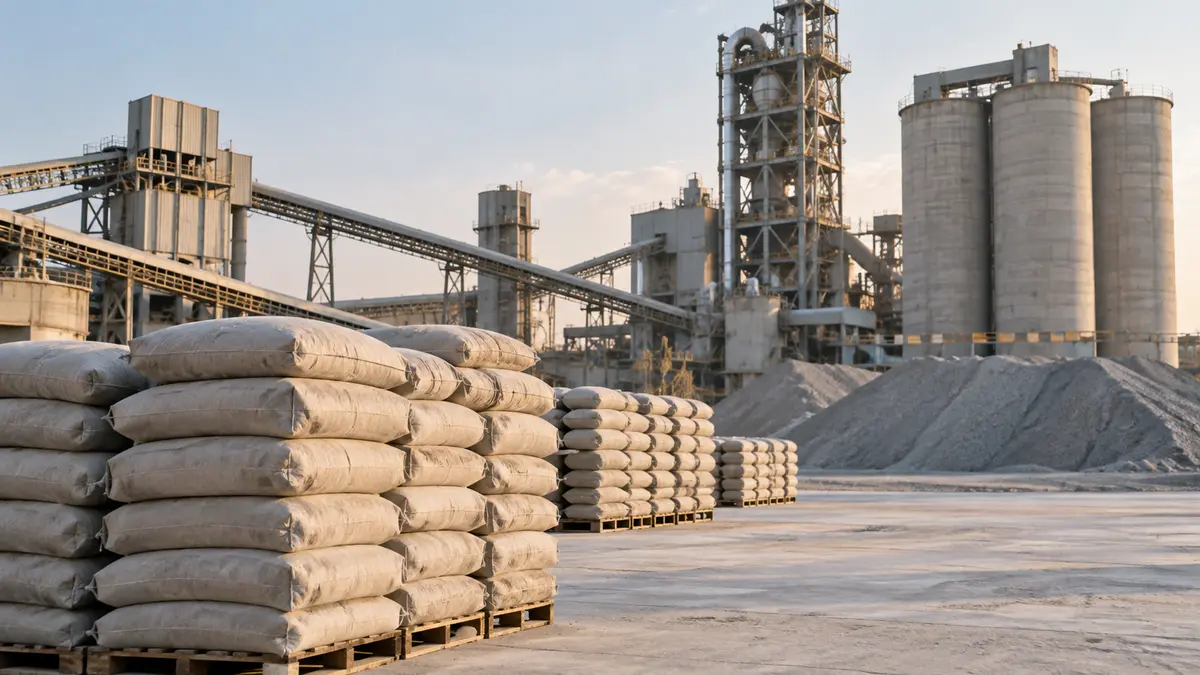
India's cement industry is entering a familiar but uncomfortable configuration: demand is growing, and supply is growing faster. Capacity additions of 115-125 million tonnes (mt) expected over 2026-27 and 2027-28 will outpace volume growth, easing utilisation from around 70% to 68-69% and putting pricing discipline to the test, according to a September 2026 report by Crisil Ratings covered by Business Standard. The overhang is not a crisis forecast — utilisation stays above its long-term average — but it changes who wins and who bleeds in the world's second-largest cement market.
The arithmetic of the overhang
The starting point is a capacity base of an estimated 720-730 mt of installed grinding capacity as of March 2026, according to Anand Kulkarni, director at Crisil Ratings. The industry added around 55 mt in 2025-26 (FY26), and another 115-125 mt is expected over FY27 and FY28. Against that, cement volumes grew at a compound annual growth rate of 5.5-6% between FY25 and FY26, broadly matching effective capacity additions and keeping utilisation at around 70%, similar to FY25.
The mismatch arrives in the next two financial years. With capacity additions expected to outpace demand in FY27 and FY28, utilisation could moderate to 68-69%. Kulkarni's explanation of why the industry keeps building into a known imbalance is structural: cement capacity additions tend to be chunky because of long gestation periods, and large additions may lead to a demand-supply imbalance in the short term. Over the medium term, he expects demand and supply growth to remain balanced.
The independent estimates converge. Mohit Kapoor, associate director of investment banking at Equirus Capital, expects cement demand to grow 7-8% over the next two to three years, slightly ahead of gross domestic product growth, while capacity increases by 8-9% annually. Industry utilisation, currently around 69%, could decline by 100-150 basis points over the next two to three financial years, he said — and even then would remain above the 10-year rolling average of around 65%.
Why companies keep building anyway
The expansion is not a collective error; it is a rational response to a demand story that managements still believe. Jayakumar Krishnaswamy, managing director of Nuvoco Vistas, said in a July interaction with Business Standard that while almost every cement company had announced aggressive expansion plans about a year ago, the industry has since adopted a more realistic outlook — and that the expansion plans reflect long-term confidence rather than short-term demand fluctuations.
Atul Daga, chief financial officer of UltraTech Cement, put the same logic in plainer words during the company's first-quarter FY27 earnings call in July: demand remains strong, and the challenge is that companies do not have capacity — they have to expand. Vinod Bahety, whole-time director and chief executive officer of Ambuja Cements, listed the pillars of that confidence: infrastructure, urbanisation, industrialisation, logistics investments and housing demand.
Ambuja's own numbers frame the horizon. According to the company's Q1 FY27 investor presentation and internal analysis, industry capacity is estimated at 958 mt against demand of 621 mt by FY30; for FY26 the company estimates industry capacity at 751 mt and demand at 474 mt. The gap between the two horizons — a comfortable FY30 picture and a tight FY27-FY28 window — is precisely where the overhang lives.
Concentration: the top five absorb the wave

The expansion is increasingly concentrated among larger players. According to Akshay R Shetty, research analyst at Mirae Asset Sharekhan, the top five cement companies are expected to hold a combined capacity of 465-470 million tonnes per annum (mtpa) in FY26, rising to 580-590 mtpa by FY28. A January 2026 report by Systematix Research, covered by ET Infra, made the same point from the other side: larger players are expected to account for nearly 65% of total industry capacity, putting them in a stronger position to benefit from the anticipated demand recovery.
Concentration changes the meaning of an overhang. In a fragmented industry, surplus capacity becomes a price war; in a concentrated one, it becomes a tool — capacity that leaders can idle or run selectively while smaller regional players carry the utilisation pain. That is why the same 68-69% utilisation figure reads differently depending on where a company sits in the capacity table.
Regions: the North wakes up, the South stays loose
Analysts expect regional markets to feel the overhang unevenly. Kapoor expects North, West and Central India to face weaker utilisation over the next two to three years: maximum capacity additions are expected in the North, followed by the South and East, while demand growth is expected to be relatively stronger in the East and South-East.
The South remains the loose market. Shetty describes it as fragmented, with utilisation in the mid-50% range and likely to continue facing pricing pressure. The North is emerging as the new area of concern: Satyadeep Jain, lead analyst for cement, metals, mining and utilities at Ambit Capital, notes that capacity growth in the North had been muted for seven to eight years but is now accelerating, with the region set to expand cement capacity by 38%, or almost 50 mt, over FY25-28 — pressure that could affect established northern players such as Shree Cement.
Prices: a partial pass-through and a GST-adjusted path
The price line of 2026 tells the same story in rupees. Crisil said pan-Indian average cement prices rose 4-4.5% sequentially in Q1 FY27, helped by partial pass-through of higher fuel, packaging and freight costs. For FY27, prices adjusted for lower goods and services tax are expected to rise 1-3%, while elevated input costs could reduce operating margins by about 50-75 rupees per tonne.
The quarterly path through FY26 was softer before it turned. The Systematix report expected prices to revive in Q4 FY26 after a weak third quarter, in which realisations fell an average 1.7% quarter-on-quarter; the southern market saw the steepest correction, around 2-3% QoQ, followed by the East, while prices in the West, North and Centre remained largely stable. Softer pricing was expected to be partly offset by lower power and fuel costs and reduced freight expenses.
The demand side of the FY26 story was strong enough to keep volumes ahead of the price wobble. Systematix expected the industry to grow 9-10% in FY26, driven largely by an acceleration in central and state government capital expenditure, with the capex cycle gathering momentum and providing a key demand push for cement consumption across infrastructure and housing projects.
Profitability: near the bottom of the cycle
Jain's framing puts utilisation in its place: sector profitability is currently near the bottom of the cycle due to a cost increase of about 400 rupees per tonne, and utilisation alone does not determine profitability. Between 2020-21 and 2023-24, he recalls, utilisation improved but profitability remained under pressure because of the Russia-Ukraine war and fuel inflation.
The rating-agency view of the margin path is more granular. In a December 2025 note covered by ET Infra, ICRA projected operating profit per tonne (OPBIDTA) to rise to 900-950 rupees in FY26 from about 810 rupees in FY25, aided by pricing and volumes, after an expected 12-18% increase; in FY27, OPBIDTA for its sample set is expected to moderate slightly to 880-930 rupees per tonne as input costs rise. ICRA's volume path: growth of 6.5-7.5% in FY26, with volumes expanding 8.5% in the first eight months of FY26, and 6-7% in FY27, supported by housing and infrastructure demand, a possible reduction in GST on cement and continued government infrastructure spending.
Capacity additions in ICRA's tally run slightly below Crisil's: 43-45 MTPA added in FY26 and 42-44 MTPA expected in FY27, with overall industry utilisation projected to remain stable at 70-71% in FY27 on an expanded base. Utilisation in North and Central India is likely to stay above the national average of about 70%, while the South may continue to see lower utilisation due to surplus capacity. ICRA expects prices to rise 2-4% in FY27 after an estimated 3-5% increase in FY26, following a 7% decline in FY25; blended realisations were already up around 5% year-on-year in the first eight months of FY26, with increases in most regions except the West.
The FY26 quarterly tape: earnings ran ahead of prices
The financial tape of FY26 shows an industry whose volumes outran its price wobble. For the third quarter of FY26, Systematix factored in volume growth of 10.5% year-on-year, revenue growth of 9.7% and a sharp 29% growth in profit after tax for its coverage universe, with softer pricing partly offset by lower power and fuel costs and reduced freight expenses. ICRA's demand reading for the same fiscal adds the sequential shape: volumes expanded 8.5% during the first eight months of FY26, with demand expected to improve sequentially in the second half of the year as post-monsoon construction gathered pace.
That combination — double-digit volume growth, high-single-digit revenue growth and a profit line growing about three times faster — explains why managements kept sanctioning capacity even as blended realisations dipped 1.7% quarter-on-quarter in the third quarter. A price correction inside a volume boom reads to a board as a timing issue, not a demand issue, and the 29% profit-after-tax line is the number that funds the next grinding unit.
Gestation: why the wave cannot be switched off
The "chunky additions" point has a physical basis. A grinding unit or an integrated line takes years from announcement to commissioning, so the capacity arriving in FY27 and FY28 was sanctioned in 2023-2025, when volumes were growing 8-9% a year and prices were recovering from the FY25 decline. Cancelling or delaying a sanctioned plant costs more than running it at 68% utilisation. The overhang is therefore inherited rather than chosen, and it expires on the commissioning schedule rather than on the price signal — which is also why both Crisil and ICRA see the medium term returning to balance without anyone having to cancel anything.
Who absorbs the overhang: three channels
The 115-125 mt of FY27-FY28 additions will be absorbed through three channels, and the mix between them decides the sector's earnings path. The first is utilisation: idle or selectively run capacity, concentrated in the South and, increasingly, in the North. The second is price: realisations rising 1-3% on a GST-adjusted basis while elevated input costs take 50-75 rupees per tonne off operating margins — a squeeze that lands hardest on players without pricing power. The third is demand policy: capex execution, housing demand and any reduction in GST on cement that pulls the demand curve towards the new supply. Crisil's medium-term balance and ICRA's stable 70-71% utilisation both assume the third channel does part of the work.
What the overhang changes for investors and buyers
For equity investors, the near-term signal is uncomfortable: faster supply growth may keep a lid on stock prices even as the Nifty Cement index sits at a three-month low, unless companies post faster earnings growth. For construction buyers, the overhang is a quiet ally: surplus capacity in a region caps the pass-through of fuel and freight inflation into delivered cement prices, at least until the FY28 additions are absorbed.
The watch list for the next four quarters
- Utilisation: whether it settles at 68-69% as Crisil expects, or holds at 70-71% as ICRA's FY27 projection implies.
- The North: the 38% capacity expansion over FY25-28 and its effect on northern price discipline and on players such as Shree Cement.
- The South: whether mid-50s utilisation and weak pricing persist, or consolidation tightens the region.
- Price realisations: the 1-3% GST-adjusted FY27 increase Crisil expects against 50-75 rupees per tonne of input-cost pressure.
- Top-five concentration: the move from 465-470 mtpa in FY26 towards 580-590 mtpa by FY28 and what idling discipline it produces.
- Demand policy: central and state capex execution, housing demand and any reduction in GST on cement.
Why this overhang is not 2015, and not a crisis
Two features separate the current imbalance from a destructive oversupply cycle. First, utilisation stays above the 10-year rolling average of around 65% even after the expected decline — the industry remains, in aggregate, a working industry rather than an idle one. Second, the demand base is broader than in earlier cycles: infrastructure, urbanisation, industrialisation, logistics and housing pull together, and government capex acceleration has repeatedly rescued volumes when private construction slowed.
What the overhang does change is the distribution of pain and the timing of relief. Regional markets with surplus capacity — the South first, the North next — carry pricing pressure; concentrated leaders carry the capacity but can choose when to run it; and the medium term, in both Crisil's and ICRA's readings, returns to balance once the chunky FY27-FY28 additions are digested.
The strategic conclusion
India's cement story of 2026 is not a demand story — demand grows 6-9% a year by every estimate in this file — but a supply-timing story. Capacity arrives in lumps because plants take years to build; demand arrives in a smoother line because roads and houses are funded year by year. The gap between those two curves is the overhang, and it will be closed either by demand catching up in FY28-FY30 or by prices and margins absorbing the wait.
For the industry, the practical task is to survive the window: hold price discipline where concentration allows it, accept weaker realisations where it does not, and keep the FY30 picture — 958 mt of capacity against 621 mt of demand — in view while the FY27-FY28 window passes. For everyone who buys cement in India, the same window is a two-year discount on a market that expects to be tight again by the end of the decade.
Just Published

European housing prices and rents
Schneider–PTC: the industrial data integration test behind the deal
Avio USA starts work on its Virginia manufacturing site

One equity market, two currency measures

Russia’s draft budget raises spending and borrowing plans

Russia Sets the 2027 Minimum Wage at 28,935 Rubles, Up 6.8%, on the Way to 35,000 by 2030
Partner news digest
 Qatar LNG expansion: readiness, financing and the production test
 Pennon’s capital plan: turning finance into better water outcomes
 Italy’s diesel relief gap: taxes, price ceilings and implementation
 EU–China hybrid trade: from understanding to measurable implementation
 Schneider–PTC: the industrial data integration test behind the deal
 IKEA’s hybrid resale model: buyback, marketplace liquidity and furniture logistics
 Banking AI beyond the ranking: capability, execution and evidence of value
 Fishing labour beyond the product label: practical protection
 Rhenus and the Middle Corridor: terminals need coordinated connections
 Royal Mail restructuring: the test is reliable delivery
 Fuel Finder on Google Maps: when price transparency becomes useful competition
 Samsung’s memory profit surge: what the preliminary record explains
Leave a comment