
Three Billion Dollars of Fish: How Russia's Seafood Trade With China Ended 2025
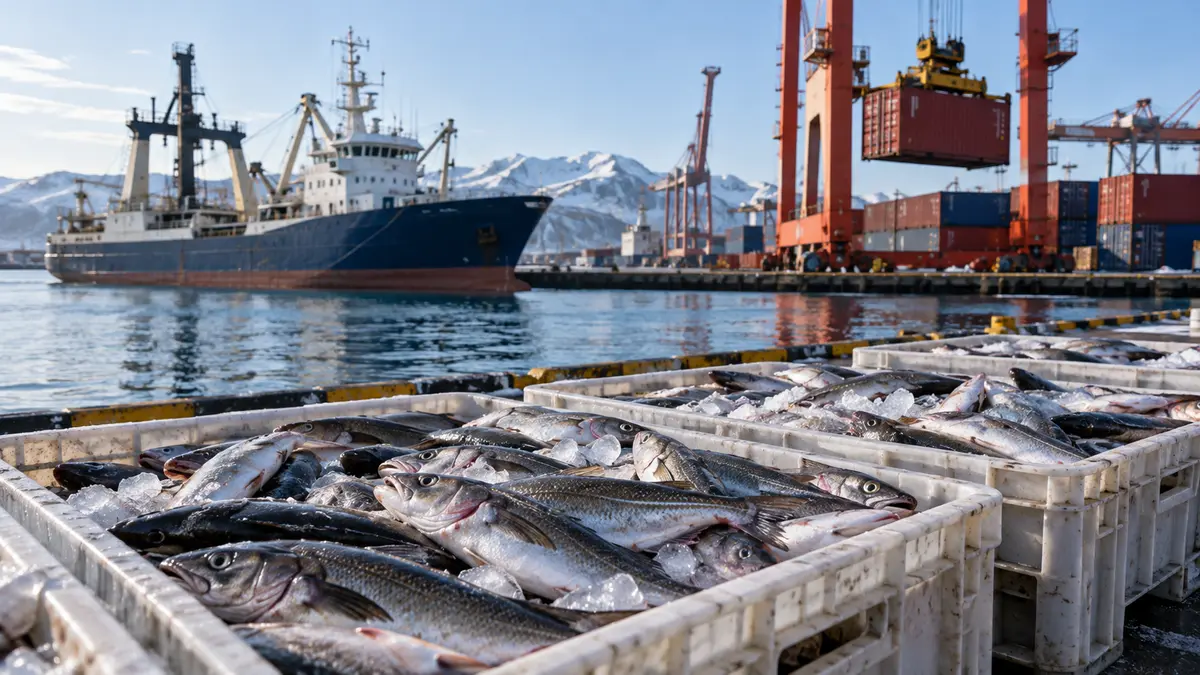
Russia's fish and seafood trade with China reached $3 billion in the first eleven months of 2025, up 10% year on year, while physical shipments grew 6% to 1.1 million tonnes, the Fish Union said on Dec. 25, 2025, presenting an analysis of data from China's General Administration of Customs. The aggregate hides several different markets moving in different directions: a record pollock catch, a surimi line that is learning to sell processed value, a cod trade that earned more from fewer tonnes, a crab business where prices fell faster than volumes grew, and a herring surge that multiplied. This is the anatomy of Russia's largest seafood export relationship at the end of 2025.
The headline numbers of the China trade
The Fish Union built its picture from the importing side: the customs statistics of China, the world's largest fish processing hub and, increasingly, one of its largest consumers. In value terms, $3 billion over January to November 2025 is 10% above the same period of 2024. In volume terms, 1.1 million tonnes is 6% more. The gap between the two growth rates is the first signal of the year: the average exported tonne became more expensive, and the mix of products shifted toward categories where the seller captures work, not just weight.
That shift matters because the China relationship has two layers. The first is raw material for Chinese processors: frozen pollock, cod and herring that arrive as blocks, fillets and whole fish and leave as value added products for third markets. The second is direct consumption: live crab, surimi and ready formats that go to Chinese tables. The 2025 numbers show both layers growing, but with very different economics, and reading them together is the only way to understand what actually happened to the trade.
Pollock: the engine of the export machine
Frozen pollock remains the backbone of the trade. Shipments to China grew 10% in the eleven months, to 514,000 tonnes, while their value rose 45%, to $670 million. The union links the dynamic directly to the catch: the Russian pollock harvest grew 7% over the same period, to 2 million tonnes, and the additional volume found its way into the Chinese processing pipeline. A 45% value increase on a 10% volume increase also implies a firm price recovery in the category, after several years in which global whitefish prices moved against the seller.
Pollock is Russia's main fishing resource and the species on which the economics of the Far Eastern fleet rest. A 2 million tonne catch in eleven months puts 2025 among the strongest pollock years of the decade, and the China channel is where the marginal tonne is priced. When Chinese processors bid for Russian pollock, they effectively set the floor for the entire Russian whitefish complex, from fillet to fish meal.
Surimi and mince: value added at sea
The clearest evidence of the value shift is surimi. Exports of the product, the washed paste from which crab sticks are made, grew 30% in January to November, to 29,000 tonnes, and 1.5-fold in value, to $65 million. The union ties the increase to production: output of pollock mince on Russian vessels at sea grew 21%, to 86,000 tonnes. A factory trawler that converts catch into mince and surimi on board captures the processing margin that would otherwise be handed to the buyer together with the raw fish.
The same logic explains the strangest line of the report. Frozen pollock fillet exports fell 55%, to 9,000 tonnes, and 40% in value, to $20 million. Fillet is the most labor intensive cut of the whitefish chain; when at-sea mince and surimi capacity grows and onshore plants reconfigure toward paste, the fillet line is the first to shrink. The decline is not a loss of market but a reallocation of the same fish into a higher margin form.
Cod: fewer tonnes, more dollars

Cod tells the opposite story of pollock: shipments to China decreased 15%, to 76,000 tonnes, yet export revenue grew by a quarter, to $455 million. The price effect here is not a market cycle but a management decision. The mixed Russian-Norwegian fisheries commission cut the total allowable catch of Atlantic cod in the Barents Sea for 2025 by 23%, to 347,000 tonnes, of which Russia's share is 144,400 tonnes. A smaller quota in a market with firm demand produces exactly the observed combination: fewer tonnes, higher unit prices, higher revenue.
For the China trade this means cod behaves like a premium line rather than a volume line. The revenue per tonne implied by the eleven-month figures is several times that of pollock, and the quota decision, taken bilaterally in the commission, effectively became a price policy for the exported cod box. It is also a reminder that part of Russia's export revenue is set in negotiation rooms rather than on trading floors.
Crab: a premium market with a falling price tag
Live crab is the category Russia effectively created in China, and 2025 exposed its vulnerability to its own success. Exports of live crabs grew 10% in the eleven months, to 35,000 tonnes, but export revenue decreased 5%, to $970 million. The harvest context explains the pressure: around 87,000 tonnes of crabs were taken in the same period, 9% more than a year earlier. More crab chasing the same premium demand means softer prices, and crab nevertheless remains the single largest revenue line of the Russia-China seafood trade despite the decline.
The crab story also carries a structural dimension. The second phase of the investment quota program, distributed in 2022, committed the industry to build 23 crab fishing boats among 31 planned vessels, and those boats enter a market where the price per tonne is now falling. The premium that justified the investment was set in the scarcity years; the abundance years test whether volume can compensate for it.
Herring: the quiet volume story
The fastest growing line of the report is the least glamorous. Frozen herring exports to China grew 2.2-fold, to 200,000 tonnes, and 2.6-fold in value, to $145 million. The driver is biological and simple: the Russian catch of Pacific herring exceeded 530,000 tonnes in the eleven months, 37% more than a year earlier. Herring is a pelagic species with volatile stock cycles, and 2025 was a strong phase of that cycle.
Herring's role in the China trade is that of a volume filler and a processing raw material: cheap, fatty, abundant, and well suited to the salting and smoking lines of Chinese coastal plants. Its multiplication in 2025 added tonnage and revenue without requiring any new market creation, and it cushioned the trade against the fillet decline.
Reading the customs mirror
One methodological point deserves attention because it shapes every number above. The Fish Union analyses the trade from the Chinese side, using import data of the General Administration of Customs, rather than from Russian export declarations. Mirror statistics of this kind are standard practice in seafood trade analysis: the importer's records are harder to distort by transshipment and re-export routing, and they capture what actually entered the Chinese market. The price of the method is that the figures describe the calendar of Chinese clearance, not the calendar of Russian loading, which is one reason the eleven-month window is used instead of a full year.
The window itself matters for interpretation. December, the month in which the pollock B season ends and the year's last crab and herring cargoes are cleared, is not in the dataset. The full-year 2025 picture will therefore sit above the eleven-month numbers in volume, and the December mix, heavier in pollock and crab, can shift category shares slightly. The direction of every trend reported by the union, however, is unlikely to change.
The seasonal structure of the Russian fishing year adds one more layer to the window. The pollock A season runs through the first months of the year and the B season closes it in the autumn and winter, while the herring and crab peaks fall in between; the eleven-month customs cut therefore mixes a full A season, a partial B season and almost the whole pelagic cycle. Analysts reading the union's table are in effect reading a composite of three biological calendars, which is why category shares move from one report to the next even when the annual trend is stable.
The price layer: what a tonne was worth
Dividing the union's value figures by its volume figures produces implied unit values that make the structure of the trade visible. Frozen pollock averaged about $1,300 per tonne; surimi about $2,240; cod about $6,000; frozen herring about $725; and live crab about $27,700 per tonne. These are arithmetic implications of the reported totals, not quoted prices, but they order the categories exactly as the industry experiences them: herring and pollock as volume businesses, surimi as the first step up the value chain, cod as a quota-priced premium, and crab as the luxury line on which the revenue of the whole trade leans.
The ordering also explains the strategic behaviour of the fleets. Investment goes where the implied unit value is highest and most defensible: crab boats and processing plants under the quota program, at-sea mince and surimi lines on factory trawlers, and herring capacity that costs little and pays little but keeps vessels employed between premium seasons.
The industry behind the numbers
The export figures sit on top of a sector that has changed shape over the past decade. At parliamentary hearings in March 2025, the head of the Federal Fisheries Agency, Ilya Shestakov (Ilya Shestakov), recalled that the industry's turnover reached a record 1.1 trillion rubles in 2024, with profit of 173 billion rubles, against 170 billion rubles of turnover and about 27 billion rubles of profit in 2014. Tax revenues moved from about 10 billion rubles in 2014 to more than 67 billion rubles in 2023, and in 2024 the federal budget received more than 227.4 billion rubles from the sector. The scale of that change is easiest to see in the budget line: a sector that paid about 10 billion rubles of taxes in 2014 delivered more than 227.4 billion rubles to the federal budget in 2024, and the distance between the two numbers is the distance between a resource rent economy and an industrial one.
Investment quotas as the structural backbone
Shestakov attributes the transformation to the investment quota mechanism launched after the 2016 reform: the right to catch defined volumes for 15 years in exchange for investment in the sector. The first phase raised about 300 billion rubles and produced 39 vessels and 25 fish processing plants; the second phase, begun in 2023, plans 31 vessels, including 23 crab boats, four logistics centers and 11 processing plants. The at-sea mince and surimi capacity that shows up in the 2025 China numbers is, in large part, the physical form of that program.
New markets beyond China
The China concentration carries risk, and the industry's own strategy documents show an attempt to diversify. In February 2025 the All-Russian Association of Fish Industry Enterprises, VARPE, projected surimi production of at least 85,000 tonnes for the year, up from 70,800 tonnes in 2024, and pointed to India, which cut its base customs duty on frozen fish paste from 30% to 5% and agreed an export certificate form with Russia. VARPE's president, German Zverev (German Zverev), argued that in fresh wild fish surimi Russia competes only with the United States, and that the shorter shipping distance to India is an advantage. The association's studies put potential surimi exports at 80,000 tonnes by 2030, alongside interest in supplying frozen pollock, cod, salmon, pelagic species, shrimp, squid and scallops to Indian processors.
Diversification does not reduce China's weight in the short term; it builds an alternative channel for the categories where China sets the price. Surimi is the test case: a product where Russia already leads in China and South Korea, and where a second large buyer changes the bargaining position of the seller.
The balance of the 2025 China trade
The eleven-month picture can be summarized in a short list of moving parts:
- Total: $3 billion of fish and seafood exported to China, up 10%; 1.1 million tonnes, up 6%.
- Frozen pollock: 514,000 tonnes, up 10%; $670 million, up 45%, on a catch of 2 million tonnes, up 7%.
- Surimi: 29,000 tonnes, up 30%; $65 million, up 1.5-fold, on at-sea mince output of 86,000 tonnes, up 21%.
- Frozen pollock fillet: 9,000 tonnes, down 55%; $20 million, down 40%.
- Cod: 76,000 tonnes, down 15%; $455 million, up 25%, after the Barents Sea TAC cut of 23% to 347,000 tonnes.
- Live crab: 35,000 tonnes, up 10%; $970 million, down 5%, on a harvest of about 87,000 tonnes, up 9%.
- Frozen herring: 200,000 tonnes, up 2.2-fold; $145 million, up 2.6-fold, on a catch above 530,000 tonnes, up 37%.
Outlook: leadership with a question mark
The 2025 result confirms Russia as a structural supplier of the Chinese market in raw and semi-processed seafood, and as the creator of premium categories such as live crab. The question mark for 2026 sits in three places. The first is price: part of the value growth of 2025 was a recovery from low bases in pollock and herring, and recoveries end. The second is quota: the cod cut shows how a single management decision rewrites a revenue line overnight, and the same instrument applies to other shared stocks. The third is concentration: a trade relationship worth $3 billion a year with one buyer gives that buyer pricing power in every category where Russia sells volume rather than uniqueness.
The industry's answer, visible in the investment quota fleet and in the surimi push toward India, is to move up the value chain and widen the buyer base. Whether the 2026 numbers show a second year of value growth or a return to volume logic will say which of the two strategies is actually working.
Just Published

European housing prices and rents

Schneider–PTC: the industrial data integration test behind the deal

Avio USA starts work on its Virginia manufacturing site

One equity market, two currency measures

Russia’s draft budget raises spending and borrowing plans

Russia Sets the 2027 Minimum Wage at 28,935 Rubles, Up 6.8%, on the Way to 35,000 by 2030
Partner news digest
 Qatar LNG expansion: readiness, financing and the production test
 Pennon’s capital plan: turning finance into better water outcomes
 Italy’s diesel relief gap: taxes, price ceilings and implementation
 EU–China hybrid trade: from understanding to measurable implementation
 Schneider–PTC: the industrial data integration test behind the deal
 IKEA’s hybrid resale model: buyback, marketplace liquidity and furniture logistics
 Banking AI beyond the ranking: capability, execution and evidence of value
 Fishing labour beyond the product label: practical protection
 Rhenus and the Middle Corridor: terminals need coordinated connections
 Royal Mail restructuring: the test is reliable delivery
 Fuel Finder on Google Maps: when price transparency becomes useful competition
 Samsung’s memory profit surge: what the preliminary record explains
Leave a comment