
If a Tree Falls in Canada: The Tariff Wall Closing on the North American Lumber Trade
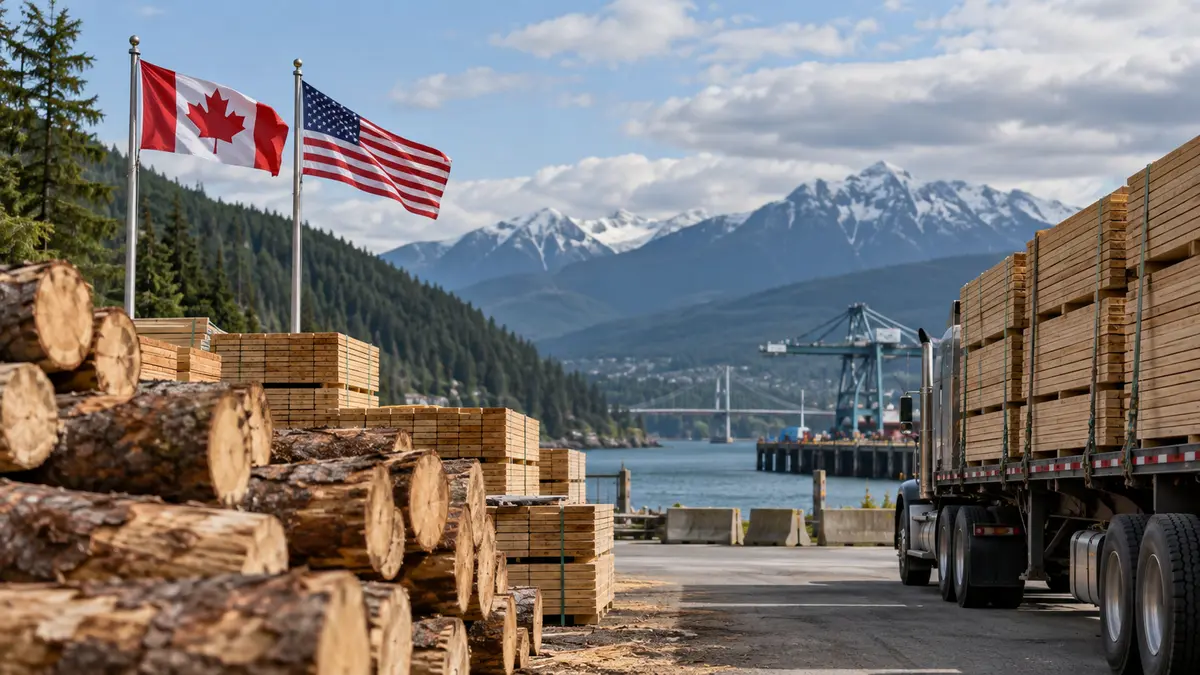
Canada sent more than 15 billion dollars of lumber and other sawmill products to the United States in 2024, and that wood now faces softwood import duties set to rise to 34.45% in October from 14.54%, with a further 25% Trump-imposed tariff possible on top. For Canada's one-industry forestry towns, the threat lands on a sector already in crisis; for the United States, it lands on a housing market short of 1.5 million single-family homes. A Financial Post feature published on April 23, 2025 traced both sides of the border - the mayors, mill owners, builders and foresters who live inside the oldest trade dispute in North America.
A one-industry town at the edge of the trade war
Port McNeill, a forestry town of 2,500 people on north Vancouver Island, is the feature's starting point. Its mayor, James Furney, held the office for 36 years and jokes that he is the hereditary mayor: his father Gerry arrived from Ireland in 1956, found work in a West Coast logging camp and built a fuel-delivery business servicing the camps. The town is home to third- and fourth-generation loggers, and its timberlands, spared the worst industrial logging excesses of the 1960s and 1970s, keep producing the cut-and-milled lumber the US homebuilding industry wants. "To think that anyone is going to be insulated from what is going on with Trump would be delusional," Furney says. "We are a forestry town and people around town are already watching their wallets and curtailing their spending, and businesses that should be ramping up now to hire summer students aren't going to be hiring."
The provincial backdrop makes the federal shock harder to absorb. The NDP government elected in British Columbia in 2017 set out to modernise forestry, making First Nations key stakeholders and limiting old-growth harvesting, but in practice produced a tangle of new regulations, permitting bottlenecks, consultation rounds and annual allowable cut limits that are set high and never reached. The province has plenty of wood and plenty of potential buyers - the US was a 5.69-billion-dollar export market for British Columbia in 2024 - but not enough of that wood has been getting cut. The logging side of Lemare Group's business has shed about 200 workers over six years, by president Eric Dutcyvich's estimate, not for lack of trees: his forest technicians report they could cut at twice the current rate, but the province's regulatory pipeline is clogged. Ten years ago there were 81 sawmills in British Columbia; today there are 61.
The malaise is not confined to the West Coast. The feature warns it could spread to other lumber towns in Ontario and Quebec and push the industry to the brink of collapse, all thanks to a trade war nobody outside the Oval Office wanted - including US homebuilders, who fancy Canadian spruce over American yellow pine because it is lighter and easier for carpenters to haul around, put a nail through and remove a nail from. That preference is the quiet reason the tariff debate is not symmetric: the product crossing the border from north to south is not perfectly substitutable with what US forests yield, and the builders' lobby says so openly.
The duty stack: how 14.54% becomes 34.45%
The softwood lumber dispute initially flared in the 1980s, but its current iteration began when an 11-year trade agreement between Canada and the US expired at the tail end of the Obama administration - the period now remembered in the industry as the "good old days", when a quota replaced duties and exceeding the quota meant paying a penalty. When the US declined to renew, the industry entered what Vancouver-based consultant Russ Taylor calls "a kind of no man's land". Without an agreement, Canadian lumber exports fall under US trade law and the Department of Commerce, which each year calculates an anti-dumping duty from the volume of lumber Canada sells into the US below market cost - "think of it as a penalty," Taylor says - and a countervailing duty from the government subsidies the Canadian industry allegedly receives for silviculture funds, forestry investments and retraining programmes. Add the two together and you have the softwood lumber duty for the next year, until the exercise repeats.
That annual recalculation is itself a source of instability. The duties zig up and down, are calculated once a year and create a measure of uncertainty among American builders and Canadian lumber towns that no contract can fully hedge. For a sawmill planning capital spending, or a builder pricing a subdivision twelve months out, the October number is a moving target set by a foreign commerce ministry's spreadsheet - layered since 2025 with the possibility of a proclamation signed in Washington. The industry has learned to live with the duty; what it has not learned to live with is the duty plus a tariff plus a trade war whose endpoint nobody can date.
The US position is that the Canadian industry is unfairly subsidised because most wood is cut on public land, not subject to natural market forces. The complaint dates back to 2004, when Canada created a stumpage fee system based on market forces for harvesting trees on Crown land; in 2015 the US claimed the issue had not been fixed and still takes the same position. When Canada contests the duties at the World Trade Organization, the cases land in the body's backlog: "Canada generally wins these disputes at the WTO," Taylor says, "but even when Canada does win at the WTO, the decision is already two years too late, so that whatever the damage is has already been done." Meanwhile American sawmills, content with the status quo, lobby the White House for the additional 25% tariff on Canadian producers.
Why the US cannot simply replace Canadian spruce

The tariff debate collides with a housing deficit. The US has not built enough homes to keep pace with demand since the 2008 financial crisis, and according to James Tobin, chief executive of the National Association of Home Builders, the shortfall in single-family homes now stands at 1.5 million units - a structural deficit projected to increase even without tariffs. The US imports about 30% of its lumber and timber, and 80% of that comes from Canada. "Spruce-pine-fir is a preferred building material when it comes to certain components in a house," Tobin says. "I firmly believe that we would not build as many homes as affordably in this country if it weren't for our Canadian trade in lumber." His ideal scenario would be free trade in lumber across the border, but he concedes it will never happen while US producers lobby for tougher duties. Layer tariffs on the existing duty regime and the supply of Canadian lumber crossing the border could dry up, making an already bad housing situation exponentially worse.
The Ontario rail corridor and the memory of US$1,700
On the Canadian side of the border, the exposure is concrete. Lecours Lumber Co. Ltd., a third-generation family sawmill about 30 minutes west of Hearst in northern Ontario, mills black spruce and sends roughly 85% of its lumber by train through the Sault Ste. Marie border crossing to Michigan and beyond; visit a new subdivision in Texas and there is a decent chance the houses are made of northern Ontario spruce. Owner Roger Lecours, whose hair has gone white over the trade war, describes lumber as a commodity where price volatility is simply part of the game: prices in May 2020 were barely treading water at US$345 per 1,000 board feet, a year later they were bumping against a record US$1,700, and now sit closer to US$575. What is unique today is the Trump factor - a wildcard that makes him wonder whether there will be an American market for northern Ontario spruce six months from now. His plan B is selling more wood to domestic purchasers.
The geography of the operation is seasonal: the frozen ground during a northern Ontario winter allows heavy timber-harvesting equipment to manoeuvre and cut, and the logging trucks have been running two loads a day into the Lecours yard. "Right now, we are waiting to see where the dust settles," Lecours says of the tariffs - a sentence that doubles as the industry's motto for 2025.
In Port McNeill the knock-on effects are already visible in company accounts. Dutcyvich's father came from Saskatchewan in the 1960s to work as a butcher in the town, but the store's workers were on strike when he showed up; instead of crossing the picket line he headed into the woods, worked his way up the ladder and eventually bought his own logging operation. Lemare Group today has a civil construction arm and a forestry arm, and it is the former that has been paying the bills these years. The knock-on effect of less wood being cut is that there is not enough lumber for the mills, and when there is not enough lumber and no profit to be made, mills close. Dutcyvich, who is also president of the local chamber of commerce and a childhood friend of the mayor, notes that even if allowable cut limits started being reached tomorrow, replacing the skilled workers already lost at the flip of a switch would be impossible. "If tariffs come onto our products, no question, it is going to hit us hard, and every one of us is concerned, but it is not all about Trump," he says. "What is damaging the industry - today - is instability and policy."
Plan B arithmetic: 20.3 billion board feet and the metric problem
The domestic alternative has hard limits. Canadian forests yielded 20.3 billion board feet of lumber in 2024, and close to 60% of those board feet were shipped to the US, while Canada itself used seven billion board feet of homegrown wood. Taylor thinks Canada could reasonably raise annual domestic consumption to eight billion board feet, but conjuring a country that uses everything it cuts would take magical thinking. Liberal Leader Mark Carney's proposal - if Trump does not want the wood, Canada can use it to build 500,000 new homes a year over the next decade - is a big number, but small against the export flow. Selling overseas is not a quick fix either: Canadian mills are geared to the US market and operate on the imperial system, hence the two-by-four, while the rest of the planet builds in metric, so competing for global market share would require expensive retooling. "We are a perfect fit with the U.S. market, and we always have been, which is why we are so focused on that market," Taylor says.
The forest itself is changing
For professional foresters, the tariff threat is not even the longest shadow. George Graham, a retired forester in Hearst, worries most about Ontario losing its northern black spruce forest for good. Spruce trees release pollen that fertilises cones in a narrow window in late May and early June, a process triggered by day length; pollen has a shelf life, and when temperatures get too warm it cannot survive. Forest geneticists predict the black spruce forest could experience reproductive failure on a mass scale by 2050. "We take our forests for granted; they're just trees, right? They don't move. They don't change. But, of course, forests do change," Graham says, describing a decades-long progression of deterioration, weaker resistance to insect and fungal attacks and eventual reproductive failure. Managing a sustainable working forest means planning 60 to 100 years ahead; the more urgent plan is "assisted migration" - planting black spruce genotypes adapted to warmer southern Ontario conditions in the north, in huge numbers, so that a forest still exists there to cut a century from now. "We are really at a point now where we have got to intervene," he says.
What the lumber trade watches next
- The October step-up of combined softwood duties to 34.45% and whether the additional 25% Trump tariff materialises on top.
- Whether British Columbia's allowable cut limits and permitting pipeline can be repaired fast enough to feed the remaining 61 sawmills.
- Whether US homebuilders' lobbying for Canadian spruce can offset US producers' lobbying for higher duties.
- Whether domestic Canadian consumption can absorb any meaningful share of the 20.3 billion board feet cut in 2024.
- Whether assisted migration of black spruce moves from foresters' plans to planting programmes before reproductive failure spreads.
The feature ends where it began, in Port McNeill, with Furney looking out of his office window at millions of trees growing faster than they are being cut. Trump will not be forever; tariffs may come and go; bad policy can be reworked. Quoting a Clint Eastwood classic to a truckers' association, the mayor summed up the industry's posture in five words: "We will endeavour to persevere." Behind the line sits the arithmetic of the dispute - a duty stack built annually by the Department of Commerce, a housing deficit built since 2008, and a forest whose own clock runs longer than either.
Just Published
European housing prices and rents

Schneider–PTC: the industrial data integration test behind the deal
Avio USA starts work on its Virginia manufacturing site

One equity market, two currency measures

Russia’s draft budget raises spending and borrowing plans

Russia Sets the 2027 Minimum Wage at 28,935 Rubles, Up 6.8%, on the Way to 35,000 by 2030
Partner news digest
 Qatar LNG expansion: readiness, financing and the production test
 Pennon’s capital plan: turning finance into better water outcomes
 Italy’s diesel relief gap: taxes, price ceilings and implementation
 EU–China hybrid trade: from understanding to measurable implementation
 Schneider–PTC: the industrial data integration test behind the deal
 IKEA’s hybrid resale model: buyback, marketplace liquidity and furniture logistics
 Banking AI beyond the ranking: capability, execution and evidence of value
 Fishing labour beyond the product label: practical protection
 Rhenus and the Middle Corridor: terminals need coordinated connections
 Royal Mail restructuring: the test is reliable delivery
 Fuel Finder on Google Maps: when price transparency becomes useful competition
 Samsung’s memory profit surge: what the preliminary record explains
Leave a comment