
A Kind of 'Perfect Storm': Russia's Pulp and Paper Industry Counts the Cost of 2025
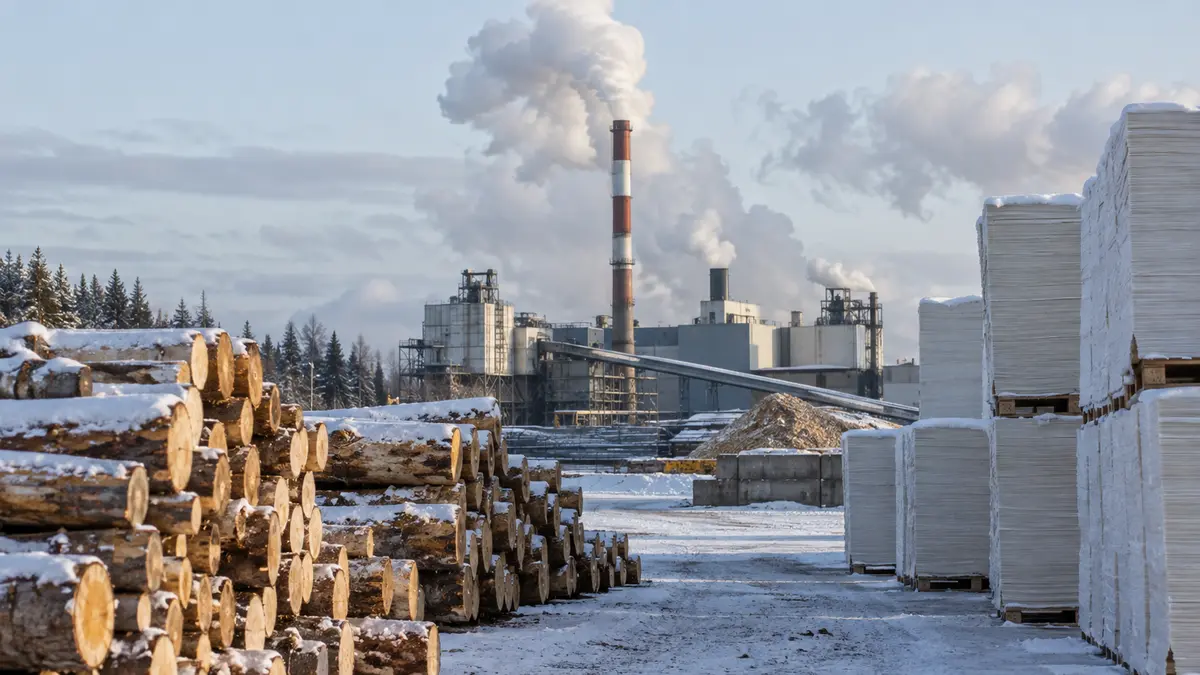
Russia's pulp and paper industry is closing 2025 in what Zakhar Smushkin (Захар Смушкин), chairman of the board of directors of Ilim Group (группа «Илим»), calls "a kind of perfect storm": a sales geography narrowed by sanctions to two markets, overcapacity and falling prices in China, a stalled mechanical wood processing sector at home, and a macroeconomic setting that punishes exporters. In an interview with Kommersant (Коммерсантъ) published on December 25, 2025, Smushkin set out the industry's numbers for the year, explained why the Russian forest base is losing to plantation forestry in South America and Southeast Asia, and listed the policy changes he says must come before investment returns - warning that without them the sector slides towards bankruptcies.
An industry running in reverse
The official statistics Smushkin cites describe a sector contracting on almost every line. Over the three previous years, timber harvesting in Russia fell by a cumulative 14%, and in January-October 2025 it dropped a further 9%. Cellulose output declined by 3% over the three-year period and by 1.5% in the ten months of 2025, while the growth of paper and board production slowed to 2.7% and 0.7% respectively. The most telling indicator is corrugated packaging, traditionally the gauge of consumption: after two years of 7-8% annual growth, output of corrugated boxes in January-October 2025 was lower than a year earlier, and Ilim expects full-year corrugated consumption to dip as well. White papers look worse still: on the company's estimate, Russian consumption of office and offset paper will fall by 10-15% in 2025 against 2024, and coated paper by up to 20%.
Profitability traces the same curve with a steeper slope. Pre-tax profit across the forest industry complex - timber harvesting, pulp and paper, and wood processing - fell by 48% between 2021 and 2024, and by a further 69% in the first nine months of 2025 year on year. "As a result, the profit of forest industry enterprises vividly reflects the negative trend," Smushkin says.
Ilim as the industry's barometer
Ilim is the largest player in the Russian pulp and paper market, producing several times more than its nearest competitor and more than 70% of the country's market pulp, which is why Smushkin treats the group's dynamics as a proxy for the sector as a whole. Production volumes have kept rising, mainly as the new pulp and board mill at Ust-Ilimsk ramps towards full capacity: 3.6 million tonnes of commercial product in 2022, about 3.7 million in 2023, 3.9 million in 2024 and about 4 million tonnes in 2025. Net profit moved in the opposite direction - 22 billion roubles in 2022, 17 billion in 2023, 15 billion in 2024 - and 2025, Smushkin says plainly, will be a loss-making year. The combination of growing tonnes and shrinking money is the essence of the year: the industry sells more into a market that pays less.
Three shocks at once

The first shock is sanctions pressure, which has cut the accessible sales geography down to two de facto markets. About 30% of Ilim's output goes to the domestic market and 70% is exported, predominantly to China. The second shock is the price environment on that key market: Chinese paper and board production is growing rapidly while Chinese mills run at only 60-70% of capacity, which is where genuine overcapacity sits. Excess capacity, the rising role of integrated pulp and China's growing fibre self-sufficiency have sharpened competition and pushed global pulp and paper prices down; tariff and trade wars add nothing positive. Even though China's exports grew by 5% in January-November 2025 on redirection away from the United States, geopolitical tension weighs on consumer confidence and on price levels.
The arithmetic of that price fall is stark. Compared with 2021, Russian exports of cellulose, paper and board to China have risen by almost 50% in tonnes, but by only about 20% in money terms; the difference between the two growth rates is precisely the effect of lower prices. The third shock is the degradation of mechanical wood processing in Russia - sawn timber, plywood and panels. The global market for structural materials is negative, the main reason being the construction crisis in China combined with limited access to alternative markets. As sawmills slow down, pulp and paper companies lose access to third-party wood residues, balance wood and chips: historically the two segments coexisted, with processors supplying balance wood and chips to the mills and receiving sawlogs in return. Now the incumbent leaseholders from mechanical processing do not harvest the volumes the pulp mills need, and the mills cannot enter their forest fund because it is protected by their lease agreements. Pulp companies have to reach further into the forest, literally beyond the haul radius they previously considered economically justified; Smushkin argues that forest use policy has to be revised at state level for the raw material base to become efficient again.
The macro squeeze: rate, tariffs, rouble
Beyond the sector-specific factors, Smushkin puts the sharpest blame on monetary policy, which he calls one of the main causes of the crisis across all export-oriented Russian industries. The current key rate, in his assessment, is not economically justified: it does not support the economy of manufacturing companies but sharply and negatively affects it. One visible consequence is a shrinking domestic market, because Ilim's own customers divert part of their funds to servicing bank credit at extremely high rates and cut their consumption. A second factor is the tariffs of natural monopolies - energy and rail - which rise ahead of inflation and by multiples of the target level that the central bank itself pursues through the high rate: on one side the regulator tries to cool inflation with expensive money, on the other monopolies index their tariffs well above it, fuelling inflation and diluting the effect of the rate. In the fiercely competitive Chinese market this cost growth cannot be passed into price, so it comes straight out of an already deteriorated margin.
The main tactical factor is the exchange rate. The rouble strengthened during 2025, and every point of appreciation directly reduces export efficiency. Under heavy sanctions pressure, with the financial system in transformation, Smushkin doubts that the rate is formed by market forces alone and argues that until the situation normalises a mechanism is needed to counter or compensate the distortions; on Ilim's view, an export-oriented economy is best served by a rate of 95-97 roubles per dollar. Higher tax rates and wage growth against a labour deficit complete the list. Thirty years of investment aimed at export markets, where domestic demand has long been saturated, have left the industry's operating model paralysed: production cannot simply be stopped, because the mills carry expensive equipment, so product is sold at prices that cover variable costs and only part of fixed costs - and on a full-cost basis, including the cost of financing, the profit and loss statement shows a loss.
Support that arrives too small and too late
The transport compensation idea, Smushkin recalls, was relevant in the first half of 2025, when the redirection of exports to China jammed the railways with goods from energy carriers to industrial products; Russian Railways and the government responded and the problem was largely resolved within half a year. Other sectors received point support - coal producers got deferrals on the mineral extraction tax and insurance contributions plus credit restructuring, metallurgists got a shift of the liquid steel excise and extraction tax deadlines - but such measures are limited in time and do not remove the root cause of the crisis, and transport is no longer the critical factor. Broad subsidies look unrealistic in a deficit budget where helping one sector means taking from another. Instead Ilim proposed not to introduce, or to postpone, increases in non-tax payments: forest lease rates, charges for the use of surface water bodies, the environmental fee under extended producer responsibility, and payments for negative environmental impact, as well as postponing environmental efficiency programmes that bring no direct economic effect to the enterprises.
The plantation gap
The deepest structural problem lies in the forest itself. For decades the main export competitors of Russian producers were Nordic and North American companies; today they are producers from South America and Southeast Asia, where growing wood turned out to be far more effective thanks to humid climate and to forestry and reforestation legislation. Where Russian rules are so conservative that they do not even allow using tree seeds grown in another region of the country, competitors in Brazil, Indonesia, China and several other countries deploy productivity-raising technologies including genetic engineering. The result is a gap of an order of magnitude: a cutting rotation of 80-100 years and 2 cubic metres per hectare in Russia against eight years and more than 30 cubic metres per hectare under plantation models. That gap translates directly into haul radius, cost and capital intensity of forest operations: the wood component in the cost of one tonne of cellulose is 120-130 dollars in Brazil, 150-160 dollars in Chile and 160-190 dollars in Russia. Add the difference in logistics tariffs - shipping from South America to China costs less than from Russia to China - and in energy, where South American mills are energy-surplus, and the competitiveness gap widens further.
Two legal themes compound it. Forest road construction legislation is imperfect and needs reform, and Smushkin expects both it and the plantation question to be reflected in the industry strategy now being updated by the Ministry of Industry and Trade, in amendments to the Forest Code and in government resolutions. The second is a fresh collision over forest lease rates: a 2023 government resolution changed the calculation procedure, and Rosleskhoz (Рослесхоз) clarified the same year that it applied only to newly concluded leases; at the end of 2025 the agency changed its position and plans to recalculate rates retroactively for all contracts, including those concluded before 2024 and those under priority investment projects. The new rates exceed auction prices, which the Forest Code treats as the basis for lease rates, and extending them to priority projects whose investors have already fulfilled their obligations on investment volume, jobs and output undermines the logic of the instrument; some participants, Smushkin notes, would not have entered such projects at all knowing the price would rise by more than 70%. Companies balancing on the edge of losses simply have no money to pay billions of roubles in increased lease charges for the past three years.
What would restart investment
Technology and people close the circle of constraints. Pulp and paper is one of the most capital-intensive industries, and the equipment installed at Russian mills is neither Russian nor Chinese; under sanctions, technological independence means shifting within a short time to machinery produced at home or in friendly countries, a transition domestic machine building has to catch. Single-industry towns face staff outflow as wages rise elsewhere, and holding employees requires coordinated work with regional and municipal authorities on social conditions. The financial conditions are quantifiable: to maintain fixed assets a business must generate at least 15% return on invested capital, so the commercial rate should not exceed 15% and the key rate should sit at no more than 10-12%; large investment projects become feasible again only at a rate no stronger than 95 roubles per dollar. If monetary policy stays as it is, Smushkin says, there is nothing to counterpose - hedging methods for this simply do not exist.
The warning
Asked what happens if the government does not meet the industry halfway, Smushkin answers in one word: bankruptcies. Losses first; when they become comparable with equity, companies reach negative net assets and bankruptcy. The movement towards negative results is visible in the full-year dynamics, and yields at many companies are already close to zero or negative. "If this continues, we will simply lose the industry," he says: if some mills stop, restarting them will be practically impossible, not because of technology but because in the current labour market people will leave for other regions and not return. For now Ilim keeps only the minimum of projects that hold technological equipment in safe working order, plus a digitalisation project: with macro uncertainty and unstable prices, the company has moved from annual to quarterly planning cycles supported by optimisation software.
What the industry watches next
- Whether monetary policy shifts towards a key rate in the 10-12% range that would make investment projects bankable again.
- Whether the rouble settles near the 95-97 per dollar corridor exporters call economically justified.
- Whether the retroactive recalculation of forest lease rates is withdrawn or grandfathered for priority investment projects.
- Whether China's construction and paper markets absorb additional tonnes without further price erosion.
- Whether the updated industry strategy and Forest Code amendments close the plantation and forest road gaps.
The 2025 result for the Russian pulp and paper industry is therefore a paradox of volume and value: output held or grew at the largest producers while prices, profits and investment capacity fell away. The industry's own diagnosis names no single villain - sanctions, Chinese overcapacity, the construction slump, the rate, the rouble and the lease system each take a share - which is exactly why Smushkin calls it a perfect storm rather than a cycle. The question for 2026 is which of these factors policy can actually move.
Just Published

European housing prices and rents

Schneider–PTC: the industrial data integration test behind the deal
Avio USA starts work on its Virginia manufacturing site

One equity market, two currency measures

Russia’s draft budget raises spending and borrowing plans

Russia Sets the 2027 Minimum Wage at 28,935 Rubles, Up 6.8%, on the Way to 35,000 by 2030
Partner news digest
 Qatar LNG expansion: readiness, financing and the production test
 Pennon’s capital plan: turning finance into better water outcomes
 Italy’s diesel relief gap: taxes, price ceilings and implementation
 EU–China hybrid trade: from understanding to measurable implementation
 Schneider–PTC: the industrial data integration test behind the deal
 IKEA’s hybrid resale model: buyback, marketplace liquidity and furniture logistics
 Banking AI beyond the ranking: capability, execution and evidence of value
 Fishing labour beyond the product label: practical protection
 Rhenus and the Middle Corridor: terminals need coordinated connections
 Royal Mail restructuring: the test is reliable delivery
 Fuel Finder on Google Maps: when price transparency becomes useful competition
 Samsung’s memory profit surge: what the preliminary record explains
Leave a comment