
The Segment That Grew: Russia's Hotel Property Sets an All-Time Investment Record in a Cooling Market
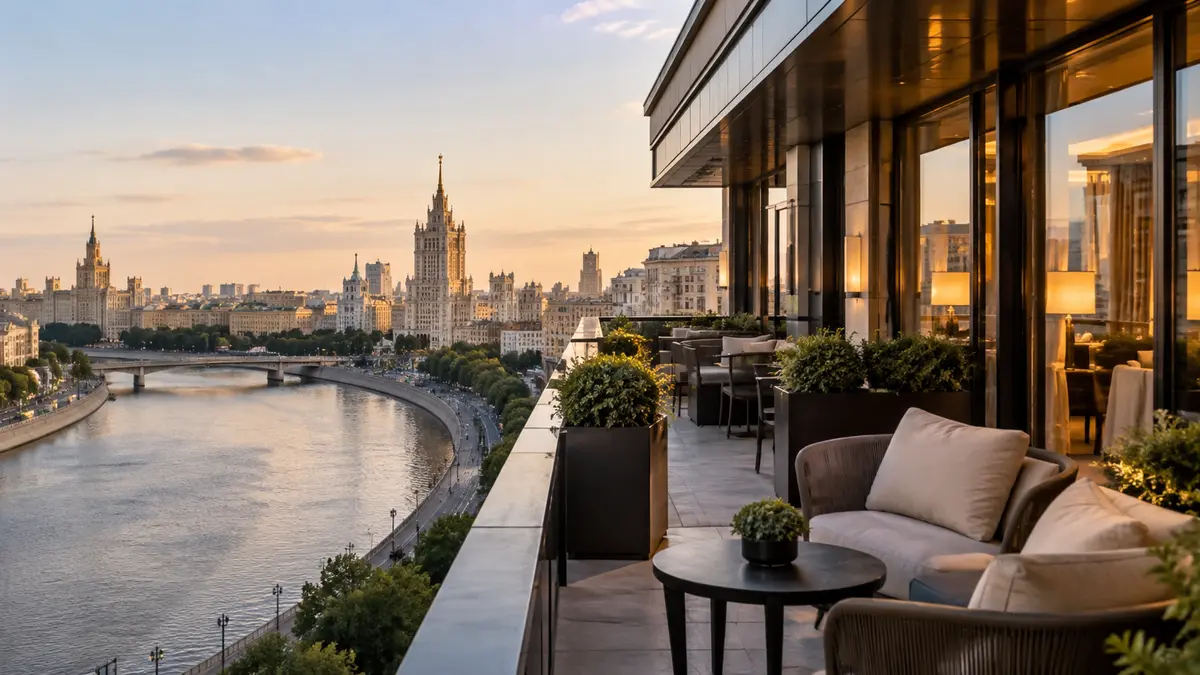
Hotel property closed 2025 as the only growing segment of Russia's commercial real estate market: investment in the segment doubled to a record 27 billion rubles in IBC Real Estate's tally, while Ricci's nationwide estimate puts hotel investment at 50-55 billion rubles, 46% above 2024, against a market that cooled by about 35% to 800-850 billion rubles. The record was built on state-subsidized lending, resort demand and a handful of large deals, Kommersant reports in its year-end review; RBC confirms hotels were the sole segment to grow.
The record inside a cooling market
The commercial property market lived through 2025 with the same constraints as in 2024: a high key rate, persistent inflation and rising construction and operating costs that squeezed project margins. All of it happened without any principal change in the geopolitical background — sanction pressure continues to intensify and foreign capital is practically absent from deals. That is why banks play the decisive role in the investment process today: "They are the main systemic investors in the real estate market," says Marina Malakhatko (Марина Малахатько), partner at NF Group.
The Bank of Russia's rate-cutting policy turned out more restrained than market participants expected, so the cost of borrowed financing remains high, Malakhatko notes; the negative effect was reinforced by rising costs of construction and finishing works and by a deficit of qualified labour. In her view the trend will persist in 2026 because of the VAT increase to 22% and the lowering of the simplified taxation threshold. Ricci counted the annual total at 800-850 billion rubles, 35% below last year's 1.3 trillion; Nikoliers forecasts 1.2 trillion rubles including development sites.
Market participants call this restrained activity rather than decline. "The decrease of the annual indicator means not a fall of the real estate market but stabilization after two years of active growth. Investment volumes in 2023-2024 (about 1 trillion and 609 billion rubles respectively) exceeded the average annual indicator of the previous seven years by three to four times," emphasizes Mikael Kazaryan (Микаэл Казарян), head of capital markets and investments at IBC Real Estate. The number of investment deals stayed stable this year, but the average ticket shrank by about 40%, Malakhatko adds. The third quarter delivered a spike: the key rate cut from 21% to 16.5% gave the market an additional impulse, and transaction volume reached 194 billion rubles, the maximum quarterly value of the last ten years, Kazaryan says. A noticeable trend was the growth of collective investments, especially closed-end funds in warehousing: their share rose to 15% of operational property purchases in Ricci's data.
The hotel segment that grew
Against that background the hotel line stands out. Kazaryan names the largest Moscow deals — the sale of Hyatt Regency Moscow Petrovsky Park and of the suburban LesArt Resort — and sums up: "In the hotel segment the investment indicator grew two times, and the current record result (27 billion rubles) is the maximum for the entire history of observations." Nationwide, the picture is similar in structure: about 50-55 billion rubles of investment, 11% of the total volume excluding development sites, with 71% of deals made by profile private investors and a growing share of developers, Ricci writes. RBC's reading of the same estimate adds the dynamic: 46% above 2024, the only growing segment while the rest of the market fell by about 35% on average, with state support of domestic tourism as the driver.
The deal list shows who bought the record. The largest transaction was the purchase by LSR Group of three three-star Ibis hotels for 4.9 billion rubles. Another major deal was the 10 billion rubles paid by Fun & Sun for Swissotel Resort Sochi Kamelia — a resort asset on the Black Sea coast, exactly the type of property the year's demand favoured. Between these poles — city hotels bought by a residential developer and a seaside resort bought by a tour operator — sits the logic of 2025: hotels were acquired both as cash-flow assets in solvent destinations and as inventory for travel companies selling the domestic product.
Supply: 10,000 rooms and 25 hotels from two chains

The investment record met an unusual supply wave. In 2025 Russia planned to commission 10,000 new hotel rooms, IBC Real Estate calculated in June: the indicator is 3.7 times higher than the 2024 value and may become the maximum since 2014, when 11,200 rooms were delivered. The expansion of the fund was planned including by the largest operators: Azimut Hotels and Cosmos Hotel Group told Kommersant they planned to open 25 new hotels in total.
Cosmos Hotel Group president Alexander Biba (Александр Биба) links the growth of activity to state support measures: projects that received concessional loans for construction and reconstruction at 2-5% in 2022-2024 are coming to the market this year. Over the horizon of the next five years the program assumes the construction of 78,000 rooms, adds IBC Real Estate general director Alexey Efimov (Алексей Ефимов); deputy minister of economic development Dmitry Vakhrukov (Дмитрий Вахруков) previously estimated the combined cost of these projects at 2 trillion rubles. The second driver, according to Azimut Hotels general director Maxim Brodovsky (Максим Бродовский), is the growth of the domestic tourism market and the increase of business trips across the country: according to Rosstat, 85.5 million people stayed in Russian hotels last year, 10.9% more than a year earlier, and in January-April of this year the growth was 5%, to 24.9 million people.
Whether the new rooms relieve the market is debated. The increase of the room fund of Russian hotels may partially smooth the deficit of places in periods of peak demand, believes Oleg Germanenko (Олег Германенко), head of strategic consulting at Nikoliers: previously the shortage of fund contributed to the growth of alternative accommodation segments, including tourist housing — during the May holidays, short-term rental demand grew 14% year on year per CIAN Analytics, and per Ostrovok apartments became the most demanded form of accommodation for the June holidays with 28% of sales across Russia. Marina Smirnova (Марина Смирнова), head of hotel business and tourism at CMWP, doubts that this year's increase will substantially influence the deficit problem: modern hotels in principle form only 5.6% of Russia's hotel fund.
Geography explains part of the tension. Developers usually choose for hotels locations with stable and solvent tourist flows, explains Ksenia Nepomnyashchikh (Ксения Непомнящих), deputy director of strategic and management consulting at CORE.XP; because of that new objects often appear in the central part of the country, while the Far East still has few projects — a short season and remoteness from the large cities make investments risky. Efimov offers another example: the Kaliningrad region, where the combined hotel fund reaches 1,400 rooms, while in Moscow and St. Petersburg the values are times higher — 30,300 and 16,500 rooms respectively; the deficit of supply under high demand leads to price growth.
Execution risk completes the picture. Smirnova does not exclude that part of the hotel objects declared for commissioning this year will later be moved to later dates; Nepomnyashchikh does not exclude that the tempo of supply growth will ultimately slow, including because of a revision of support measures — the Ministry of Economy earlier indicated that the limit under the concessional lending program for hotel construction is exhausted and that it will probably not be prolonged. Biba counts on a moderate tempo of growth of the quality room fund, 5-6% a year.
Openings in the two capitals
The capital markets story was matched by a visible opening pipeline. The volume of new hotel supply in Moscow by the results of 2025 may compose 1,300 rooms, comparable with the results of the pre-crisis 2016-2018, when commissioning stood at 1,200-1,900 rooms, per Nikoliers data. Among the largest openings: AZIMUT Hotel Aerostar Moscow 4*, Cosmos Selection Arbat and Palmira Art Hotel. In St. Petersburg the volume of new supply is comparable with last year's and is provided by the opening of one hotel — Svet.
Resorts, clusters and "real estate that prolongs life"
Beyond the capitals, the growth had a resort geography. The hotel real estate market grew at the expense of regional objects in large resort cities and popular tourist clusters, where loading and revenue grew noticeably, says Alexey Muzyka (Алексей Музыка), director of Domina Invest. A substantial part of objects is realized within the framework of resolution No. 141 (on subsidies for credits on investment projects directed at the development of domestic tourism), which grants the industry tax and investment preferences; "such dynamics will be preserved for the nearest several years," he believes.
The wider taste of investors points in the same direction. "Now in trend is real estate that prolongs life. This is medicine, predictive biohacking, multisport, fitness, therms, resorts," notes Denis Kolokolnikov (Денис Колокольников), founder and managing partner of RRG. Hospitality, wellness and resort formats sit at the intersection of the two trends of the year — state-subsidized capital and domestic demand for experiences inside the country.
Where the capital left: offices, warehouses, retail
Hotels did not absorb the market's capital so much as absorb the capital that left other segments. Offices remained the most popular segment for the second year, about 55% of investments in classical commercial real estate per Nikoliers, but Moscow office deals halved to about 292.5 billion rubles, and warehousing fell 25-29% to 115-130 billion rubles as rates stabilized and the room for revising contract terms was exhausted, per Ricci. Retail attracted the same 50-55 billion rubles as hotels, with about 70% of deals made by investment funds. The parity of hotels with retail — a historically much larger segment — is the clearest measure of how far hospitality moved up the capital pecking order in a single year.
The through-line of the year was collective investment: the share of closed-end funds rose to 15% of operational property purchases and about 3% of site purchases in Ricci's data, reaching 53% in warehousing — the financialization backdrop against which the hotel record's 71% private-investor share stands out.
2026: VAT, rates and the price of capital
The conditions that produced the record are changing. In 2026 the trend will be preserved because of the increase of VAT to 22% and the lowering of the threshold of the simplified taxation system, Malakhatko warns: "This will be reflected in the final cost of real estate, above all capital-intensive projects such as hotels and trade centres. Taking into account the inflationary character of VAT, the tempo of inflation decline will be slower than expected, which puts in question the forecasts of leading banks about a decrease of the key rate to 10% by the end of 2026." For hotels, the most capital-intensive segment of the year's growth, that means a higher cost of every new room in the pipeline.
The rate path cuts both ways. The decrease of the key rate, on one hand, will allow attracting more accessible credits for the purchase of large objects and, on the other, will lead to a revision of conditions on deposits and placements, which will stimulate both large and private investors to search for alternatives for investments, including through mechanisms of collective investments. If deposits become less generous, part of the private capital that bought 71% of this year's hotel deals may stay in the segment — but at a higher price of construction and a slower subsidy pipeline.
Key numbers of the hotel year
- Hotel investment: doubled to a record 27 billion rubles (IBC Real Estate); nationwide 50-55 billion rubles, +46% to 2024 (Ricci, RBC).
- New rooms planned for 2025: 10,000, 3.7 times the 2024 value and the maximum since 2014 (IBC Real Estate).
- Chain openings: Azimut Hotels and Cosmos Hotel Group planned 25 new hotels in total.
- Largest deals: Swissotel Resort Sochi Kamelia for 10 billion rubles (Fun & Sun); three Ibis hotels for 4.9 billion rubles (LSR Group).
- Capital supply: about 1,300 new rooms in Moscow (AZIMUT Aerostar, Cosmos Selection Arbat, Palmira Art Hotel); one hotel, Svet, in St. Petersburg.
- Subsidy pipeline: 78,000 rooms over five years under resolution No. 141, projects worth about 2 trillion rubles.
The 2025 record is best read as a bet on two forces at once: domestic tourist demand that filled resort hotels to revenue records, and subsidized credit that moved stalled projects from paper to opening. The 2026 tax shift tests the first force through costs and the second through the price of capital; the postponement risk in the opening pipeline will show whether 2025 was a peak or a platform for the hotel segment of Russia's property market.
Just Published
European housing prices and rents

Schneider–PTC: the industrial data integration test behind the deal
Avio USA starts work on its Virginia manufacturing site

One equity market, two currency measures
Russia’s draft budget raises spending and borrowing plans
Russia Sets the 2027 Minimum Wage at 28,935 Rubles, Up 6.8%, on the Way to 35,000 by 2030
Partner news digest
 Qatar LNG expansion: readiness, financing and the production test
 Pennon’s capital plan: turning finance into better water outcomes
 Italy’s diesel relief gap: taxes, price ceilings and implementation
 EU–China hybrid trade: from understanding to measurable implementation
 Schneider–PTC: the industrial data integration test behind the deal
 IKEA’s hybrid resale model: buyback, marketplace liquidity and furniture logistics
 Banking AI beyond the ranking: capability, execution and evidence of value
 Fishing labour beyond the product label: practical protection
 Rhenus and the Middle Corridor: terminals need coordinated connections
 Royal Mail restructuring: the test is reliable delivery
 Fuel Finder on Google Maps: when price transparency becomes useful competition
 Samsung’s memory profit surge: what the preliminary record explains
Leave a comment