
In Search of New Markets: Record Russian Fertilizer Exports Meet a Falling Price Cycle
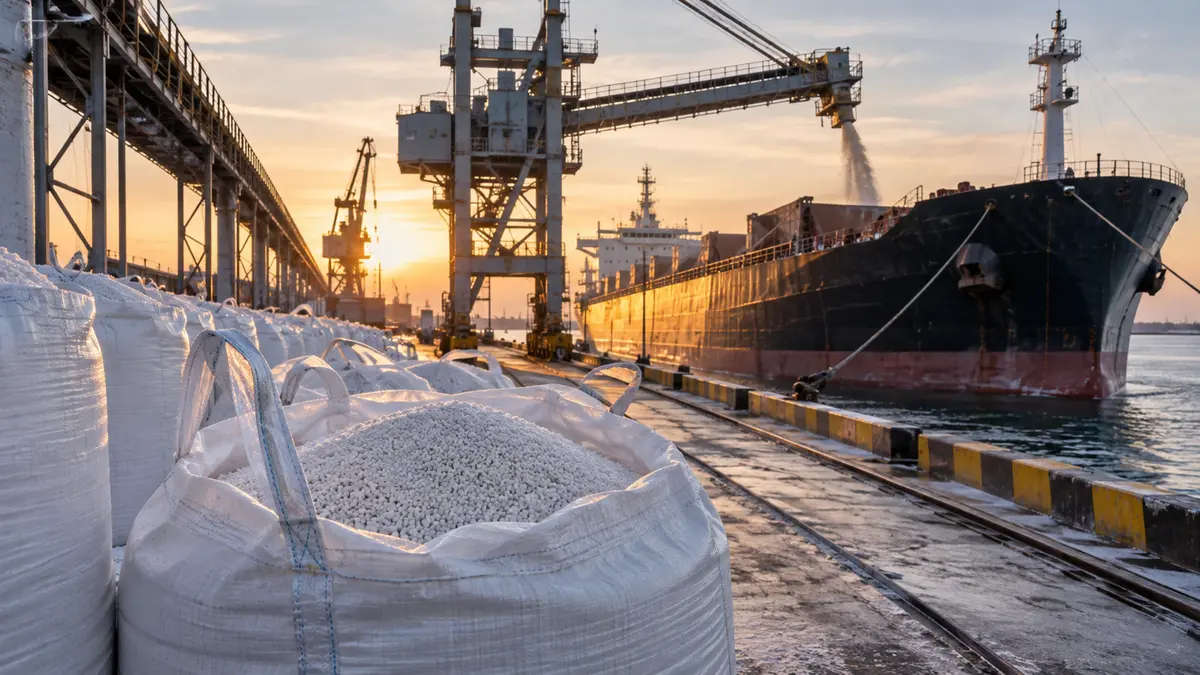
The global mineral fertilizer market spent the autumn of 2025 in a rare configuration: prices were falling on nearly every key benchmark, the two largest demand centers were reshaping trade flows in real time, and Russia was approaching a record 45 million tonnes of exports after losing its oldest premium market. What looks like a routine price correction is in fact a redistribution of the entire export map of the industry, with consequences that will outlast the current quoting cycle.
A second month of decline across the board
The cost of the main types of mineral fertilizers on key world markets continued falling for a second consecutive month as of early November 2025. Granular urea, the most popular product in the nitrogen segment, lost 8.7% between mid-September and October 22, sliding to $368 per tonne on an FOB Baltic basis. Prilled urea followed with a 6.8% decline to $370 per tonne.
The phosphate segment was weakening under the pressure of growing global stocks and improving availability. The diammonium phosphate (DAP) price index gave up 7.1% over a month and a half to reach $683 per tonne, while ammonium phosphate (MAP) fell 12% to $618 per tonne. Only potash looked stable, and its stability had a specific institutional explanation rather than a market one.
The two markets that move everything
The dominant influence on the global sector at that moment came from the situation on the two largest markets — India and China — and the two countries were pushing prices in the same direction for opposite reasons.
In India, urea market participants were waiting for the results of a tender by the state agency Rashtriya Chemicals & Fertilizers Limited (RCF) to purchase 2 million tonnes of the product. The price offered by the trader turned out to be below market expectations, which fed bearish sentiment, experts at the analytical firm MMI noted. At the end of October, India's Department of Fertilizers recorded that the supply crisis in the country had been definitively overcome — a milestone marked by a sharp drop in quotes. Since August, Indian DAP stocks had exceeded the previous year's level and sat at the long-term average, favoring physical availability. Under conditions of sufficient domestic stocks and limited global availability, importers in India are able to manipulate world prices in their own interest, MMI experts observed.
China, meanwhile, was pressuring prices from the supply side with exports far above the previous year: in January–September the country shipped more than 2.8 million tonnes of urea, dramatically more than the 253,000 tonnes sent abroad in the same period a year earlier. And the direction of Chinese policy remained unresolved: the question of widening the export window was left hanging until December 1, a factor capable of defining the further trajectory of world prices on its own.
India's subsidy machinery keeps buying
Looking forward, India had the capacity to increase purchase volumes thanks to the nutrient-based subsidy (NBS) approved by the government at the end of October for the rabi season of 2025/26, running from October 1, 2025 to March 31, 2026, covering phosphate and potash fertilizers. Preliminary budget needs were estimated at $4.3 billion. MMI noted that subsidy rates per tonne of the main fertilizer grades had been increased by 5–10% compared with the previous year, depending on phosphorus and sulfur content. The subsidies are provided directly to companies at approved and announced rates in order to keep retail prices stable for farmers — a mechanism that insulates Indian demand from world price swings and makes it the most predictable large buyer in the market.
China's 2026 import quota
In the previous week, China had approved its fertilizer import quotas for 2026. The total procurement volume was set at 13.65 million tonnes, of which 3.3 million tonnes fall on urea, 6.9 million tonnes on DAP and 3.45 million tonnes on complex NPK fertilizers. Acceptance of applications for 2026 was scheduled to begin on December 15, 2025, and the intensity of those applications would itself be read by the market as a signal about the health of key chemical products.
Potash: the calm segment with a contractual anchor

Potassium chloride remained the most stable fertilizer segment. Its world quotes depend on long-term contracts of suppliers with India and China, which serve as the reference point for other importers. The prices of the then-current contracts stood at $349 per tonne CFR India and $346 per tonne CFR China. According to MMI's forecast, in 2026 contract prices could decline by roughly $10 per tonne — a modest correction that nonetheless underscored the segment's dependence on administrative rather than spot pricing.
The correction was not supposed to last
The correction of world fertilizer prices against the summer maxima persisted into the fourth quarter of 2025, especially in nitrogen fertilizers, noted Nina Adamova, an expert at the Center for Economic Forecasting of Gazprombank. But she saw the decline as temporary: given that China, a major supplier of nitrogen and phosphate fertilizers, suspended urea and DAP exports from October 15, the market should expect prices to resume growing in the coming months. In other words, the autumn weakness was built on a supply decision that could be reversed by the same pen stroke that introduced it — which is precisely what made the December 1 decision on the Chinese export window so consequential.
Russia's record year and the pivot eastward
Against this volatile global backdrop, Russia was having a historic year as a supplier. Russia traditionally ranks among the main providers of fertilizers to the Chinese and Indian markets, and by the estimate of the Russian Fertilizer Producers Association (RAPU), shipments to those two countries in 2025 could reach 10 million tonnes combined.
"We have already supplied around 2.5 million tonnes to India, which means we will arrive at 5 million tonnes by the end of the year — these are absolutely record figures. The same concerns supplies to China, where the figure is approximately the same," the association's head Andrei Guryev said in September.
Overall, RAPU forecast that Russia could increase foreign deliveries of mineral fertilizers to a record 45 million tonnes in 2025, with the bulk of that volume going to friendly countries. By the end of the previous year, their share of Russian fertilizer exports had already reached 76%. The export machine was therefore not merely growing; it was growing while re-pointing itself away from the West and toward Asia, the Middle East, Latin America and Africa.
The European door closes on a schedule
The reorientation had a hard political driver. Shipments to the European Union — traditionally a strategic market for Russian chemical products, worth around 5.5 million tonnes a year — had been declining steadily since 2022, even though no direct sanctions on Russian fertilizers applied there until July 1, 2025.
After the EU approved the introduction of duties in mid-June 2025, the tariff stood at €40 per tonne for nitrogen fertilizers and €45 per tonne for complex fertilizers, on top of the previously existing ad valorem duty of 6.5%. The decisive feature of the European decision was its trajectory: in 2028 the rates are set to rise to prohibitive levels of €315 and €430 per tonne respectively. The EU, in effect, published a multi-year schedule for its own market closure, giving exporters an unambiguous deadline to complete their pivot.
Experts were confident that losing the European market would not prevent further growth in Russian exports, thanks to active demand growth from other major consumers such as Brazil and Turkey. The geography of the industry's growth was being redrawn not by agronomy but by tariff schedules.
Quotas at home: the state's second lever
If tariffs defined the external perimeter, quotas defined the internal one. Approved government quotas on exports of chemical products for the period from December 1, 2025 to May 31, 2026 became a potential constraint on the record trajectory. The state has applied the fertilizer export quota mechanism since December 2021 to guarantee supply of the domestic market and as one of the measures restraining food price growth in Russia.
The quota in force until November 30, 2025 amounted to 19.9 million tonnes, including more than 12.3 million tonnes for nitrogen fertilizers and more than 7.6 million tonnes for complex ones. The permitted volume for the following six months was reduced to 18.7 million tonnes, of which more than 10.6 million tonnes were allocated to the nitrogen segment and more than 8 million tonnes to complex fertilizers. "The decision will allow the uninterrupted operation of agricultural producers, compound feed manufacturers and other consumers, ensuring a sufficient level of fertilizers on the domestic market," the government emphasized.
At the same time, market sources believed the reduction was not necessarily final: if companies, after fully covering the needs of domestic agricultural producers, are ready to export more, the quota volume could be revised upward — something that had already happened several times under the mechanism.
The domestic contract: frozen prices, covered demand
Beyond quotas, the state uses a second stabilization tool — the freeze of fertilizer prices for Russian consumers, and as of late 2025 producers had no hope of indexation. As the Federal Antimonopoly Service (FAS) confirmed, despite requests from chemical market participants to raise prices at least to the level of inflation, such an option was not being discussed.
The price architecture had a long history. Prices of nitrogen and complex fertilizers for Russian farmers were frozen in July 2021 against the background of a sharp rise on external markets, to which domestic quotes had been linked. In line with FAS recommendations, ceiling prices were indexed in June 2022 (by 5%) and in September 2022 (by 5–10% depending on fertilizer type). The last time the question of raising prices was discussed in government was the spring of 2025: the FAS, the Ministry of Economic Development and the Ministry of Industry and Trade supported indexation, while the Ministry of Agriculture opposed it. The agricultural lobby won, and the freeze held.
The social contract worked in both directions. By mid-October, RAPU reported, fertilizer producers had already covered more than 88% of agricultural producers' needs for all of 2025. The association recalled that since 2013, when a new investment cycle began in the industry, supplies to the priority domestic market had grown two and a half times. "We are fully covering the growing demand of Russian farmers. The volume of fertilizer application has doubled — to 77 kilograms per hectare," the association noted.
Production keeps climbing toward a record
With demand growing on both external and internal markets, output kept rising. In the first nine months of 2025, Russian fertilizer production increased 4% year on year to 48.9 million tonnes in physical weight. Nitrogen fertilizer output for January–September grew 3% to 21.5 million tonnes; phosphate and complex fertilizers also grew 3% to almost 14 million tonnes; potash fertilizers grew 8% to 13.4 million tonnes. By the end of the year, RAPU told Kommersant, production could reach a historic record of 65 million tonnes.
The structure of that growth is worth noting: the fastest expansion was in potash, the segment with the most stable world pricing, while nitrogen — the segment most exposed to Chinese export policy and European tariffs — grew more slowly. The record was being built on the back of two decades of investment that began in 2013, and on a domestic market that consumes an ever larger share of the output at administratively frozen prices.
Rabobank's warning: the affordability trap
Not everyone read the demand picture the same way. According to Rabobank's analytical unit, the world mineral fertilizer market was entering a phase of prolonged decline, with global demand for chemical products set to continue falling in 2026.
The key reason for the negative dynamics, the analysts argued, is high prices themselves. The market's core indicator — the Fertilizer Affordability Index — continued to decline. "Price growth suppresses demand, while record grain harvests and low grain prices reduce farmers' profitability, forcing them to economize on fertilizers," the report, published in the last days of October, noted.
The bank's forecast detailed how the contraction would travel through the segments:
- Urea consumption would shrink on the main markets in 2026, as price growth had already pushed Brazilian farmers to switch to ammonium sulfate.
- Global phosphate demand had already fallen 4% in 2025, and the trend was set to intensify the following year.
- Potash, where consumption had recovered the previous year, would also turn toward the global decline because of price growth, with Brazil's plans for record imports in 2026 only partially compensating.
This is the affordability trap in its pure form: years of tight supply and geopolitical risk premiums lifted prices to levels where the farmer — the final payer in the chain — rations his application. Demand destruction of that kind does not show up as a crisis; it shows up as a quieter, slower market that never returns to its previous consumption curve.
How the pieces fit together
Read as a system, the autumn of 2025 offered a coherent if unstable picture. On the demand side, India had rebuilt stocks, ended its supply crisis and gained the ability to lowball tenders, while its subsidy budget of $4.3 billion guaranteed a floor of purchases regardless of world prices. China oscillated between record exports and sudden suspensions, with its 2026 import quota of 13.65 million tonnes already fixed and its export window the market's single biggest open question. On the supply side, Russia was completing a historic pivot: a record 45 million tonnes of exports, 10 million of them to India and China, a 76–plus percent share of friendly countries, and a European market being phased out on a published tariff schedule through 2028.
The state's role inside Russia was equally systematic. Quotas of 18.7 million tonnes for December–May, a price freeze upheld against the industry's own regulators, and 88% of annual domestic demand covered by mid-October — all of it subordinated to one priority: cheap food inputs at home first, export records second, and upward quota revisions only if the first condition is overfulfilled.
What to watch beyond the record
Three variables will decide whether the 2025 record becomes a plateau or a peak. The first is China's export window: the December 1 decision on widening it, and the pace of applications under the 2026 import quota from December 15, will tell the market whether the world's swing supplier intends to sell or to hoard. The second is affordability: if Rabobank is right and the Fertilizer Affordability Index keeps falling, then application rates — not prices — become the market's binding constraint, and the phosphate contraction of 4% in 2025 becomes a trend rather than an episode. The third is the quota mechanism itself: whether the reduced December–May volume of 18.7 million tonnes is later revised upward, as it has been before, will show how much export appetite the state is willing to release once domestic demand is demonstrably covered.
For the industry, the lesson of 2025 is structural rather than cyclical. The export map of fertilizers has been redrawn: Europe is exiting on a tariff timetable, Asia is buying at record scale, and the pricing power of buyers like India has grown with every rebuilt stockpile. Prices fell for a second month — but the market that produced that decline is not the market of five years ago, and it will not produce the same kind of rallies either.
Just Published

European housing prices and rents

Schneider–PTC: the industrial data integration test behind the deal
Avio USA starts work on its Virginia manufacturing site

One equity market, two currency measures

Russia’s draft budget raises spending and borrowing plans
Russia Sets the 2027 Minimum Wage at 28,935 Rubles, Up 6.8%, on the Way to 35,000 by 2030
Partner news digest
 Qatar LNG expansion: readiness, financing and the production test
 Pennon’s capital plan: turning finance into better water outcomes
 Italy’s diesel relief gap: taxes, price ceilings and implementation
 EU–China hybrid trade: from understanding to measurable implementation
 Schneider–PTC: the industrial data integration test behind the deal
 IKEA’s hybrid resale model: buyback, marketplace liquidity and furniture logistics
 Banking AI beyond the ranking: capability, execution and evidence of value
 Fishing labour beyond the product label: practical protection
 Rhenus and the Middle Corridor: terminals need coordinated connections
 Royal Mail restructuring: the test is reliable delivery
 Fuel Finder on Google Maps: when price transparency becomes useful competition
 Samsung’s memory profit surge: what the preliminary record explains
Leave a comment