
The Golden Handcuff Market: How Lock-In Rates Pushed US Homebuyers Toward New Construction in 2024
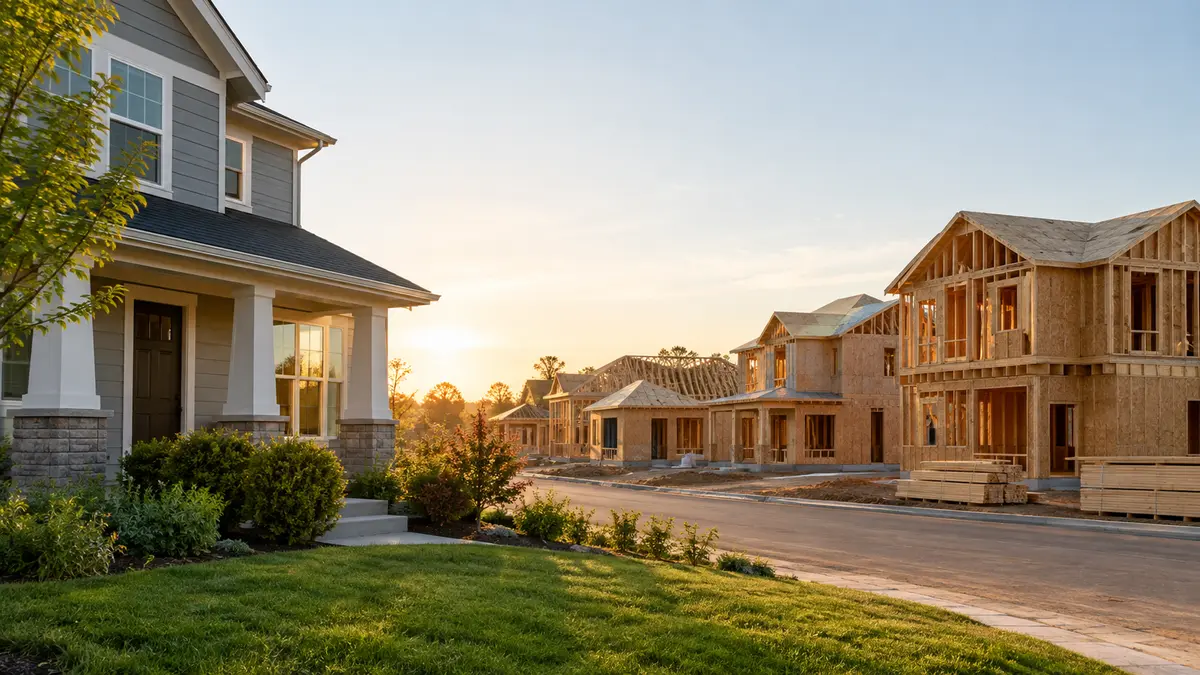
The United States housing market entered 2024 with a paradox at its centre: mortgage rates sat above 7%, affordability was stretched, yet one corner of the market was growing. New single-family home sales ran at an annualized pace of about 693,000 in March, up 8.3% from a year earlier, while sales of previously owned homes fell 3.7% over the same span. The divergence is not a curiosity — it is the visible edge of a structural shift in which locked-in homeowners refuse to sell, builders step in with incentives, and the price gap between new and existing homes narrows to its closest in three decades. This analysis unpacks the mechanisms behind the 2024 rotation toward new construction.
Two markets moving in opposite directions
The spring selling season of 2024 was, by every account in the market data, plagued with low supply, high prices and spiking interest rates. Yet would-be homebuyers did not disappear; they changed lanes. According to the U.S. Census Bureau and the U.S. Department of Housing and Urban Development, about 693,000 new single-family houses were sold in March on an annualized basis, up 8.3% from a year ago, at a median sales price of $430,700. Over the same period, the National Association of Realtors recorded sales of previously owned homes dropping 3.7% from March 2023.
Those two statistics describe one market with two speeds. The existing-home segment — historically the bulk of American housing turnover — was contracting, while the new-build segment expanded. The reason, as economists quoted in the market coverage put it, is opportunity: "There's more opportunity in new construction," said Nicole Bachaud (Nicole Bachaud), a senior economist at Zillow Group (Zillow Group). New homes in 2024 simply had more incentives and better availability than previously owned ones, and buyers responded to the only segment where supply was actually being produced.
The golden handcuff that froze existing supply
The contraction on the resale side traces back to a single mechanism: the mortgage rate lock-in effect. Many areas across the country faced a low inventory of existing homes because the lock-in effect — what Bachaud called the "golden handcuff" — kept existing owners from becoming sellers. With 30-year fixed-rate mortgage rates sitting above 7%, homeowners who had bought at much lower rates in recent years did not like the prospect of trading in their low rate for a higher one.
The arithmetic of the handcuff is straightforward. A household that refinanced or purchased below 3% during the buying boom of 2020-2021 faces a payment shock if it sells and buys again at 7%-plus, even at a similar price. Selling means surrendering an asset — the cheap mortgage itself — that cannot be repurchased at today's terms. The rational response is to stay put, and when millions of households all stay put, listing inventory thins, prices hold, and transactions migrate to the only segment where a buyer can actually find a home: new construction.
The rate roller-coaster behind the freeze

Understanding 2024 requires the rate path that produced it. The average rate on the 30-year fixed mortgage has been on a wild ride since the start of the pandemic era: it hit more than a dozen record lows in 2020 and 2021, below 3%, causing a historic run on homebuying and a sharp rise in prices, only to more than double in 2022. Rates then hit a more than 20-year high in October 2023, hovering around 8%, before falling back below 7% in December — still twice what they were three years earlier.
The early-2024 tape continued that volatility. The average 30-year fixed rate hit a recent low of 6.61% at the end of December and was up slightly to 6.76% in the first days of January, according to Mortgage News Daily (Mortgage News Daily). Where rates went next was, in the framing of the market participants, hostage to the data. "The rate momentum is as good as the trajectory of economic data. So if the data continues to do what it has been doing, there's no reason rates couldn't go down into the 5's, possibly even the high 4's if some of the talking heads are right about recession in 2024," Matthew Graham (Matthew Graham), chief operating officer of Mortgage News Daily, said on CNBC's "The Exchange."
Builders answer with incentives, not resistance
While existing owners sat on cheap mortgages, homebuilders were doing the opposite: competing for the same buyer with money on the table. Builders offered incentives like rate buy-downs and price cuts, and could even pay for closing costs, because they are typically more flexible with pricing than individual resale sellers. "This has been helping incentivize some potential buyers to turn to the new home sales market," said Matthew Walsh (Matthew Walsh), assistant director and economist at Moody's Analytics (Moody's Analytics).
A rate buy-down deserves a word because it is the incentive most precisely aimed at the lock-in problem. Where a resale seller can only cut price, a builder can subsidize the mortgage itself, temporarily or permanently lowering the buyer's rate and therefore the monthly payment — the very variable the golden handcuff punishes. The builder, unlike an individual seller, is a repeat player with inventory to clear and margins to manage across dozens of units; paying a few points on a buyer's loan can be cheaper than holding finished stock.
The narrowing price gap: closest to parity in three decades
The most consequential number of 2024's new-versus-existing contest is the price gap. New builds were still sold for slightly more than existing homes, but the gap had significantly narrowed since the fall. "Prices are much closer to parity than during any point in the last three decades," Walsh said. Over the last six months, the median price for a new home was only about 4% higher than the median price of an existing house — dramatically lower than before the pandemic, when the median new home carried a premium of more than 40% over an existing one.
A 40-plus-percent premium is a structural barrier: new construction serves the top of the demand curve and existing homes serve everyone else. A 4% premium is a rounding error against the incentives on offer. When a builder throws in a rate buy-down or closing costs worth a few points, the effective price of the new home can sit at or below the comparable resale. That is the condition under which price-sensitive buyers — historically confined to the existing-homes market by their budgets — could, in 2024, find more options on the new-home side.
Volume over margin: the builder strategy shift
Walsh's summary of the two supply regimes captures the whole rotation: "On the existing side, you have such a tight supply for sale. But on the new homes side, you have builders prioritizing transaction volumes over margins." Prioritizing volume over margin is a deliberate trade. Builders accept thinner profit per unit in exchange for velocity — closing more units, recycling capital faster and avoiding the carrying cost of finished, unsold inventory.
That strategy only works while demand exists at the offered price, and 2024's incentive arms race was precisely a bid to keep demand in the market despite 7% headline rates. The March sales pace of 693,000 units, up 8.3% year on year, suggests the bid was working in the aggregate even as the resale market shrank. The median price of $430,700 tells the second half of the story: builders were holding prices broadly stable while giving value back through concessions rather than headline cuts, protecting the asset values of the communities they were still selling into.
Early-year signs that buyers had not given up
The rotation to new builds was not the only movement of 2024; the year opened with evidence that rate relief, however modest, pulled buyers back toward the market as a whole. Buyers were coming back, as Washington, D.C.-area real estate agent Paul Legere (Paul Legere) discovered when he hosted two open houses over one early-January weekend — homes in the $1.1 million to $1.2 million price range — and found them the busiest he had experienced in the last year. "Even on Saturday, during torrential rain, we both had over 10 groups of active shoppers. These were people that had been in the market and had slowed or put their search on hold and are coming back, earnestly looking for a new property," he said, adding that he expected an infusion of inventory in the following weeks as the more positive rate outlook encouraged owners to list.
The national data pointed the same way. A report from Redfin (Redfin), the national real estate brokerage, found demand picking up in December as rates fell: its Homebuyer Demand Index — a seasonally adjusted measure of requests for tours and other homebuying services from Redfin agents — rose 10% from a month earlier to its highest level since August. Pending sales, which measure signed contracts on existing homes, were down 3% from December 2022, but that was the smallest decline in two years. Tight inventory had helped keep prices higher, another hurdle for buyers, and the early-2024 question was whether falling rates would unlock listings before they reignited price growth.
The affordability mechanism that decides everything
Prices and rates do not act independently on buyers; they act through the monthly payment. Much would depend on both interest rates and home prices in the months to come: prices continued to rise due to lack of supply, and if rates continued to drop, price gains could accelerate, because the lower the rate, the more potential homebuyers can afford. This is the reflexive loop at the heart of the 2024 market — relief on rates expands the qualified buyer pool, which meets an inventory still frozen by lock-in, which pushes prices up, which partially cancels the relief.
The new-build segment sits half outside that loop, and that is why it grew. Builders can add supply on their own schedule, price to the payment the buyer can afford, and bridge the remaining gap with buy-downs and closing-cost credits. Resale sellers can do none of these things: their supply is fixed by their own mortgage terms, and their pricing flexibility stops at the equity in the house. As long as rates remain far above the coupons locked into existing mortgages, the marginal unit of housing available to an American buyer is built, not resold.
How builders competed for the 2024 buyer
- Rate buy-downs: subsidizing the buyer's mortgage rate to attack the payment problem directly, rather than cutting the sticker price.
- Price cuts: explicit reductions where local supply demanded them, used sparingly to protect community values.
- Closing-cost credits: builders paying for closing costs, reducing the cash a buyer needs at settlement.
- Availability itself: finished and near-finished inventory offered when resale listings were scarce, turning supply into an incentive.
- Volume-over-margin pricing: accepting thinner per-unit profit to keep transactions moving, per Moody's Analytics' reading of the market.
What the 2024 rotation means going forward
The year's data leaves three conclusions that outlast the March sales report. First, the lock-in effect reallocated market share rather than destroying demand: buyers who could not find or afford resale homes bought new ones, and the 8.3% growth in new-home sales alongside a 3.7% decline in resale is the clearest possible picture of that reallocation. Second, the new-versus-existing price gap — 4% versus more than 40% before the pandemic — redefined what "new construction" means for budget-conscious households: for the first time in decades, it became a mainstream option rather than a premium one. Third, the market's direction remained hostage to rates, and rates to data: Graham's range of possibilities, from the high 4%s in a recession to the 5%s on benign numbers, spans outcomes that would either unfreeze resale listings or entrench the builder-led market further.
For the buyers at the centre of all this, the practical lesson of 2024 was to shop both markets and price the incentives, not just the listing. A resale home with a seller who cannot move is not really supply; a new build with a buy-down is cheaper than its sticker. The golden handcuff kept millions of owners in place — and in doing so, it handed the marginal buyer the keys to the builder's sales office.
Just Published

European housing prices and rents

Schneider–PTC: the industrial data integration test behind the deal
Avio USA starts work on its Virginia manufacturing site

One equity market, two currency measures

Russia’s draft budget raises spending and borrowing plans

Russia Sets the 2027 Minimum Wage at 28,935 Rubles, Up 6.8%, on the Way to 35,000 by 2030
Partner news digest
 Qatar LNG expansion: readiness, financing and the production test
 Pennon’s capital plan: turning finance into better water outcomes
 Italy’s diesel relief gap: taxes, price ceilings and implementation
 EU–China hybrid trade: from understanding to measurable implementation
 Schneider–PTC: the industrial data integration test behind the deal
 IKEA’s hybrid resale model: buyback, marketplace liquidity and furniture logistics
 Banking AI beyond the ranking: capability, execution and evidence of value
 Fishing labour beyond the product label: practical protection
 Rhenus and the Middle Corridor: terminals need coordinated connections
 Royal Mail restructuring: the test is reliable delivery
 Fuel Finder on Google Maps: when price transparency becomes useful competition
 Samsung’s memory profit surge: what the preliminary record explains
Leave a comment