
The Building-Materials Squeeze: Four Years of 70% Price Growth and a 5% Developer Margin
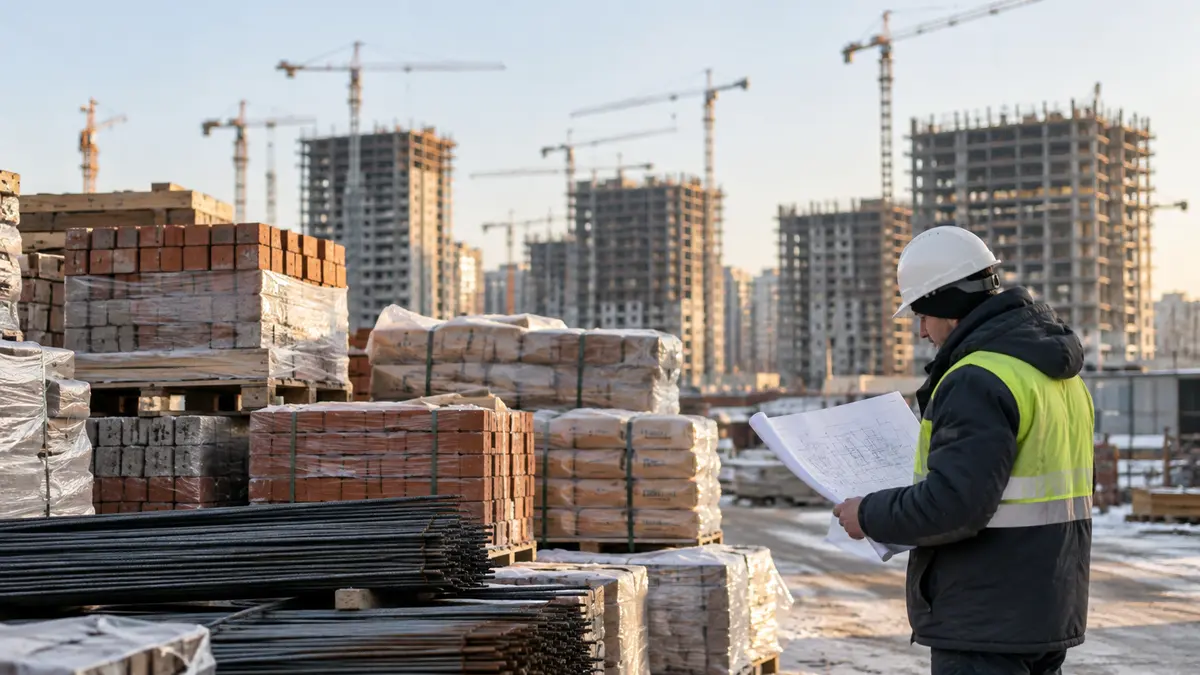
Russia's building-materials market entered the second half of 2024 with a rhythm that market participants have learned to dread: prices that have been climbing for several years added about 15% in the first six months alone, and close to 70% over four years, according to developers and analysts surveyed by Kommersant. Against that backdrop, profitability in some development segments has fallen to about 5%, and the industry is openly discussing mechanisms — from hedging material prices inside project finance to fixing metal prices for social projects — that could keep residential construction economics alive.
A four-year climb that never paused
The scale of the move is best described by those who buy materials every week. Elena Lelikova, procurement director of A101 Group, says building materials have risen about 70% in price over the last four years, and that in the summer of 2024 alone the main positions added up to 15%. The seasonal peak of demand traditionally falls on July and August; in 2024 it was reinforced by two extra forces: the need to restore regions damaged by floods and record demand for land plots for individual housing construction. Both shrink available supply and provoke price growth, she explains.
The composition of the four-year increase matters as much as its size. Since 2020, according to Lelikova, gas blocks have almost doubled in price, thermal insulation has become two and a half times more expensive, rebar and waterproofing have added about 50%, and concrete about 44%. These are not niche positions: they are the skeleton, the envelope and the structure of a residential building. When such items move together, the estimate of an entire project moves with them.
Evelina Ishmetova, co-founder of the Developers.RF programme, puts the construction-cost effect at 7-10% on average, depending on the type of construction and the materials used, with the largest contribution from rolled metal and concrete — the two components present in almost every project. In Moscow, she notes, the cost of realising projects often outruns the increase in material prices, which shows up in property prices; in multi-apartment construction this is less noticeable than in the private sector, where the estimate reacts almost immediately.
What the official statistics show
The official picture confirms the direction but not the magnitude of the market's own estimates. According to Ishmetova, the Ministry of Construction of Russia recorded an increase in the estimated cost of construction of 6-8% in the first quarter and 5-7% in the second quarter of 2024. Rosstat registered a 17.5% year-on-year rise for some materials. Expert assessments of annual price growth range from 5-10% to 30-50%, which she reads as evidence of a highly volatile market rather than of disagreement about the trend.
The ministry's own list of fastest-growing positions is narrow and telling: the largest increases, in the 9-12% range, were recorded for rolled metal, cement and concrete, and insulation materials. The drivers named are logistics, energy and demand — the same three forces that producers cite when explaining their own price lists.
The 2023 echo recorded by NOSTROY
The National Association of Builders, NOSTROY, had already flagged the previous year's spike: in 2023 it recorded price growth of more than 30% for bricks, ceramic tiles, wallpaper, paints and varnishes, thermal insulation, rebar steel, glued laminated timber, construction sealants and silicones. The 2024 story is therefore not a new shock but a second wave on top of a base that had already been re-priced once.
Cement and insulation: increases announced in advance

Ekaterina Kosareva, managing partner of VMT Consult, describes the mechanics of the average 15% increase across main positions and stresses seasonality: prices for building materials traditionally rise in summer, while the year-end increment is smaller. Mineral wool added about 10% in 2024, and the increase was not a surprise — producers had announced it at the end of 2023.
Cement, one of the basic materials of construction, keeps getting more expensive on a rising base. In 2023, according to developers, prices rose 35-40%; in the first half of 2024 the increase was 15-20%, with a prospect of up to 30% by the end of the year. Beyond the seasonal factor, cement producers point to growing costs of their own: the need to raise salaries, more expensive electricity and other utility payments, higher carrier tariffs and the key rate. A visible trend on the supply side is the elimination of intermediaries: producers increasingly work with developers directly to cut costs.
Metal, ceramics and the furnished flat
Metal behaves paradoxically. The cost of metals on the London exchange sits at the level of summer 2021, Kosareva notes, yet rebar prices keep rising — by 10-15% — because of complicated logistics chains and other cost components: expensive transportation, high energy intensity and labour intensity of the materials. Seasonality applies here too: growth in the high season, a modest decline towards the year end.
Finishing materials are rising fast mainly because of supply difficulties: porcelain stoneware, for example, added 18%. Furniture and appliances are also getting more expensive, but developers do not plan to abandon furnished offers — furnished flats remain in demand, and the cost is passed into the product.
The developer ledger: from 5% to 30% depending on the counterparty
Official statistics differ from what builders meet on site. Alexander Kravtsov, managing partner of Fizika Development, says prices grew in the first half of 2024 across all positions — cement, sand, crushed stone, concrete, all metal groups, thermal insulation, facade elements and engineering systems — with an average increase of 8-12% across Russia depending on segment, plus a rise in logistics costs.
Igor Kartsev, chief executive of Maximum Life Development, calculated an average increase of 5-30% for the first half of the year, with the highest growth in wood, rebar, metal and concrete, while insulation and other components rose less. Natalia Korotaevskaya, commercial director of Akvilon Group in St. Petersburg and the Leningrad region, agrees with the range: 10-30% across positions, with the most serious increase in general construction works, driven above all by a deficit of labour, especially monolithic concrete workers. These specialists are in demand in every region with active construction, including the restoration of new territories, and their labour has become markedly more expensive; materials for engineering systems and the rental and maintenance of special machinery are also rising.
Anzhelika Alshaeva, chief executive of the KVS real estate agency, offers the more moderate end of the range: positions have added 5-15% since the start of the year, slower than one or two years ago. Cement and, consequently, concrete, and rebar keep rising, but the total deficit that accompanied earlier price waves is absent. Her company contracts all necessary materials in full at the beginning of the year, so for now the increase is not critical, she says.
Labour: the cost that hides inside subcontract prices
Part of what looks like a materials story is in fact a labour story. Vitaly Korobov, chief executive of Element, says the pressure on construction cost comes from rising prices for subcontract works against a personnel deficit on the market: by the beginning of July, subcontract prices were up 10-25% compared with the same period of 2023. Korotaevskaya's account of monolithic workers describes the same mechanism from the site side.
Why margins collapsed from 20% to 5%
The cumulative effect is visible in the margin. Kosareva formulates the industry's problem bluntly: it is impossible to buy building materials in advance even within a single project, including because of compliance requirements in the escrow-account legislation; free funds for such purchases simply may not exist. As a result, the margin of construction as a business has fallen from 15-20% in 2020 to about 5%.
Lelikova describes the same trap from the financing side. While preferential mortgage programmes were running, developers could take additional financial load onto themselves; now they cannot. At the same time, developers cannot stockpile materials: that is possible only through prepayment of future supplies, and project-finance limits are not enough to reserve the necessary pool of materials for the entire construction period — whether of one residential building or a whole district. Her conclusion is a proposal rather than a complaint: banks should offer developers the possibility of hedging the cost of building materials together with escrow loans.
The import tail that still sets prices
Despite significant localisation of production, some building materials still carry a high import share, Ishmetova notes, both in finished products and in raw materials for their production. The first group includes premium-class finishing materials, sanitary ware and equipment, and electrical equipment; the second includes mineral insulation and equipment for producing construction chemicals and dry mixes.
Kravtsov adds that the share of imported components remains large among finishing materials, and their cost rises proportionally to the exchange rate of foreign currencies and delivery prices. He expects price growth to continue in the near term because of high inflation, ruble volatility, energy prices, the labour deficit and other factors that affect pricing at every stage of the chain from producer to developer.
Not everything rises, however. Rubber and plastic products have increased in price the least, which market participants connect with the presence of Russian plants capable of producing these goods and with supplies from China. European building goods, by contrast, continue to get more expensive.
Where the pressure stops: housing prices and the demand brake
The transmission of material inflation into flat prices has so far been limited. Lelikova notes that over the last year the increase in final housing prices was only 9% in St. Petersburg and 2.7% in the Leningrad region, and she sees no grounds for growth in the near future: the winding down of preferential mortgage programmes has seriously cooled demand.
That is the asymmetry of 2024. Costs keep rising on the supply side, while the demand side has lost its main accelerator. Developers are left with internal optimisation: Frunze Aleksanyan, head of audit and cost engineering at Nikoliers, says price increases for building materials noticeably affect construction cost, raising project values and reducing margins, and that developers adapt by optimising and automating processes and searching for new supply chains to cut costs.
What the industry wants from banks and regulators
The wish list that emerges from the market is concrete. Lelikova argues that the market and regulators should develop mechanisms guaranteeing the stability of building-material prices, and that this is especially significant for social facilities, which developers build within credit lines for residential buildings at a tangible credit rate and then transfer to the municipal balance. Modern school buildings, which are erected faster and better meet contemporary educational tasks, are increasingly built with active use of metal structures; since the cost of metal is highly volatile, she considers it reasonable to fix its price for two to three years forward from the moment a social project's design begins and the chosen solutions are estimated.
The hedging idea and the price-fixing idea share one logic: in a market where materials cannot be stockpiled and margins have no buffer, the only remaining defence is to move price risk out of the construction period and into contracts signed before it starts.
The pressure factors of 2024
- Labour deficit, especially monolithic concrete workers, pushing up general construction works and subcontract prices.
- Logistics: complicated chains and expensive transportation adding to metal and imported finishing materials.
- Energy and utilities: electricity and tariff growth feeding into cement and energy-intensive products.
- The key rate: financing costs embedded in producers' and developers' prices alike.
- Seasonality: the July-August peak amplified in 2024 by flood-region restoration and record demand for individual housing land.
- Import dependence in premium finishes, sanitary and electrical equipment, mineral insulation and equipment for construction chemicals and dry mixes.
- Escrow and project-finance rules that prevent stockpiling materials in advance.
Three channels through which material inflation reaches the estimate
Between a producer's price list and a developer's estimate, the 2024 increase moves through three channels. The first is direct material cost: cement, metal, concrete and insulation enter the estimate at market prices, and the ministry's 9-12% range together with the developers' 8-12% range describe precisely this channel. The second is labour and subcontract: monolithic workers, engineering teams and special machinery enter through subcontract prices, which Element measured at 10-25% higher by early July than a year earlier. The third is logistics and import: freight, exchange rates and delivery prices enter through imported finishing materials, sanitary ware and electrical equipment. Each channel has its own driver — seasonality and energy in the first, demographics and the restoration of new territories in the second, currency in the third — which is why no single headline number ever describes the whole squeeze, and why expert estimates spread from 5-10% to 30-50%.
The contract calendar as the only available hedge
With stockpiling blocked by escrow rules and project-finance limits, the only price defence left inside a developer's own control is the contract calendar. The KVS practice of contracting all necessary materials in full at the beginning of the year converts spot exposure into a fixed basket before the summer peak; the company's 5-15% figure is, in effect, the cost of the positions that reprice annually or were not contracted early enough. A101's proposal pushes the same logic one step outside the company: if banks hedge material prices alongside escrow loans, the contract calendar stops being a private discipline of the strongest buyers and becomes a financed instrument available to the whole market. Until then, the calendar is the margin — and the margin, at about 5%, has no room left for a missed signing date.
Outlook: acceleration rather than stabilisation
The experts surveyed expect growth to accelerate in the near term rather than stabilise, and the structure of the market offers few relief valves. Producers cannot quickly satisfy growing demand — the materials market is common to all developers — and the demand side, cooled by mortgage reform, cannot absorb further price increases without squeezing the estimate. What remains is contract discipline at the start of the year, direct work with producers, substitution of the least critical positions and the hope that hedging and price-fixing mechanisms move from discussion into banking practice.
Until then, the arithmetic of 2024 stands: about 15% in half a year, about 70% in four years, and a margin of roughly 5% between them. The building-materials squeeze is not a price story alone; it is a test of whether Russian development can keep building at all when its cost base moves faster than its revenue.
Just Published

European housing prices and rents

Schneider–PTC: the industrial data integration test behind the deal
Avio USA starts work on its Virginia manufacturing site

One equity market, two currency measures

Russia’s draft budget raises spending and borrowing plans

Russia Sets the 2027 Minimum Wage at 28,935 Rubles, Up 6.8%, on the Way to 35,000 by 2030
Partner news digest
 Qatar LNG expansion: readiness, financing and the production test
 Pennon’s capital plan: turning finance into better water outcomes
 Italy’s diesel relief gap: taxes, price ceilings and implementation
 EU–China hybrid trade: from understanding to measurable implementation
 Schneider–PTC: the industrial data integration test behind the deal
 IKEA’s hybrid resale model: buyback, marketplace liquidity and furniture logistics
 Banking AI beyond the ranking: capability, execution and evidence of value
 Fishing labour beyond the product label: practical protection
 Rhenus and the Middle Corridor: terminals need coordinated connections
 Royal Mail restructuring: the test is reliable delivery
 Fuel Finder on Google Maps: when price transparency becomes useful competition
 Samsung’s memory profit surge: what the preliminary record explains
Leave a comment