
Russia's Grocery Retail Loses Speed: What the 2023 Top-10 Numbers Reveal About 2024
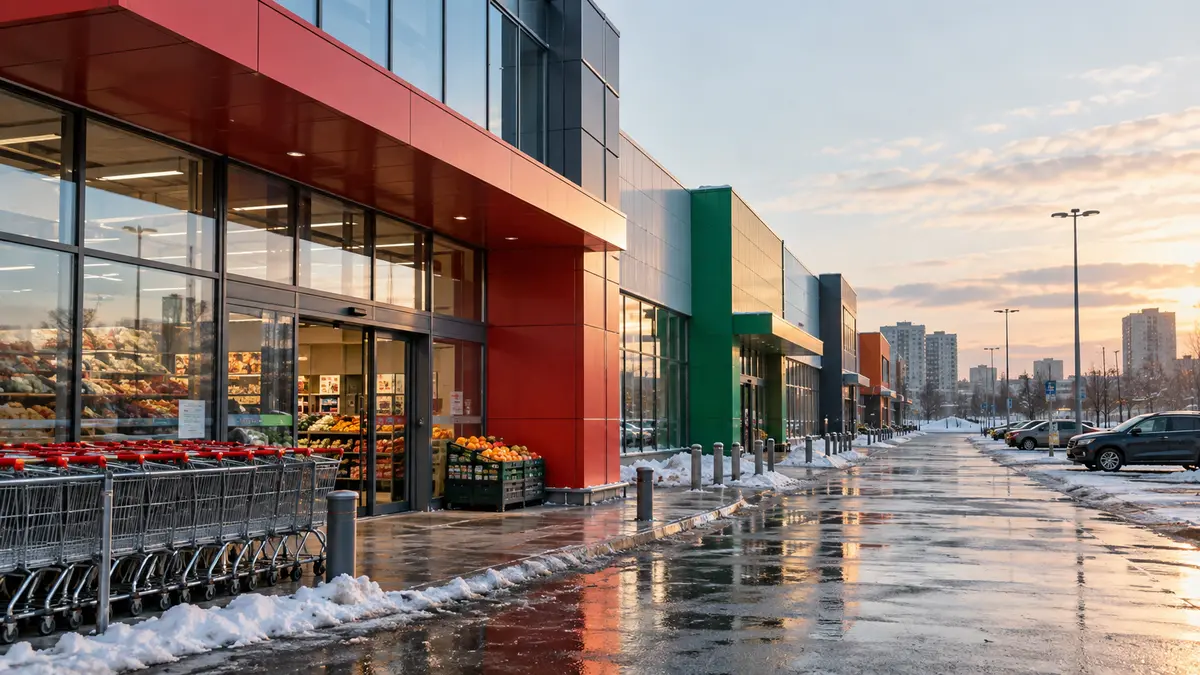
Russia's ten largest food and fast-moving consumer goods chains finished 2023 with revenue growth of 14.1% to 9.1 trillion rubles excluding VAT, according to Infoline. In absolute terms the number is enormous; in relative terms it marks a clear deceleration, because a year earlier the same top ten had added 21.3%. The gap of 7.2 percentage points is the cleanest single measure of how quickly the post-crisis retail boom of 2022-2023 turned into a market of managed growth. Behind the aggregate figure sits a rotation rather than a uniform slowdown: one top-five player accelerated, three lost momentum, hypermarkets kept shrinking, and the strategies the chains announced for 2024 diverge sharply.
A top line that grew, but grew slower
The Infoline estimate covers the ten largest chains of food and everyday-goods retail in Russia. Their combined revenue reached 9.1 trillion rubles excluding VAT in 2023, up 14.1% year on year. The comparison with 2022 is the point: growth then was 21.3%, so the sector shed 7.2 percentage points of momentum in a single year. A market that expands by more than a fifth one year and by roughly a seventh the next is not a market in crisis, but it is no longer a market where revenue growth can be taken for granted. Every strategic decision announced by the leaders in early 2024 reads as a response to that change of regime.
The deceleration was not evenly distributed. Among the top five players, Infoline identifies a slowdown at Magnit, at Mercury Retail Group, the owner of the Krasnoe & Beloe and Bristol chains, and at the hard discounter Svetofor. The pattern matters because those three represent three different growth machines: a classic multi-format grocer, an alcohol-and-convenience specialist, and a no-frills discounter. When all three slow at once while the market leader accelerates, the explanation is structural rather than company-specific.
The inflation engine behind the slowdown
Mikhail Burmistrov (Mikhail Burmistrov), chief executive of Infoline-Analitika, ties the common deceleration to a single macro variable: the average annual inflation rate fell from 11.94% in 2022 to 7.42% in 2023. Grocery revenue in a high-inflation year is partly a price phenomenon; baskets grow in rubles even when they shrink in units. As inflation halves, that nominal tailwind weakens, and the chains that had grown mostly with prices feel the loss first. The mechanism also explains why the slowdown appeared despite healthy footfall: the same shopper buying the same goods simply produces fewer rubles of revenue growth.
The flip side of the inflation argument is that real consumption did not collapse. The top ten still added more than a trillion rubles of revenue in a year, and the leaders that invested in price perception, formats and logistics kept double-digit growth. The 2023 ranking is therefore best read as a redistribution of growth inside a still-expanding market, not as the beginning of a contraction.
The leaderboard: one accelerator, three brakes

The company-level numbers show how differently the same macro year landed. X5 Group, the operator of Pyaterochka, Perekrestok and Chizhik, grew revenue by 20.6% to 3.13 trillion rubles, against 18.3% in 2022: the only top-five player that accelerated. Magnit added 9% to reach 2.5 trillion rubles after 26.7% growth a year earlier. Mercury Retail Group grew 20.4% to 1.15 trillion rubles after 31.9%. Svetofor added 8% to 399.5 billion rubles after 40.2%. Magnit declined to comment and had not yet disclosed official full-year results at the time; Krasnoe & Beloe, Bristol and Svetofor did not respond to the newspaper.
Lenta occupies a separate line in the story: Infoline notes that the acquisition of the Monetka chain accelerated Lenta's revenue growth by 3.5 percentage points to 14.6%, lifting the company to 615.8 billion rubles. The Lenta case is the clearest illustration of the new regime: inorganic expansion, not price inflation, is now the reliable source of extra growth points.
X5: the only top-five accelerator
X5's acceleration from 18.3% to 20.6% looks modest next to the decelerations around it, but it is the strategic signal of the year. The group achieved it while shifting assortment toward the low-price segment, expanding the Chizhik hard-discount banner and keeping Pyaterochka's growth rates high. In other words, X5 converted the inflation slowdown into share gains by competing harder on price exactly when price competition became decisive.
Magnit and the like-for-like question
Magnit's 9% full-year growth after 26.7% is the sharpest brake in the top five, and the quarterly detail explains its nature. BCS Mir Investitsiy attributed Magnit's third-quarter result to a moderate increase in selling space and comparable sales: total revenue for the period rose 5.7% to 628.5 billion rubles, while like-for-like sales growth slowed to 3.1% from 4.7% in the second quarter. A retailer whose like-for-like engine cools to low single digits must buy or build its growth elsewhere, and that is precisely the strategic fork the 2023 numbers expose.
The discounter war turns inward
Svetofor's collapse from 40.2% growth to 8% is the most dramatic single-line change in the ranking, and Infoline attributes it to rising competition from Chizhik, Pobeda and Nakhodka. The hard-discount segment spent 2022-2023 expanding into a vacuum left by exiting Western players and by consumers trading down. By 2023 the vacuum was filled: discounters now compete with each other for the same price-sensitive shopper, and the weakest price proposition loses traffic first. The segment did not shrink; its growth simply stopped being free.
For the market as a whole this is a warning about the limits of the trade-down thesis. Discounting remains the fastest-growing format in Russian grocery, but from 2024 onward its growth has to be taken from rivals with equally sharp pencils, which converts format expansion into a margin war.
The hypermarket problem
The most troubled format, in Burmistrov's assessment, is the hypermarket: big-box stores face a sustained outflow of shoppers to other formats and to marketplaces. The numbers confirm the diagnosis. Auchan's Russian revenue fell 3.9% in 2023 to 276.7 billion rubles, and in the fourth quarter its turnover of 76.9 billion rubles was lower than VkusVill's 77.9 billion rubles for the same period. Over the full year VkusVill grew 26.9% to 259.8 billion rubles, surpassing Metro's 226.7 billion. Auchan and Metro did not respond to the newspaper.
The symbolic crossing - a delivery-first fresh retailer outselling a hypermarket giant in a quarter - captures the direction of traffic. Large-format grocery loses on two fronts at once: convenience formats take the weekly top-up trip, and marketplaces take the planned bulk purchase of non-food goods. What remains in the hypermarket trolley is the part of consumption that neither quick delivery nor a dark store serves well, and that residual shrinks every year.
What the VkusVill crossing means
The VkusVill comparison deserves a second look because it inverts the usual hierarchy of Russian grocery. A chain built on fresh categories, own labels and delivery - historically the most expensive operating model per order - now outsells a hypermarket incumbent on a quarterly turnover basis. The mechanism is not that VkusVill became cheap; it is that its assortment matches the frequency of modern shopping: small baskets, often, delivered. The hypermarket's assortment matches a shopping ritual - the big weekly or monthly trip - that is precisely the behaviour losing share to marketplaces and proximity stores. Format destiny, in other words, follows basket frequency, and the frequency has moved away from the big box.
Three playbooks for 2024
The strategies the chains stated for 2024 fall into three distinct playbooks, and each one is a bet on a different source of growth in a slower market:
- VkusVill: scale the proximity-and-delivery model. The company says it increased new store openings fivefold in 2023 to 530 points and raised the online share of sales above 50%, and in 2024 it intends to keep developing delivery, opening stores and expanding the assortment.
- Lenta: grow through acquired formats. The stated strategy combines Monetka proximity stores and Super Lenta supermarkets with the development of online services, converting the 2023 acquisition into a multi-format platform.
- X5: win on price and consolidation. The group reported that it will continue the active development of Chizhik, keep Pyaterochka's growth rates high while shifting assortment toward the low-price segment, and consider M&A deals and partnerships.
None of the three playbooks relies on inflation. All three rely on taking share - from formats, from rivals, or from offline altogether - which is what a post-boom market looks like from the inside.
What analysts expect in 2024
The forward views quoted around the ranking split along a familiar line between volume optimists and price realists. Burmistrov expects the top ten's growth to accelerate again in 2024, driven by the effect of M&A deals, the development of online sales and the expansion of discounters. Marat Ibragimov (Marat Ibragimov), senior analyst at Gazprombank, counters that average check and retail revenue will remain under pressure in 2024 because food inflation is expected to slow further toward the second half of the year; for now, he argues, the chains grow through organic expansion and the absorption of smaller competitors.
Renaissance Capital adds the margin dimension: retailers will keep investing in prices, while labour shortages and competition for employees will put additional pressure on profitability. Put together, the three views describe a market where revenue growth is purchasable - through price investment, acquisitions and format expansion - but where every purchased point of growth costs margin.
Reading the slowdown: nominal growth, real rotation
The analytical core of the 2023 ranking is the separation of three growth sources that the boom years had fused together. The first is price: with average inflation at 7.42% instead of 11.94%, the nominal contribution to revenue growth shrank mechanically. The second is traffic and like-for-like: Magnit's deceleration from 4.7% to 3.1% quarterly like-for-like growth shows how thin this layer has become for mature banners. The third is perimeter: acquisitions, new formats and new regions, the layer that lifted Lenta by 3.5 points and X5 by its Chizhik expansion.
Once the layers are separated, the strategic logic of 2024 follows. Price growth is exogenous and fading. Like-for-like growth is defendable only through aggressive price perception, which is why X5 and the discounters invest there. Perimeter growth is the only layer management fully controls, which is why M&A moves from opportunistic to structural. A chain that enters 2024 without a perimeter story - an acquisition pipeline, a new format, or an online business scaling from a low base - is left defending like-for-like traffic against rivals who are buying growth outright.
The M&A pipeline as the new growth currency
If inflation supplied the growth of 2022 and price perception supplies the growth of the moment, the 2023 ranking suggests that acquisitions supply the growth of 2024. The evidence sits in the deltas: Lenta's 3.5 percentage points of acceleration came from Monetka, and Burmistrov explicitly expects the top ten to accelerate in 2024 partly because of the effect of M&A deals. Ibragimov's formulation - chains grow through organic expansion and the absorption of smaller competitors - describes a market where the consolidation wave has only begun: regional chains with ageing formats and no capital for price wars are the natural inventory of targets for the three groups that still have balance-sheet capacity.
That logic also disciplines the buyers. An acquisition adds revenue points immediately but integrates systems, stores and people over years, in a market where Renaissance Capital warns that labour shortages and competition for employees already pressure profitability. The chains that treat M&A as a growth currency will have to price not only the target's turnover but the scarcity of the staff needed to run it.
Labour: the hidden tax on expansion
The least visible constraint in the 2023 numbers is the most persistent one. Renaissance Capital's sector review notes that retailers will continue investing in prices while labour shortages and competition for employees add pressure on profitability. For a sector whose growth strategies - more stores, more delivery, more discount banners - are all labour-intensive at the margin, wage competition acts as a hidden tax on every expansion plan. It is also regressive across formats: a hard discounter running skeletal crews feels a wage increase per store more acutely than a supermarket spreading the same payroll over higher revenue per square metre.
This is why the margin question dominates the 2024 debate even more than the revenue question. Growth is available - through price, perimeter and online - but each channel consumes the same scarce inputs: people, trucks and square metres. The ranking of 2023 measures who grew; the ranking of 2024 will measure who grew without spending the entire margin on it.
The strategic conclusion
The 14.1% of 2023 is not a disappointment; it is a regime change with a number attached. The top ten still grow faster than almost any other sector of the Russian economy, but the composition of that growth has shifted from inflation and recovery toward share capture and consolidation. The winners of the next cycle will be the chains that convert price investment into durable traffic, that keep a live pipeline of acquisitions and formats, and that manage the margin cost of doing both. The losers will not necessarily shrink; in a market where the top ten add a trillion rubles a year, losing simply looks like growing at 8% while your neighbour grows at 20% - exactly the distance that separated Svetofor from X5 in the ranking of 2023.
Just Published

European housing prices and rents

Schneider–PTC: the industrial data integration test behind the deal
Avio USA starts work on its Virginia manufacturing site

One equity market, two currency measures

Russia’s draft budget raises spending and borrowing plans

Russia Sets the 2027 Minimum Wage at 28,935 Rubles, Up 6.8%, on the Way to 35,000 by 2030
Partner news digest
 Qatar LNG expansion: readiness, financing and the production test
 Pennon’s capital plan: turning finance into better water outcomes
 Italy’s diesel relief gap: taxes, price ceilings and implementation
 EU–China hybrid trade: from understanding to measurable implementation
 Schneider–PTC: the industrial data integration test behind the deal
 IKEA’s hybrid resale model: buyback, marketplace liquidity and furniture logistics
 Banking AI beyond the ranking: capability, execution and evidence of value
 Fishing labour beyond the product label: practical protection
 Rhenus and the Middle Corridor: terminals need coordinated connections
 Royal Mail restructuring: the test is reliable delivery
 Fuel Finder on Google Maps: when price transparency becomes useful competition
 Samsung’s memory profit surge: what the preliminary record explains
Leave a comment