
LNG Canada Ships First Export Cargo From Kitimat, Opening Canada's Pacific LNG Route to Asia
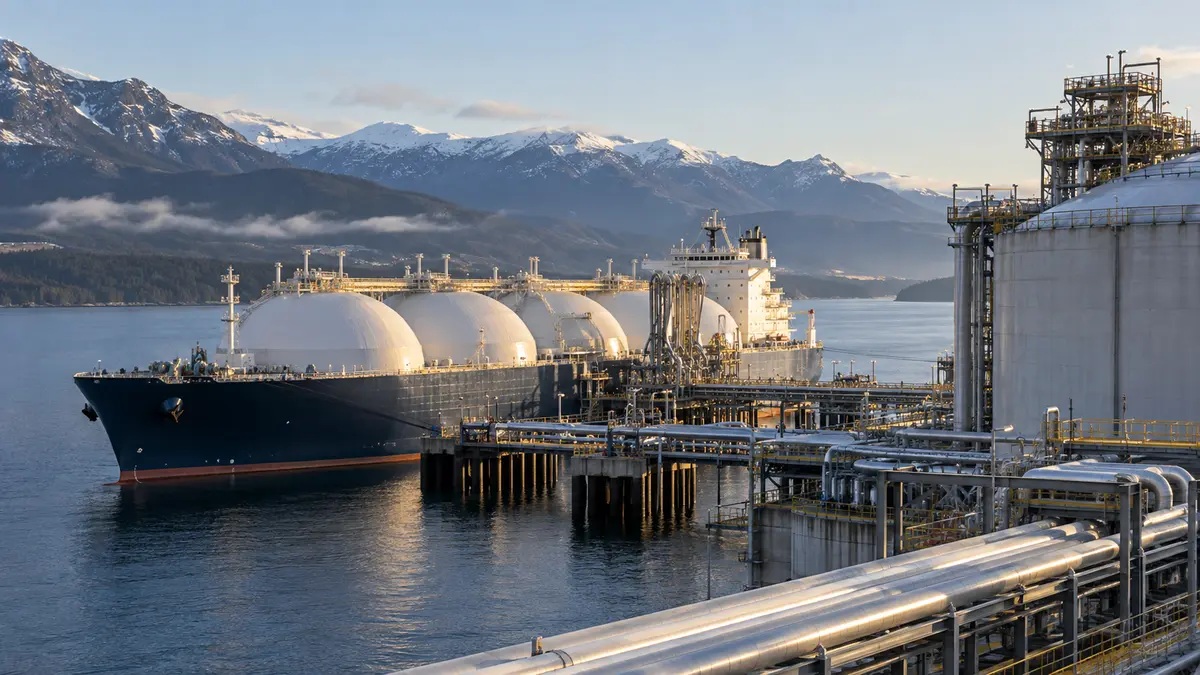
Summary: LNG Canada, the Shell-led joint venture on British Columbia's Pacific coast, shipped Canada's first-ever LNG export cargo on June 30-July 1, 2025, loading the tanker Gaslog Glasgow at Kitimat about a week after confirming first production at the roughly CDN$40 billion terminal, the company's spokesperson told Reuters.
The first cargo
Canada's first-ever LNG export cargo has been shipped from the country's Pacific coast en route to Asia, a spokesperson for the Shell-led LNG Canada said on Monday, July 1, 2025. The cargo was loaded onto the tanker Gaslog Glasgow from LNG Canada's site in Kitimat, British Columbia, just over a week after the facility confirmed first production and became the first large-scale commercial LNG operation in the country.
LNG Canada is the first major LNG facility in North America with direct access to the Pacific coast. It starts at a time when trade tensions with the United States have heightened Canada's desire to diversify its export markets. "This is something Canada really needs right now," LNG Canada CEO Chris Cooper said in an interview, pointing to those trade tensions.
The project and its owners
The LNG Canada project is a joint venture between Shell Plc, Petronas, PetroChina, Mitsubishi Corp and Kogas. It cost approximately CDN$40 billion (US$29.4 billion) to construct and has been billed as the largest private-sector investment in Canadian history. When fully ramped up, the facility will have the capacity to export 14 million metric tonnes of LNG per year.
- Joint venture: Shell Plc, Petronas, PetroChina, Mitsubishi Corp, Kogas.
- Construction cost: about CDN$40 billion (US$29.4 billion), the largest private-sector investment in Canadian history.
- Full-ramp export capacity: 14 million metric tonnes of LNG per year.
- First cargo: tanker Gaslog Glasgow, loaded at Kitimat, British Columbia, en route to Asia.
- Feedgas route: shale fields of northeast British Columbia via the Coastal Gaslink pipeline.
The market logic of the Pacific route
Canada is the world's fifth-largest producer and fourth-largest exporter of natural gas, but until now virtually all of those exports have gone to the United States. LNG Canada offers the country's natural gas producers access to energy-hungry Asian markets for the first time. Its Pacific coast location offers a direct shipping route to Asia without needing to transit the Panama Canal, something project partners hope will give Canadian LNG an advantage against U.S. competitors whose facilities are located on the other side of the continent along the Gulf coast.
The venture also holds a supply cost advantage: prices for Canadian natural gas, shipped to the plant from the shale fields of northeast British Columbia via the Coastal Gaslink pipeline, currently trade at less than half the price of the U.S. Henry Hub benchmark. "West coast LNG in Canada competes exceptionally well against anything being developed in the United States," Petronas Canada CEO Mark Fitzgerald said at a conference in Calgary in June.
Expansion plans and the competitive field
Shell and its partners are working towards reaching a final investment decision next year for doubling the project's capacity, the chief of Shell's gas business Cedric Cremers told Reuters. The startup of LNG Canada, first proposed in 2012, comes almost ten years after the United States began exporting LNG from the lower 48 states; the United States has since become the world's largest LNG exporter, leaving many in Canada's energy sector to say their country has been too slow to develop its own industry. Two smaller Pacific coast facilities, the Cedar LNG and Woodfibre LNG projects, are currently under construction, and LNG Canada itself is considering a second-phase expansion that would double the facility's capacity.
Costs of the northern coast
The advantages come with offsets. Constructing new Canadian LNG facilities and pipelines along British Columbia's remote northern coast is more challenging and expensive than along the U.S. Gulf, where infrastructure to serve the LNG sector is already developed, said RJ Johnston, incoming director of energy and natural resource policy at the University of Calgary's School of Public Policy. Ed Kallio, executive advisor for data analytics and forecasting firm Incorrys, added that the business case for expanding Canada's LNG production is weakened by greenhouse gas regulations that U.S. producers do not face: "The major risk for future LNG development in Canada is the price risk for (clean) electricity to power these processes," he said.
Company information
LNG Canada is a liquefied natural gas export joint venture led by Shell Plc with Petronas, PetroChina, Mitsubishi Corp and Kogas, operating the Kitimat terminal in British Columbia, Canada. Corporate website: https://www.lngcanada.ca/.
Contact
LNG Canada, Kitimat, British Columbia, Canada. Media and stakeholder enquiries are handled through the corporate website https://www.lngcanada.ca/.
Just Published

European housing prices and rents

Schneider–PTC: the industrial data integration test behind the deal
Avio USA starts work on its Virginia manufacturing site

One equity market, two currency measures

Russia’s draft budget raises spending and borrowing plans

Russia Sets the 2027 Minimum Wage at 28,935 Rubles, Up 6.8%, on the Way to 35,000 by 2030
Partner news digest
 Qatar LNG expansion: readiness, financing and the production test
 Pennon’s capital plan: turning finance into better water outcomes
 Italy’s diesel relief gap: taxes, price ceilings and implementation
 EU–China hybrid trade: from understanding to measurable implementation
 Schneider–PTC: the industrial data integration test behind the deal
 IKEA’s hybrid resale model: buyback, marketplace liquidity and furniture logistics
 Banking AI beyond the ranking: capability, execution and evidence of value
 Fishing labour beyond the product label: practical protection
 Rhenus and the Middle Corridor: terminals need coordinated connections
 Royal Mail restructuring: the test is reliable delivery
 Fuel Finder on Google Maps: when price transparency becomes useful competition
 Samsung’s memory profit surge: what the preliminary record explains
Leave a comment