
United Grain Company: Intervention Fund, NKHP Modernization and a Bulker Fleet on the 2030 Horizon
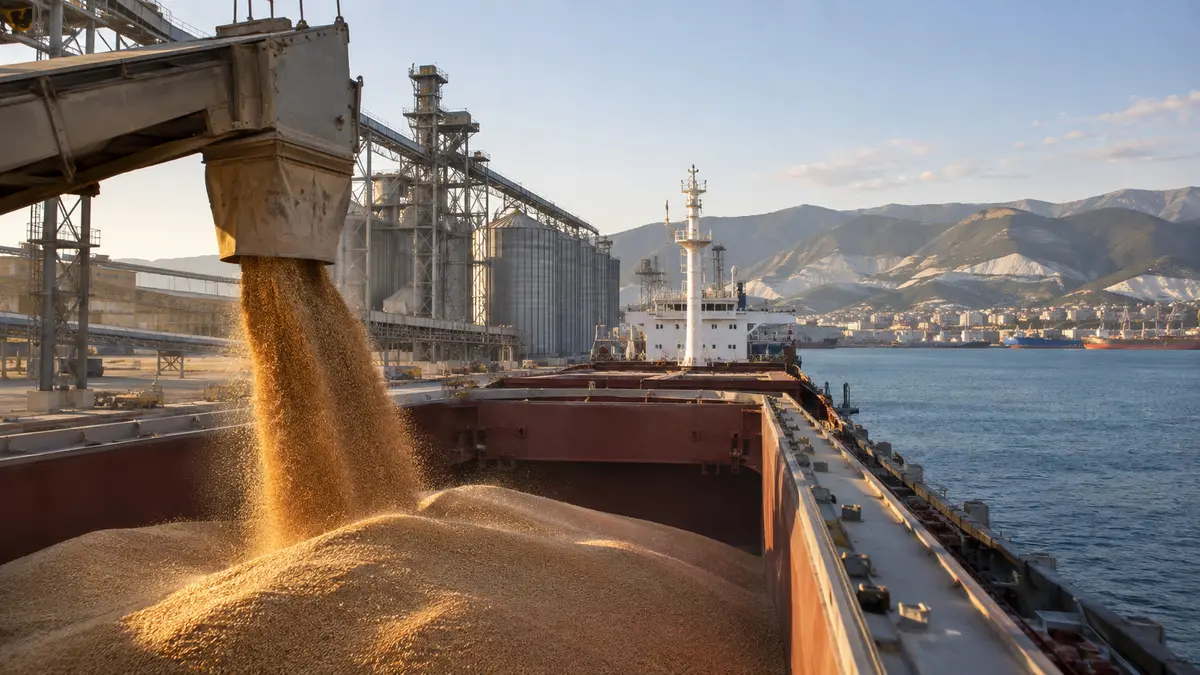
Summary: United Grain Company (OZK), the only state-participated infrastructure company on Russia's agricultural market, outlined in an April 27, 2024 interview with Interfax how it combines its role as state agent of the federal grain intervention fund with a growing export business: more than 3.6 million tonnes of grain in the fund, over 12 billion roubles already invested into the modernization of its Novorossiysk terminal NKHP, a planned own bulker fleet of about 19 vessels by 2030, and group exports of around 3 million tonnes in the current season.
The company and its mandate
OZK (Obiedinionnaya Zernovaya Kompaniya, United Grain Company) was created 15 years ago and has become a large trading and logistics operator of agricultural products and one of the leading exporters of Russian grain, CEO Dmitry Sergeev (Dmitry Sergeev) told Interfax. The group's key transshipment asset is the Novorossiysk Combine of Bread Products (NKHP), the largest port grain terminal in the Azov-Black Sea basin, complemented by several elevators, processing enterprises and a significant fleet of grain-carrying rail wagons.
As state agent of the intervention fund, OZK stores the fund's grain at 152 enterprises in 22 regions, which provides work for more than 11,000 people, Sergeev said. The 2022 purchase stage took more than 3 million tonnes of grain into the fund for over 46 billion roubles against a record harvest of almost 158 million tonnes; the stage launched after the 2023 harvest of 147 million tonnes was funded for purchases of up to 2 million tonnes, and since December 2023 more than 1 million tonnes for over 14 billion roubles had been acquired, per National Commodity Exchange (NTB) data. In total the fund holds more than 3.6 million tonnes.
Interventions and the exchange in numbers
- Commodity interventions of 2020-2022 sold 1.8 million tonnes of fund grain for 21 billion roubles, stabilizing grain and end-product prices.
- OZK's wheat auctions on the NTB, launched in 2021, underpinned the wheat exchange index on CPT Novorossiysk terms (2022) and a cash-settled futures contract (August 2022); futures turnover reached about 243,600 tonnes worth over 3.7 billion roubles, with more than 30 brokers and over 5,700 active participants.
- Total NTB commodity auction turnover grew from 11.4 billion roubles at end-2021 to 60 billion roubles in 2023, with 58 auction customers across the food market.
- Since August 2021 OZK bought more than 2.7 million tonnes of wheat for around 42 billion roubles on exchange; total exchange purchases reached about 3.2 million tonnes for 47.5 billion roubles, almost 90% of them by OZK.
NKHP modernization and the route to 11.6 million tonnes
More than 12 billion roubles had been invested into the NKHP modernization by end-2023, and the terminal set its own record of almost 8 million tonnes of grain transshipped for export last year, Sergeev said. Truck intake capacity was raised to 1,000 vehicles per day, up to 6.6 million tonnes a year; internal rail tracks were reconstructed and connected to the Russian Railways network, with the terminal expected in early 2025 to become the first Russian deep-water grain terminal able to receive direct block trains on its own tracks (+1 million tonnes a year). After the Novorossiysk transport hub reconstruction, expected in 2027, a second stage will add 3 million tonnes, bringing rail intake to up to 7.3 million tonnes a year by 2028.
The next investment step — a new berth of pier 3A and an export gallery, estimated at no less than 13 billion roubles with state expertises already obtained — was planned to start construction in the third quarter of 2024 and to raise transshipment capacity to 11.6 million tonnes a year. Routing already improves wagon turnover by 20-30%: OZK Trading sent 79 block trains totalling 262,000 tonnes to Novorossiysk in 2023.
Fleet, exports and 2023 results
OZK has initiated the creation of a Russian bulker fleet; the Agriculture Ministry estimates exporters' need at 61 vessels (27 of 40,000 tonnes and 34 of 60,000 tonnes deadweight), while OZK itself will need around 19 vessels by 2030 given the NKHP capacity growth. Project documentation for 40,000- and 60,000-tonne bulkers was presented by the Krylov State Research Center at end-2023. On trade, the group exported 2.3 million tonnes in the 2022/23 season and almost 3 million tonnes in calendar 2023, a five-year high; in the current 2023/24 season volumes stand at around 3 million tonnes with about 700,000 tonnes of wheat contracted, including first-ever commercial shipments to Malawi, Mozambique and Rwanda, 103,000 tonnes to Indonesia, about 470,000 tonnes to Turkey and almost 630,000 tonnes to Bangladesh. CFR deliveries rose from 14.7% of shipments in 2019/20 to 97% in 2022/23. Group revenue under IFRS reached 100.4 billion roubles in 2023 with EBITDA of 16.2 billion roubles. Corporate website: https://www.ozk-group.ru.
Company information
JSC United Grain Company (OZK) is a Russian grain infrastructure, trading and logistics group headquartered in Moscow, the state agent of the federal agricultural intervention fund and the owner of the NKHP port terminal in Novorossiysk. Corporate website: https://www.ozk-group.ru.
Contact
JSC United Grain Company (OZK), Moscow, Russia. Media and investor enquiries are handled through the corporate website https://www.ozk-group.ru.
Just Published

European housing prices and rents
Schneider–PTC: the industrial data integration test behind the deal
Avio USA starts work on its Virginia manufacturing site

One equity market, two currency measures

Russia’s draft budget raises spending and borrowing plans

Russia Sets the 2027 Minimum Wage at 28,935 Rubles, Up 6.8%, on the Way to 35,000 by 2030
Partner news digest
 Qatar LNG expansion: readiness, financing and the production test
 Pennon’s capital plan: turning finance into better water outcomes
 Italy’s diesel relief gap: taxes, price ceilings and implementation
 EU–China hybrid trade: from understanding to measurable implementation
 Schneider–PTC: the industrial data integration test behind the deal
 IKEA’s hybrid resale model: buyback, marketplace liquidity and furniture logistics
 Banking AI beyond the ranking: capability, execution and evidence of value
 Fishing labour beyond the product label: practical protection
 Rhenus and the Middle Corridor: terminals need coordinated connections
 Royal Mail restructuring: the test is reliable delivery
 Fuel Finder on Google Maps: when price transparency becomes useful competition
 Samsung’s memory profit surge: what the preliminary record explains
Leave a comment