
Japan Finalizes AU$10 Billion Frigate Deal With Australia, Its First Warship Export
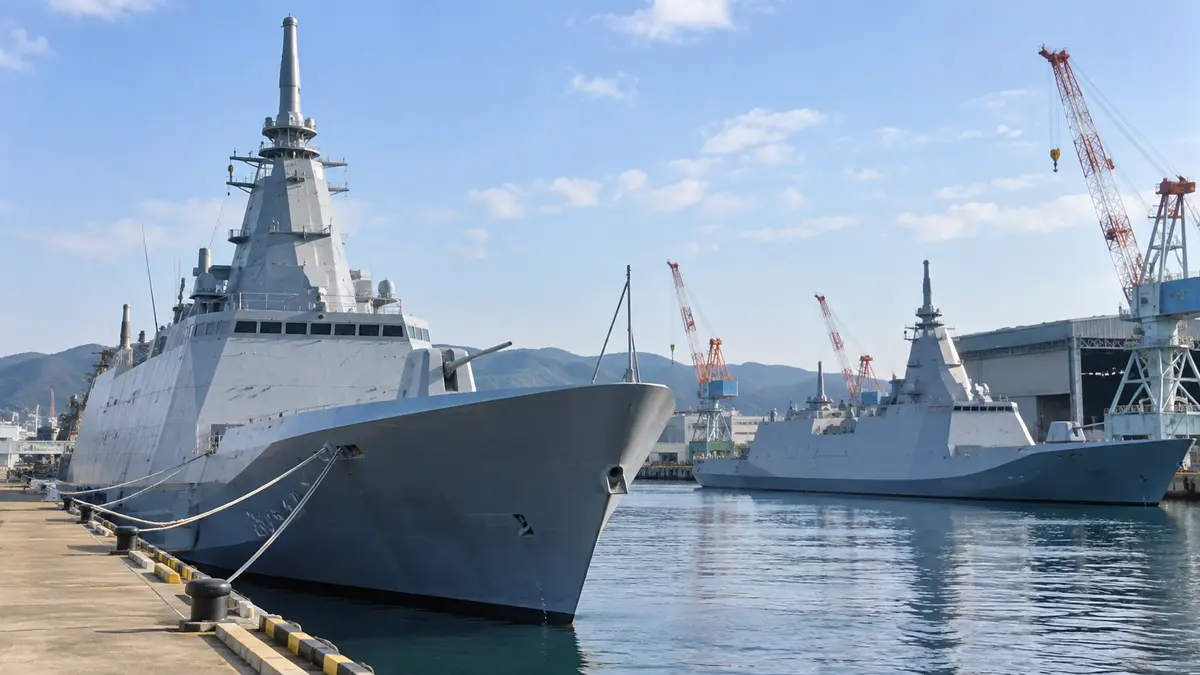
Shares in Mitsubishi Heavy Industries, Japan's largest defense company, climbed nearly 4% on Monday, April 20, 2026, after the country finalized an agreement with Australia to build three general purpose frigates - Japan's first ever warship export project, with the first vessel scheduled for delivery to the Royal Australian Navy in 2029.
An AU$10 billion first
The deal is worth 10 billion Australian dollars (about $7.15 billion) and was first announced in August, CNBC reported as the agreement was finalized. It comes on the back of reports that Japan is preparing to loosen its restrictions on arms shipments later the same month, paving the way for the official export of lethal weapons. Canberra, meanwhile, has committed as much as AU$20 billion toward a fleet of 11 general purpose frigates; the first three will be built by Mitsubishi Heavy Industries (MHI).
The new warships, based on the upgraded Mogami-class frigate, will replace the current ANZAC-class frigates in the Australian Navy, which have been in service since the 1980s. Japan said Australia could receive the first of the upgraded warships ahead of its own navy - a concession that, according to Australian news outlet ABC, tipped the AU$10 billion contest in MHI's favor.
How the contest was won
Japan's MHI beat Germany's ThyssenKrupp Marine Systems to bag the deal. The combination of an existing, upgradeable design, a delivery sequence that puts the customer first, and a political opening created by Tokyo's coming relaxation of arms export rules turned a long-running competition into a signed program. For Japan the contract is a threshold: the first warship export in the country's postwar history.
The industrial perimeter

The frigate program reaches beyond its prime contractor. Nikkei reported that other companies involved in the deal include NEC Corporation, Mitsubishi Electric and Hitachi, which will provide radar, antenna and other systems for the ships. The market read the finalization accordingly: Mitsubishi Electric shares were up 3.64%, Hitachi gained 0.8%, while NEC slipped 0.6%. MHI itself has gained about 75% over the last 12 months.
- Contract value: AU$10 billion (about $7.15 billion); first announced in August, finalized in April 2026.
- Scope: three upgraded Mogami-class general purpose frigates, first of 11 planned Australian ships.
- Delivery: first vessel to the Royal Australian Navy in 2029; Australia may receive the first upgraded ship ahead of Japan's own navy.
- Replacement role: ANZAC-class frigates in service since the 1980s.
- Competition: MHI beat Germany's ThyssenKrupp Marine Systems.
- Supply chain: NEC, Mitsubishi Electric and Hitachi to provide radar, antenna and other systems.
The strategic backdrop
The contract lands inside a hardening Australian defense posture. In its National Defence Strategy released on April 16, Canberra identified China's "growing national power and increasingly potent military capabilities" as the main factor in security dynamics in the Indo-Pacific region. The report added that Beijing will continue to prosecute its maritime and territorial claims in the South and East China Sea, using the People's Liberation Army and China Coast Guard, and stated that "PLA intercepts of foreign military vessels and aircraft operating under international law in international waters and airspace are becoming more frequent and, at times, are unsafe and unprofessional."
For Japan, the deal converts a policy shift into industrial output: a defense contractor whose shares have risen about 75% in a year now carries an export order book, and a supply chain of electronics and systems houses gains a naval program to price in. For Australia, AU$20 billion committed to 11 frigates becomes a concrete first tranche with a 2029 delivery date - and a precedent that Japan's shipyards are open for allied business.
Just Published

European housing prices and rents
Schneider–PTC: the industrial data integration test behind the deal
Avio USA starts work on its Virginia manufacturing site

One equity market, two currency measures

Russia’s draft budget raises spending and borrowing plans

Russia Sets the 2027 Minimum Wage at 28,935 Rubles, Up 6.8%, on the Way to 35,000 by 2030
Partner news digest
 Qatar LNG expansion: readiness, financing and the production test
 Pennon’s capital plan: turning finance into better water outcomes
 Italy’s diesel relief gap: taxes, price ceilings and implementation
 EU–China hybrid trade: from understanding to measurable implementation
 Schneider–PTC: the industrial data integration test behind the deal
 IKEA’s hybrid resale model: buyback, marketplace liquidity and furniture logistics
 Banking AI beyond the ranking: capability, execution and evidence of value
 Fishing labour beyond the product label: practical protection
 Rhenus and the Middle Corridor: terminals need coordinated connections
 Royal Mail restructuring: the test is reliable delivery
 Fuel Finder on Google Maps: when price transparency becomes useful competition
 Samsung’s memory profit surge: what the preliminary record explains
Leave a comment