
Malaysia's Construction Engine Keeps Running: Work Value Up 8.8% in Q2 2026
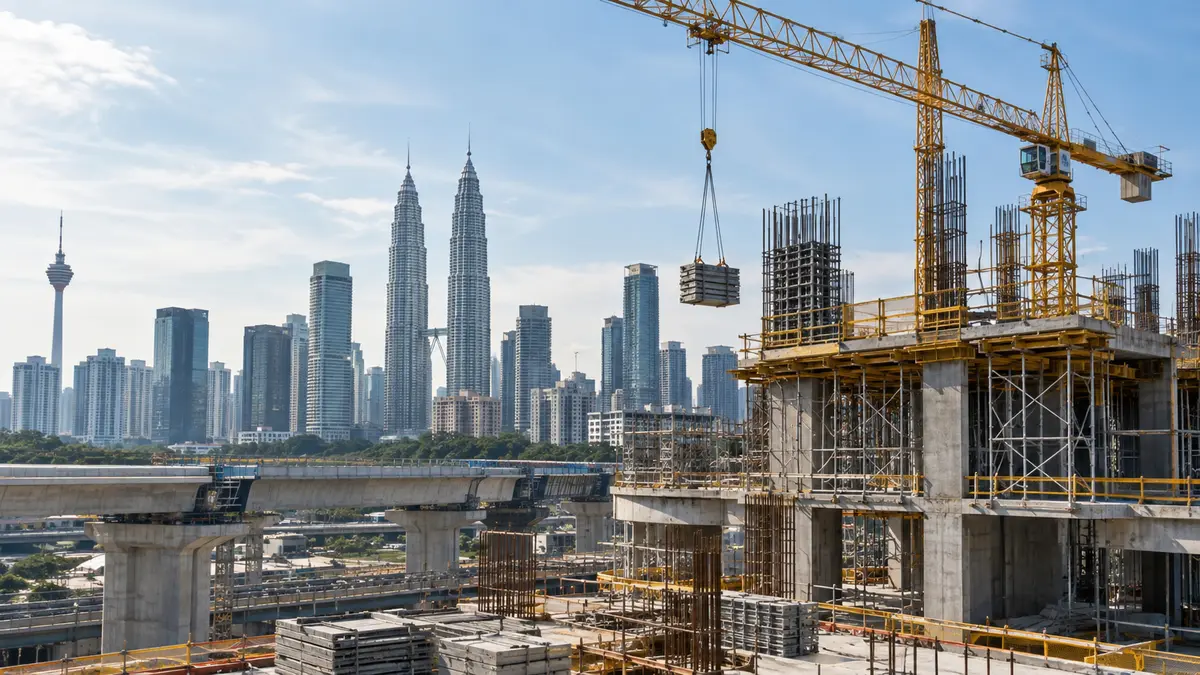
The value of work done in the construction sector of Malaysia rose 8.8% year-on-year to RM47.8 billion in the second quarter of 2026, maintaining steady momentum after an 8.5% increase in the first quarter, the Department of Statistics, Malaysia (DOSM) reported on August 13, 2026. The mix behind the headline — double-digit growth in special trade activities and non-residential building, a private sector carrying two-thirds of the value — describes an industry expanding on commercial rather than budgetary legs.
The sub-sector mix: trades and non-residential lead
Performance was mainly driven by continued expansion in the special trade activities and non-residential building sub-sectors, which recorded double-digit growth of 17.6% and 13.3% respectively. The residential building sub-sector registered an 8.7% rise, followed by civil engineering with 2.7% growth.
Civil engineering remained the largest single contributor: RM16.7 billion, or 35% of the total work value done in the quarter, driven by the construction of utility projects (RM8.1 billion) and roads and railways (RM6.9 billion). Non-residential building contributed RM14 billion (29.3% share) and residential building RM10.9 billion (22.8% share). Special trade activities added RM6.2 billion (12.9%), supported by site preparation (RM1.5 billion), plumbing, heat and air-conditioning installation (RM1.3 billion) and electrical installation (RM1.3 billion).
Private money, public follow-through
The private sector remained the primary growth driver for the quarter, contributing RM31.4 billion, or 65.8% of the total value of work done. It sustained double-digit growth momentum at 11.4% (after 13.2% in 1Q 2026), driven by strong performance in special trade activities (20.2%) and non-residential building (18.2%). The public sector, meanwhile, raised the value of work done by 4.1% (after 0.5% in the first quarter) to RM16.4 billion, accounting for 34.2% of the total, supported by the special trade activities sub-sector (11%).
The quarter-on-quarter acceleration of the public segment — from 0.5% to 4.1% — is the quieter signal in the release: it suggests state-funded work re-entering the growth column after a slow start to the year, while private activity decelerated only marginally from an already high base.
Where the work is: four anchors hold two-thirds

On a state-level basis, nearly 65.8% of the value of work done was concentrated in Selangor, Johor, the Federal Territories of Kuala Lumpur, Putrajaya and Labuan, and Sarawak. Selangor's work value was RM12.2 billion, or 25.5% of the national total, with non-residential building (RM4.8 billion) and residential building (RM3.2 billion) contributing the most. Johor took second place with RM9.4 billion (19.6%), primarily supported by non-residential building (RM3.5 billion); the Federal Territories recorded RM5.2 billion (10.8%), and Sarawak RM4.7 billion (9.9%).
The half-year picture
For the first half of 2026, the value of work done in the construction sector reached RM94.3 billion, an 8.7% rise versus a year ago. Growth was moderate against the 14.7% recorded in 1H 2025, with performance supported by positive growth across all sub-sectors, particularly special trade activities (21%) and non-residential buildings (13%).
What to watch
- Whether special trade activities keep their double-digit pace into the second half, as site preparation and installation works front-run larger projects.
- The public sector's recovery from 0.5% growth in 1Q to 4.1% in 2Q, and whether utility, road and railway works sustain it.
- Residential building's 8.7% rise against civil engineering's 2.7%: a mix tilted towards buildings rather than heavy infrastructure.
- Geographic concentration: four anchors holding about two-thirds of national work value, led by Selangor and Johor.
- The gap between 8.7% half-year growth in 2026 and 14.7% in 1H 2025 — a deceleration in pace, not a reversal.
Malaysia's construction sector in mid-2026 is not booming at the 2025 pace, but it is not stalling either: an 8.8% quarter and an 8.7% half-year, carried by private non-residential and special trade work, with public infrastructure re-accelerating from a weak first quarter. For suppliers of building materials and installation services, the sub-sector table is the actionable part — the growth is concentrated exactly where trades, fit-out and electrical work are bought.
Just Published
European housing prices and rents
Schneider–PTC: the industrial data integration test behind the deal
Avio USA starts work on its Virginia manufacturing site

One equity market, two currency measures

Russia’s draft budget raises spending and borrowing plans

Russia Sets the 2027 Minimum Wage at 28,935 Rubles, Up 6.8%, on the Way to 35,000 by 2030
Partner news digest
 Qatar LNG expansion: readiness, financing and the production test
 Pennon’s capital plan: turning finance into better water outcomes
 Italy’s diesel relief gap: taxes, price ceilings and implementation
 EU–China hybrid trade: from understanding to measurable implementation
 Schneider–PTC: the industrial data integration test behind the deal
 IKEA’s hybrid resale model: buyback, marketplace liquidity and furniture logistics
 Banking AI beyond the ranking: capability, execution and evidence of value
 Fishing labour beyond the product label: practical protection
 Rhenus and the Middle Corridor: terminals need coordinated connections
 Royal Mail restructuring: the test is reliable delivery
 Fuel Finder on Google Maps: when price transparency becomes useful competition
 Samsung’s memory profit surge: what the preliminary record explains
Leave a comment