
Half of China's Rail Bridge to Europe Now Crosses Two Xinjiang Checkpoints
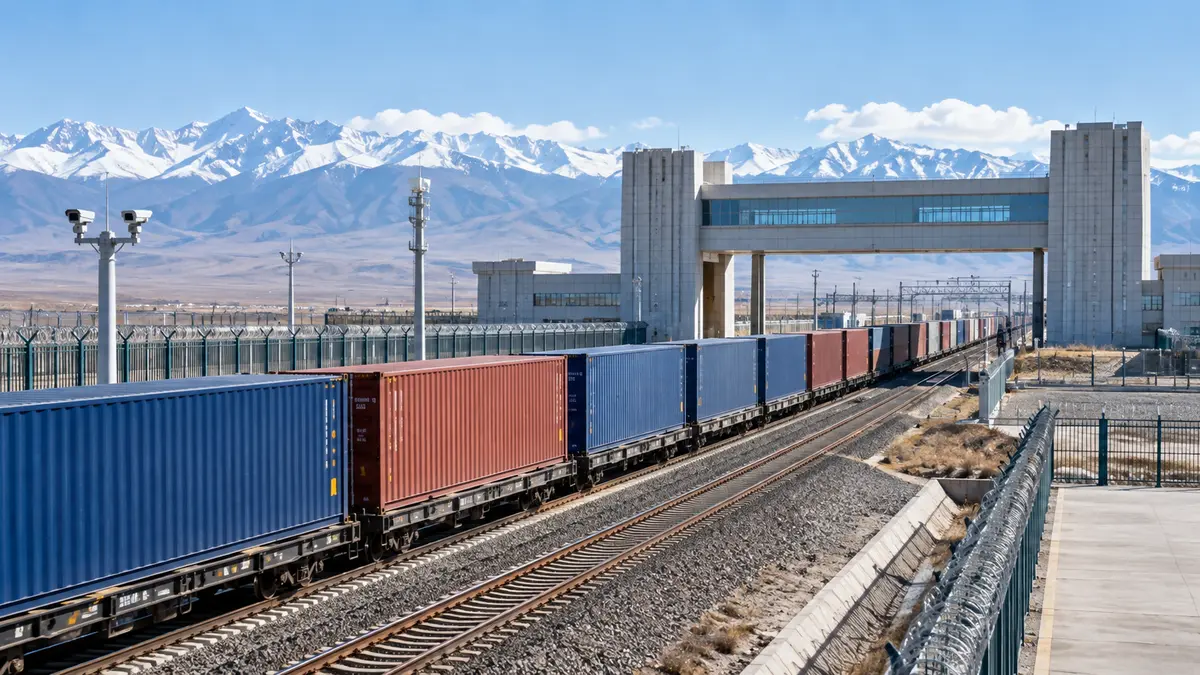
Alashankou and Horgos, two major railway hubs in northwest China's Xinjiang Uygur Autonomous Region, had recorded a combined total of more than 10,000 China-Europe (Central Asia) freight train trips this year as of Monday, July 28, according to China Railway Urumqi Group (China Railway Urumqi Group). Since the beginning of 2025, trains passing through Xinjiang's two major ports have accounted for over half of China's total - strongly safeguarding, as the group put it, the stability and smooth operation of the global supply chain.
Two checkpoints, one corridor
The split of the network between the two crossings explains why the combined figure matters. Alashankou, also known as Alataw Pass, now hosts 124 China-Europe freight train routes reaching 21 countries, including Germany and Poland. Horgos railway port operates 89 routes that serve 18 countries and 46 cities and regions abroad. Together the two checkpoints carry the route map of China's western rail exit: 213 distinct route lines between them, terminating across Europe and Central Asia.
Cargo growth is uneven - and that is the signal
As of Monday, Alashankou's cargo throughput this year had reached more than 9.77 million tonnes, up 3.7 percent year on year. Horgos had handled 7.96 million tonnes, a rise of 20.3 percent compared with the same period of 2024. The gap between 3.7% and 20.3% is the most informative number in the release: the younger crossing is absorbing growth far faster than the established one, which is what a corridor under expansion looks like before the older gate saturates.
What the two growth rates imply
- Alashankou's modest 3.7% suggests a mature gate operating near its processed capacity, adding tonnes at the margin.
- Horgos's 20.3% suggests spare processing capacity and route allocation being steered to the second gate.
- Combined, the pair keeps over half of China's China-Europe train traffic inside Xinjiang, concentrating gauge-change, customs and terminal capacity in two nodes.
Why the share of the total matters

Over half of China's total China-Europe freight train traffic crossing two checkpoints is a concentration statistic with a resilience reading. For shippers it means schedule reliability depends on the processing throughput of two border nodes; for the corridor's operators it means investment in those nodes multiplies across the entire network. The group's framing - safeguarding the stability and smooth operation of the global supply chain - is a claim about that leverage: when half of a continental rail bridge runs through two gates, keeping the gates fast is keeping the bridge open.
What to watch next
The natural follow-ups are the full-year trip count against the 10,000-plus mark reached by late July, the direction of the Horgos-Alashankou growth gap into the autumn peak, and whether new route lines continue to be added to the 124 and 89 currently published. Each of these turns a mid-year snapshot into a trend - and the trend, not the snapshot, is what decides whether Xinjiang's two checkpoints remain the centre of gravity of China's rail trade with Europe.
Just Published

European housing prices and rents

Schneider–PTC: the industrial data integration test behind the deal

Avio USA starts work on its Virginia manufacturing site

One equity market, two currency measures

Russia’s draft budget raises spending and borrowing plans

Russia Sets the 2027 Minimum Wage at 28,935 Rubles, Up 6.8%, on the Way to 35,000 by 2030
Partner news digest
 Qatar LNG expansion: readiness, financing and the production test
 Pennon’s capital plan: turning finance into better water outcomes
 Italy’s diesel relief gap: taxes, price ceilings and implementation
 EU–China hybrid trade: from understanding to measurable implementation
 Schneider–PTC: the industrial data integration test behind the deal
 IKEA’s hybrid resale model: buyback, marketplace liquidity and furniture logistics
 Banking AI beyond the ranking: capability, execution and evidence of value
 Fishing labour beyond the product label: practical protection
 Rhenus and the Middle Corridor: terminals need coordinated connections
 Royal Mail restructuring: the test is reliable delivery
 Fuel Finder on Google Maps: when price transparency becomes useful competition
 Samsung’s memory profit surge: what the preliminary record explains
Leave a comment