
Russian Operators Route Around the YouTube Slowdown Without Waiting for an Official Word
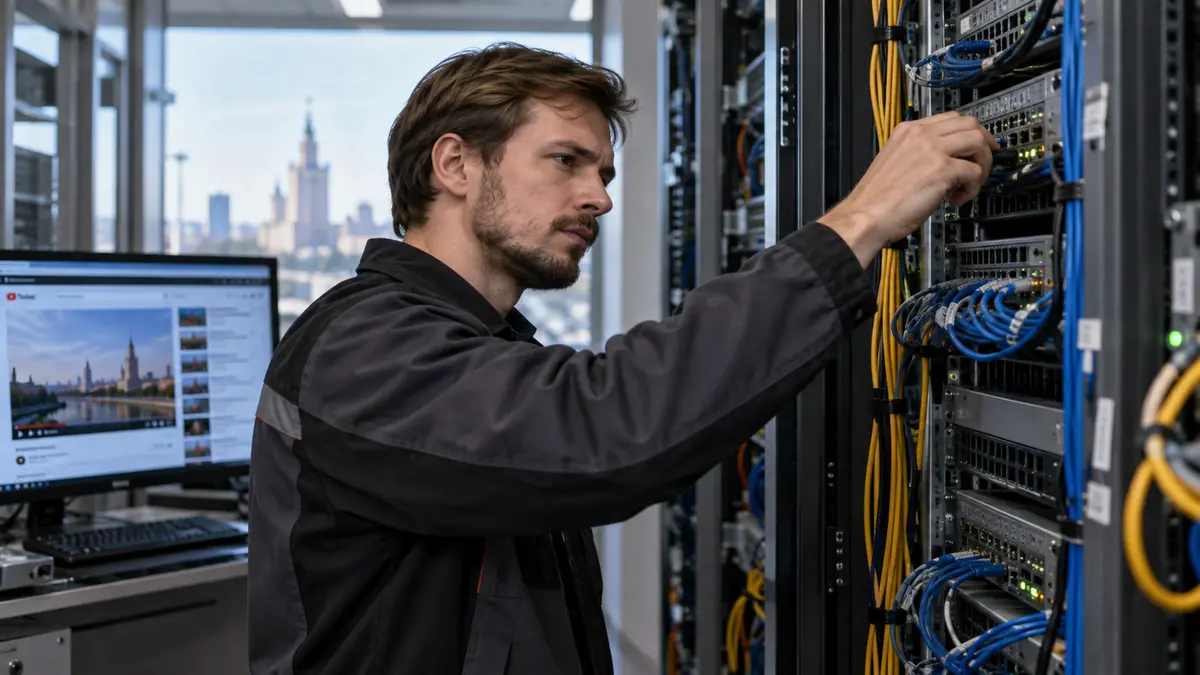
In the absence of an official statement from Roskomnadzor about the slowing of YouTube in Russia, telecom operators have begun installing solutions on their networks that make the service available to subscribers, Kommersant reported on August 28, 2024. Operators are trying to attract new subscribers, and since the service is not entered in Russia's registry of prohibited sites and is not officially blocked, their actions are entirely lawful, lawyers note.
A slowdown without a signature
The backdrop is a traffic collapse that no regulator has formally explained. Since August 1, daily traffic from Google Global Cache servers to subscribers in Russia has amounted to roughly 30% of the level observed in July. More than 135 regional telecom operators appealed to the Ministry of Digital Development and Roskomnadzor asking them to officially explain what is happening with YouTube. Kommersant previously wrote, on August 12, that problems with video loading on YouTube may be caused by traffic slowing linked to the operation of Roskomnadzor's TSPU equipment — the technical means of countering threats.
Dozens of bypasses, two public hints
Domestic providers are deploying solutions on their networks that overcome the YouTube slowdown, a source at one telecom operator told Kommersant; two other interlocutors on the telecom market confirmed the picture. According to the source, companies take such decisions precisely because regulators have never officially announced the reasons for the service's degraded performance in Russia. The deployment of bypass solutions already reaches dozens of cases across the country: Kommersant found at least two messages from fixed-line internet operators in the North-Western federal district alone stating that YouTube works on their networks without any additional tools for users. In one of the messages, user traffic is redirected from Google's Russian servers to European servers.
The largest players kept their distance. VimpelCom, MegaFon, MTS and Rostelecom declined to comment, and Kommersant sent a request to Roskomnadzor.
Marketing in the grey zone
Some operators are looking for a way to attract new subscribers ahead of the active season by using bypass means, and they calculate that liability for them is unlikely because there is no official YouTube ban — such operators interpret this in their own favor, says Dmitry Petrov, chief executive of the operator Komfortel. We see no offense in this, there are no official restrictions on the use of YouTube, confirms Oleg Grishchenko, president of the Rosteleset association, which unites more than 200 regional telecom operators.
Where the legal line runs

A source at one of the operators agrees that in the current situation the use of bypass tools does not entail liability for operators. The asymmetry is specific: if an operator opens access for users to prohibited social networks in the same way, it can receive a fine, because those networks are on Roskomnadzor's blocking list and are officially prohibited, unlike YouTube.
Ekaterina Abashina, a lawyer at the First Digital Bar Association of Moscow, explains that telecom operators do bear responsibility for failing to carry out blocking requirements under Roskomnadzor's unified registry of prohibited sites. Formally, there is no liability for low-quality traffic filtering through TSPU, because this equipment is operated by Roskomnadzor itself, she says. However, traffic manipulation on the operator's side can carry risks under the articles of the administrative code on the organization of TSPU operation, up to the revocation of the license.
- More than 135 regional operators asked the Ministry of Digital Development and Roskomnadzor for an official explanation of the YouTube situation.
- Since August 1, daily Google Global Cache traffic to Russian subscribers runs at about 30% of July volumes.
- Bypass deployments reach dozens of cases nationwide; at least one operator publicly describes redirecting traffic from Russian Google servers to European ones.
- YouTube is not in the registry of prohibited sites, which is why operator workarounds remain lawful — unlike access to banned social networks.
Just Published

European housing prices and rents

Schneider–PTC: the industrial data integration test behind the deal

Avio USA starts work on its Virginia manufacturing site

One equity market, two currency measures
Russia’s draft budget raises spending and borrowing plans
Russia Sets the 2027 Minimum Wage at 28,935 Rubles, Up 6.8%, on the Way to 35,000 by 2030
Partner news digest
 Qatar LNG expansion: readiness, financing and the production test
 Pennon’s capital plan: turning finance into better water outcomes
 Italy’s diesel relief gap: taxes, price ceilings and implementation
 EU–China hybrid trade: from understanding to measurable implementation
 Schneider–PTC: the industrial data integration test behind the deal
 IKEA’s hybrid resale model: buyback, marketplace liquidity and furniture logistics
 Banking AI beyond the ranking: capability, execution and evidence of value
 Fishing labour beyond the product label: practical protection
 Rhenus and the Middle Corridor: terminals need coordinated connections
 Royal Mail restructuring: the test is reliable delivery
 Fuel Finder on Google Maps: when price transparency becomes useful competition
 Samsung’s memory profit surge: what the preliminary record explains
Leave a comment