
Russia's Power Demand Runs 4% Hot Ahead of the 2024-2025 Winter
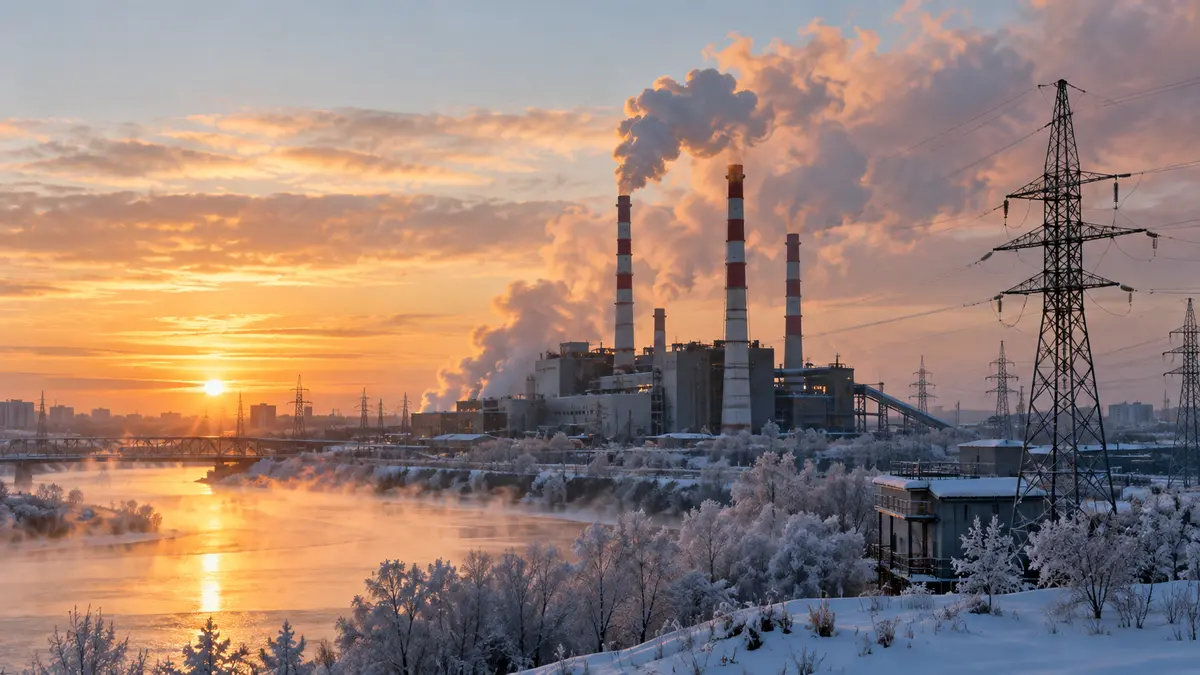
Energy consumption in Russia has grown by 4% year on year since the start of 2024, the Energy Ministry reported after a meeting on preparations for the 2024-2025 fall and winter season, with demand in the coming heating season expected to increase by a further 3.3%. The figures place the country's power system on a growth trajectory roughly three times faster than the one it recorded a year earlier.
Four percent, and accelerating
The 4% year-on-year increase in energy consumption over the period since the start of 2024 is the headline signal of the ministry's seasonal review. For a system of Russia's size, four percent of annual consumption is a very large physical volume: it is the equivalent of adding a mid-sized national grid to the balance sheet inside a single year. The ministry's number also marks an acceleration: for the full year 2023, electricity consumption grew by 1.3%, according to the baseline figures published by Deputy Prime Minister Alexander Novak in the Energy Policy journal.
The acceleration matters more than the level. A system growing at 1.3% can absorb growth inside existing reserves and scheduled maintenance windows; a system growing at 4% consumes reserve margin every quarter and turns every unplanned outage into a tighter calculation. The fall-winter season is precisely the period in which that arithmetic is tested.
The fall-winter forecast: plus 3.3%
Energy demand in the 2024-2025 fall-winter season is expected to increase by 3.3% year on year, the ministry said. The forecast is lower than the year-to-date pace but still well above the growth rates of the preceding years, and it concentrates the increment in the months when heating load, lighting load and industrial load all peak together. Seasonal readiness meetings of this kind exist to convert a forecast into a checklist: fuel stocks, repair schedules, reserve capacity and dispatch procedures.
Following the meeting, Energy Minister Sergei Tsivilev gave orders to hold national exercises for handling disruptions during the fall and winter, the ministry said. Exercises are the practical expression of a risk assessment: they rehearse the coordination between dispatchers, generators and grid companies for the scenario in which a cold snap, an outage and a fuel constraint arrive at the same time. The order signals that the ministry treats the 3.3% winter increment as a load case worth drilling, not merely a statistic.
The 2023 baseline: growth inside growth

The context for both figures sits in the baseline Novak published earlier. Electricity consumption in Russia totaled 1.139 trillion kWh in 2023 and production amounted to 1.152 trillion kWh, up by 1.3% and 1.14% respectively from 1.124 trillion kWh and 1.139 trillion kWh in 2022. Two observations follow. First, the 2023 consumption figure is almost exactly equal to the 2022 production figure, which describes a system whose demand growth is eating the output additions of the previous year. Second, production has consistently run above consumption, leaving a surplus band between the two curves.
What the surplus band means
The gap between 1.152 trillion kWh of production and 1.139 trillion kWh of consumption in 2023, roughly 13 billion kWh, is the visible part of the system's export, losses and statistical margin. It is not a reserve that can be dispatched at will: part of it leaves the country, part of it is lost in transmission. But its existence explains why a 4% demand increase does not immediately translate into shortages, and its thinness explains why the ministry pairs the growth forecast with disruption exercises rather than with reassurance.
Reading the signal
Taken together, the ministry's package describes a power system entering winter with demand growth an order of magnitude above its recent norm, a winter increment of 3.3% concentrated in the heating months, and a command decision to rehearse failure scenarios nationally. For market participants the combination is a forward indicator for fuel procurement, for repair-calendar discipline and for the value of reserve capacity in the 2024-2025 season. For the government it is the argument behind keeping generation investment programmes on schedule.
- Year-to-date consumption growth of 4% against 1.3% for the full year 2023.
- Fall-winter demand forecast of plus 3.3% year on year.
- National disruption-handling exercises ordered by Energy Minister Sergei Tsivilev.
- 2023 baseline of 1.139 trillion kWh consumed and 1.152 trillion kWh produced, up 1.3% and 1.14% on 2022.
The winter of 2024-2025 will provide the test. If consumption follows the 3.3% path, the system closes the season with its surplus band thinner than a year earlier and with a clear mandate for the next wave of capacity; if cold snaps push the increment above the forecast, the exercises ordered in October will have been the cheapest insurance the ministry could buy.
Just Published

European housing prices and rents

Schneider–PTC: the industrial data integration test behind the deal
Avio USA starts work on its Virginia manufacturing site

One equity market, two currency measures

Russia’s draft budget raises spending and borrowing plans

Russia Sets the 2027 Minimum Wage at 28,935 Rubles, Up 6.8%, on the Way to 35,000 by 2030
Partner news digest
 Qatar LNG expansion: readiness, financing and the production test
 Pennon’s capital plan: turning finance into better water outcomes
 Italy’s diesel relief gap: taxes, price ceilings and implementation
 EU–China hybrid trade: from understanding to measurable implementation
 Schneider–PTC: the industrial data integration test behind the deal
 IKEA’s hybrid resale model: buyback, marketplace liquidity and furniture logistics
 Banking AI beyond the ranking: capability, execution and evidence of value
 Fishing labour beyond the product label: practical protection
 Rhenus and the Middle Corridor: terminals need coordinated connections
 Royal Mail restructuring: the test is reliable delivery
 Fuel Finder on Google Maps: when price transparency becomes useful competition
 Samsung’s memory profit surge: what the preliminary record explains
Leave a comment