
Russia's Sunflower Oil Exports Jump 28% to 3.8 Million Tonnes in Eight Months of 2024
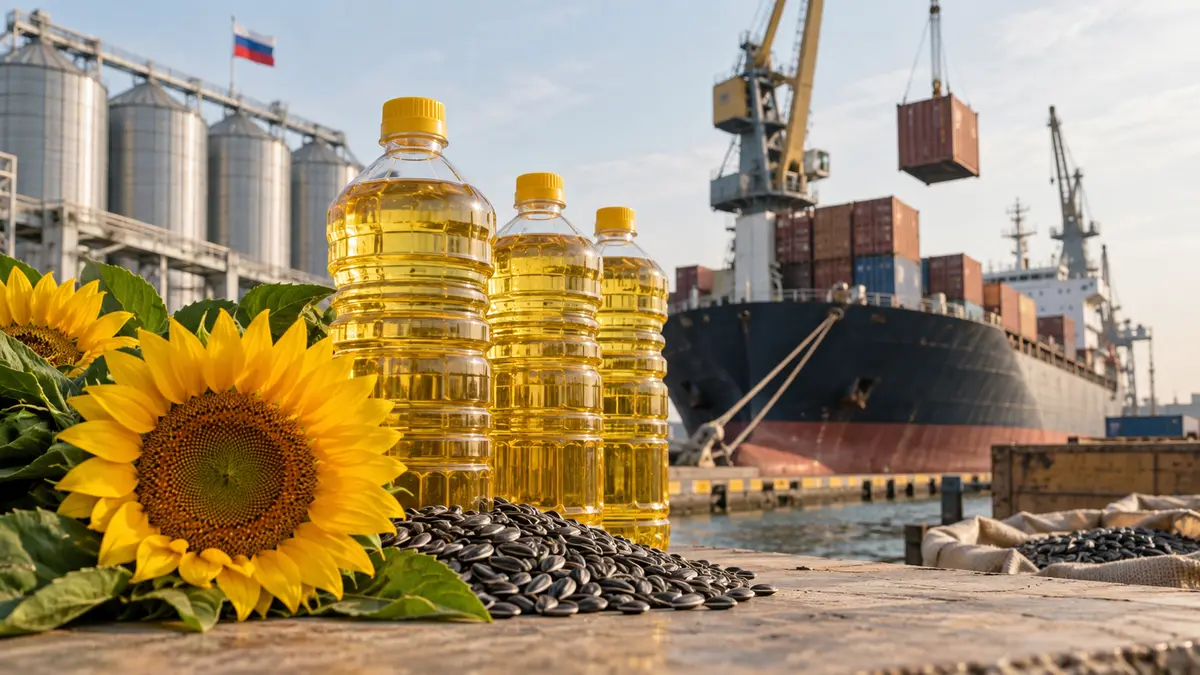
Russia's sunflower oil exports jumped 28% year on year to 3.8 million tonnes in the first eight months of 2024, the Agriculture Ministry's Agroexport Center reported on September 30, 2024, citing expert estimates — a pace that put the country's oilseed complex on track for a record year and confirmed a two-season leadership in global sunflower oil production.
Eight months, plus 28 percent
The January-August figure of 3.8 million tonnes is the headline of the Russian oilseed year. Agroexport's breakdown of destinations shows where the flow went: the top three markets were India, Turkey and China, accounting for 35%, 14% and 13% of exports respectively. Three buyers taking more than six tenths of the flow is a concentrated market, and concentration of that kind makes the export curve sensitive to the procurement policy of a handful of state-influenced importers.
For Russia, the stake is structural rather than conjunctural: Agroexport tentatively estimated that Russian sunflower exports could grow to 5.7 million tonnes by 2030. The 2024 pace — 3.8 million tonnes in eight months, annualizing above 5 million — is the first credible test of that long-run number.
The China angle from spring
The China leg of the story was visible earlier in the year from the other side of the balance sheet. In Q1 2024 Russia boosted exports of vegetable oil — sunflower, soybean and rapeseed oil — to China by 18.2% year on year to 578,300 tonnes, Agroexport said in May 2024, citing data from the General Administration of Customs of China. That was described as a record figure allowing Russia to strengthen a leading position among the largest suppliers in the segment, with Russia accounting for 58.4% of Chinese vegetable oil imports in the period.
Read together, the spring and autumn datapoints describe a market where Russia is not merely a large supplier but the price-setter of record in its main niches: majority share in China's vegetable oil imports, and a third-plus share of its own exports going to a single buyer, India.
Production leadership behind the flow
The export jump rests on a production base that has already changed rank. Agroexport reported that Russia has led in sunflower oil production for the past two seasons, having increased output by 14% to 6.6 million tonnes in the 2022/23 agricultural year, of which 4.1 million tonnes were exported. An industry that exports roughly six tenths of its output is, by construction, an export industry with a domestic remainder — and its investment cycle follows foreign, not local, demand.
- Jan-Aug 2024 sunflower oil exports: 3.8 million tonnes, +28% year on year (Agroexport, expert estimates).
- Destination mix: India 35%, Turkey 14%, China 13%.
- 2030 tentative export estimate: 5.7 million tonnes.
- 2022/23 production: 6.6 million tonnes, +14%, with 4.1 million tonnes exported; production leadership held for two seasons.
- Q1 2024 vegetable oil exports to China: 578,300 tonnes, +18.2%, a record; 58.4% of Chinese vegetable oil imports.
What to watch next

Two questions decide whether the 2024 pace converts into the 2030 estimate. The first is crush capacity: leadership in oil production is a processing story, and processing margins depend on seed supply and on the duty regime around it. The second is buyer diversification: with India, Turkey and China absorbing the majority of shipments, any shift in one of the three — a tariff change in Ankara, a stock cycle in New Delhi, a cheaper alternative oil in Chinese crushing — moves the entire Russian export curve. The 28% jump of January-August 2024 is therefore both a record and a concentration risk, printed in the same number.
Just Published

European housing prices and rents

Schneider–PTC: the industrial data integration test behind the deal

Avio USA starts work on its Virginia manufacturing site

One equity market, two currency measures

Russia’s draft budget raises spending and borrowing plans
Russia Sets the 2027 Minimum Wage at 28,935 Rubles, Up 6.8%, on the Way to 35,000 by 2030
Partner news digest
 Qatar LNG expansion: readiness, financing and the production test
 Pennon’s capital plan: turning finance into better water outcomes
 Italy’s diesel relief gap: taxes, price ceilings and implementation
 EU–China hybrid trade: from understanding to measurable implementation
 Schneider–PTC: the industrial data integration test behind the deal
 IKEA’s hybrid resale model: buyback, marketplace liquidity and furniture logistics
 Banking AI beyond the ranking: capability, execution and evidence of value
 Fishing labour beyond the product label: practical protection
 Rhenus and the Middle Corridor: terminals need coordinated connections
 Royal Mail restructuring: the test is reliable delivery
 Fuel Finder on Google Maps: when price transparency becomes useful competition
 Samsung’s memory profit surge: what the preliminary record explains
Leave a comment