
Twenty-Five Years to First Delivery: What the KF-21 Boramae Milestone Means for South Korea's Aerospace Industry
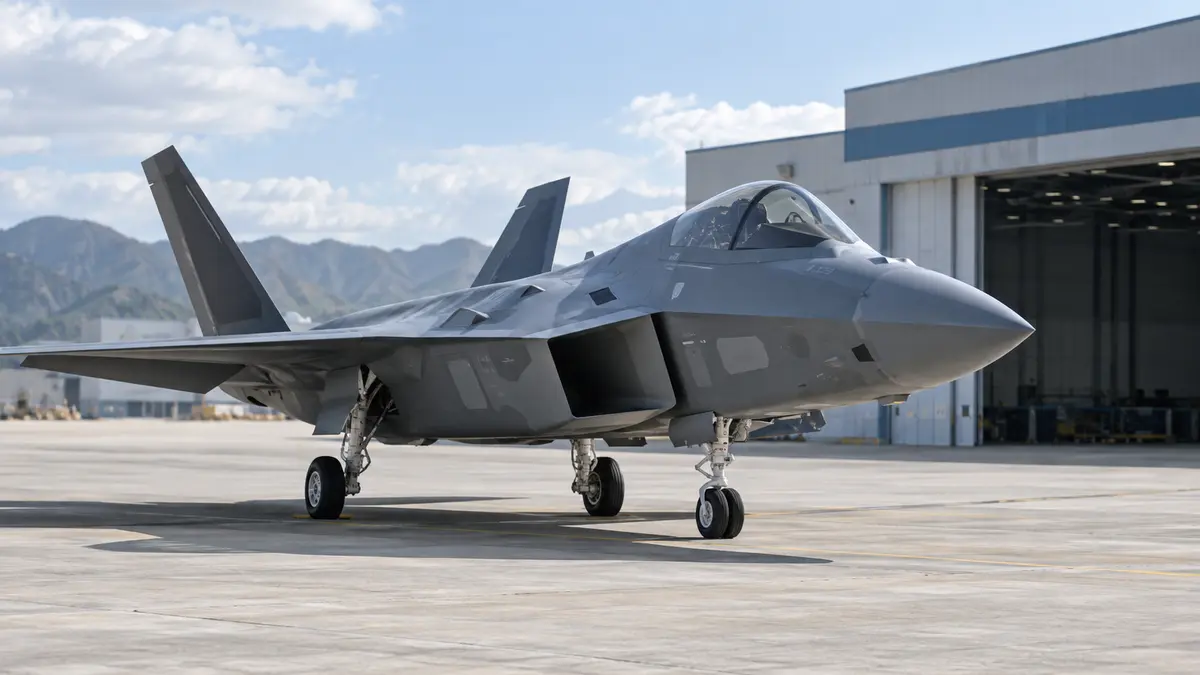
On September 22, 2026, the first mass-produced KF-21 Boramae fighter was handed over to the Air Force - 25 years and six months after the indigenous fighter plan was announced. The delivery moves the program from development into fleet operations at home, and puts the export question at the center of its next phase.
The delivery flight
The aircraft took off from Korea Aerospace Industries' manufacturing facility in Sacheon, South Gyeongsang Province, following its handover to the Air Force, and flew to its first operational base in Yecheon, North Gyeongsang Province, according to the Air Force and the Defense Acquisition Program Administration (DAPA). Maj. Han Jae-seok of the 156th Fighter Squadron under the 16th Fighter Wing, one of the Air Force's first KF-21 pilots, signed the acceptance and delivery documents before taking the aircraft, designated No. 001, into the air. An FA-50 light combat aircraft, a TA-50 fighter trainer and a T-50 advanced trainer flew in formation alongside the KF-21 as it arrived at the Yecheon base - a formation that doubled as a family portrait of the trainer-and-fighter pipeline The Korea Herald described from the handover.
The timing carried the weight of the whole program: Tuesday's handover came 25 years and six months after then-President Kim Dae-jung announced plans to develop an indigenous fighter in March 2001, and about 10 years and nine months after full-scale system development began in December 2015. The program was launched in partnership with Indonesia following years of feasibility reviews and budget-related delays, with the aim of developing an advanced supersonic fighter to replace the Air Force's now-retired F-4 Phantoms and aging F-5 fleet.
The aircraft on paper
The KF-21, whose Korean name "Boramae" means "young hawk", is a 4.5-generation multirole fighter measuring 16.9 meters long and 11.2 meters wide, with a maximum speed of Mach 1.8, or about 2,200 kilometers per hour. It has a maximum takeoff weight of 25.6 metric tons and a maximum payload of 7.7 tons. Powered by two General Electric F414 engines, the jet supports a wide range of weapons such as air-to-air missiles, precision-guided bombs and a cannon; DAPA has also flight-tested a domestically developed long-range air-to-surface guided missile set to be integrated into the KF-21, highlighting the jet's deep-strike capabilities.
The 4.5-generation label marks the aircraft's market and doctrinal position: a modern sensor-and-weapons platform one step below stealth designs, intended to replace fourth-generation fleets at a sustainable cost. For an air force that historically relied on foreign military technology, predominantly that of the United States, the type is also an industrial statement: the jet is set to replace older aircraft including the F-5, F-4 Phantom II, KF-16 and F-15K, closing generational capability gaps, and to bolster national air power with a domestically controlled product line.
From announcement to acceptance: a quarter century

The milestone list reads like a program management case study. KAI unveiled the first KF-21 prototype in April 2021, and the aircraft made its first flight in July 2022. Mass production began in June 2024. The fighter subsequently underwent around 1,600 test flights covering some 13,000 test conditions, including aerial refueling and air-to-air weapons tests. It received combat suitability certification in May 2026 before completing system development in June. The first production aircraft rolled out in March 2026 and underwent acceptance procedures before the September handover; flight tests had been completed without any accidents in January, as Yonhap reported at the time.
Two numbers in that list explain the length of the road. About 1,600 test flights and some 13,000 test conditions are the evidence base behind the combat suitability certificate: every envelope corner, every weapons separation, every refueling contact becomes a data point the certifier signs against. And the 25-year span from announcement to first delivery shows what an indigenous fighter costs in persistence: feasibility reviews, budget delays, a partner's payment crisis and a technology-theft investigation all sit inside that span, and the program absorbed them without cancelling the type.
The unit that will fly it
To prepare for the new fighter's introduction, the Air Force reactivated the 156th Fighter Squadron on June 1 as the first unit to operate the KF-21. The squadron, established in 1988, previously operated F-4E Phantom fighters before being deactivated in 2012 - a lineage choice that ties the newest jet to a unit with a fighter heritage. The Air Force has also trained an initial group of KF-21 pilots and maintenance personnel: pilots have undergone flight training to familiarize themselves with the aircraft and its operating procedures, while maintenance personnel have received specialized training.
Air Force Chief of Staff Gen. Son Sug-rag hailed the delivery as the start of a new phase for the KF-21 program, saying responsibility for the fighter had now shifted from its developers to the Air Force. He urged personnel to ensure the aircraft is swiftly integrated into operations as a key component of the country's air defense. The Air Force plans to declare the KF-21 operational in the second half of 2027 and gradually introduce more than 100 aircraft by the early 2030s.
Production economics: two contracts and a domestic supply chain
KAI has said it would manufacture an initial 40 KF-21s focused on air-to-air capabilities for delivery to the Air Force by 2028, followed by 80 additional aircraft equipped with long-range air-to-ground missiles by 2032 - a two-block fleet plan that sequences capability growth with production learning. The industrial base behind it was contracted in parallel: in June 2025 KAI signed an additional KF-21 supply agreement worth 2.39 trillion won (about $1.76 billion) for 20 more jets on top of the first contract for the initial production of 20 units signed in June 2024, with the deal also covering technical manuals, education and follow-up logistical support.
The supply chain contracts show how much of the jet is now domestic workshare. DAPA signed an additional 623.2 billion won engine supply agreement with Hanwha Aerospace, raising the total contract value to 1.18 trillion won, while Hanwha Systems finalized a deal valued at 124.8 billion won for the remaining supply of AESA radars. Airframe, engines and active radar - the three highest-value blocks of a modern fighter - thus sit with Korean primes, even where the underlying engine design remains a licensed General Electric product.
The export question
With the domestic fleet plan funded, the program's next economics depend on exports. In March 2026 government sources told Yonhap News Agency that South Korea plans to sign a deal to export 16 KF-21 fighter jets to Indonesia, in what would mark the first overseas sale of the indigenous fighter; the agreement was to be concluded on the occasion of Indonesian President Prabowo Subianto's state visit scheduled from March 31 to April 2, with the final contract to follow in the first half of the year after pricing negotiations.
Indonesia's path to that point is a cautionary tale about co-development. Jakarta had originally agreed to shoulder about 20 percent of the project's cost as a partner country through June 2026 in return for technology transfers and other conditions, but failed to keep up with payment deadlines and proposed lowering its contribution in exchange for reducing the level of technology transfers; police conducted a probe into alleged technology theft by Indonesian engineers at KAI. The two countries inked a final deal in June 2025 to slash Jakarta's contribution to 600 billion won (about US$400 million), roughly one-third of the original amount - converting a partner into a prospective customer.
That conversion is exactly what the export pipeline needs: a customer that already knows the aircraft from inside the program. KAI and DAPA have also pointed to export potential beyond Indonesia, and the September delivery gives sales teams a flying, certified, in-service reference rather than a mockup. Whether the 16-jet Indonesian contract and any follow-on orders materialize will determine whether the KF-21 line runs at domestic-fleet scale or at export scale - the difference between a national program and a product.
The trainer pipeline behind the cockpit
The formation that escorted No. 001 to Yecheon - an FA-50 light combat aircraft, a TA-50 fighter trainer and a T-50 advanced trainer - is the training pipeline that produced the pilots who signed the acceptance documents. The Air Force trained an initial group of KF-21 pilots and maintenance personnel before the delivery: pilots underwent flight training to familiarize themselves with the aircraft and its operating procedures, while maintenance personnel received specialized training. Reactivating the 156th Fighter Squadron - established in 1988, an F-4E Phantom unit before its 2012 deactivation - gives the new type a squadron with institutional memory of fast-jet operations, while the T-50 family keeps feeding the conversion flow.
That sequencing is what makes the 2027 date meaningful. A fighter becomes a capability only when trained crews, maintainers and a unit's procedures converge on it; the September handover starts that clock, and the second half of 2027 is when the Air Force plans to declare the KF-21 operational. Until then, every sortie at Yecheon is conversion training with a serial airframe.
DAPA: the procurement agency as program manager
Nearly every milestone in the record passed through DAPA's announcements: combat suitability certification in May 2026, system development completion in June, the second supply agreement in June 2025, the engine and AESA radar contracts with the Hanwha companies, and the flight test of the domestically developed long-range air-to-surface guided missile. The pattern reflects the Korean model in which the state arms procurement agency holds the technical baseline and the contracts while KAI executes as prime contractor - and in which the agency's statements, not the manufacturer's, carry the program's official dates.
For the export story the same model supplies the counterparty: foreign buyers negotiate with a state-backed program rather than with a company alone. The March 2026 Indonesian plan was reported precisely in that register - a government-level agreement to be concluded on the occasion of a state visit, with pricing to be settled before the final contract.
Blocks: how capability grows
The fleet plan is explicitly staged: an initial 40 aircraft focused on air-to-air capabilities by 2028, then 80 additional aircraft equipped with long-range air-to-ground missiles by 2032. The domestically developed long-range air-to-surface guided missile that DAPA flight-tested is the payload that defines the second block; until its integration, the fleet's strike role rests on precision-guided bombs and the cannon. Staging turns one development effort into two production learning curves and gives the Sacheon line a decade of work: initial production from June 2024, 40 jets by 2028, 80 more by 2032, more than 100 aircraft by the early 2030s. Export orders, if they materialize, slot into the same curve.
The March 2026 Yonhap report also carried the checkpoints against which the year can be graded: flight tests completed without any accidents in January, development to be completed in the first half of 2026, first batch delivery to the Air Force in the second half. All three held - certification in May, completion in June, handover in September. Schedule discipline of that kind is itself an export credential: it tells prospective buyers that the line they would join delivers on the dates it signs.
What changes now
Operationally, responsibility for the fighter has moved from its developers to the Air Force: the 156th Fighter Squadron will turn acceptance signatures into sorties, tactics and maintenance routines, with operational declaration targeted for the second half of 2027. Industrially, the line at Sacheon shifts from prototypes and first articles to block production - 40 air-to-air jets by 2028, then 80 strike-capable aircraft by 2032. Politically, the delivery closes the loop opened in March 2001: the country that announced an indigenous fighter a quarter century ago now flies one.
The remaining risks are the ordinary risks of a new type: integration of the long-range air-to-surface missile, growth to more than 100 aircraft by the early 2030s, and the conversion of export interest into signed contracts at prices both sides can defend. None of these is a development risk any longer. That, rather than the formation flight over Yecheon, is the real content of the milestone: after 1,600 test flights and 13,000 test conditions, the KF-21 Boramae is no longer a promise - it is aircraft No. 001 on the flight line at Yecheon.
KF-21 Boramae: key parameters and plan
- Generation and role: 4.5-generation multirole fighter; Korean name "Boramae" ("young hawk").
- Dimensions and performance: 16.9 m long, 11.2 m wide; maximum speed Mach 1.8 (about 2,200 km/h); maximum takeoff weight 25.6 t; maximum payload 7.7 t.
- Powerplant: two General Electric F414 engines.
- Test record: about 1,600 test flights and some 13,000 test conditions; combat suitability certification May 2026; system development completed June 2026.
- Fleet plan: 40 air-to-air aircraft by 2028, 80 more with long-range air-to-ground missiles by 2032; operational declaration in H2 2027; more than 100 aircraft by the early 2030s.
Just Published

European housing prices and rents
Schneider–PTC: the industrial data integration test behind the deal
Avio USA starts work on its Virginia manufacturing site

One equity market, two currency measures

Russia’s draft budget raises spending and borrowing plans

Russia Sets the 2027 Minimum Wage at 28,935 Rubles, Up 6.8%, on the Way to 35,000 by 2030
Partner news digest
 Qatar LNG expansion: readiness, financing and the production test
 Pennon’s capital plan: turning finance into better water outcomes
 Italy’s diesel relief gap: taxes, price ceilings and implementation
 EU–China hybrid trade: from understanding to measurable implementation
 Schneider–PTC: the industrial data integration test behind the deal
 IKEA’s hybrid resale model: buyback, marketplace liquidity and furniture logistics
 Banking AI beyond the ranking: capability, execution and evidence of value
 Fishing labour beyond the product label: practical protection
 Rhenus and the Middle Corridor: terminals need coordinated connections
 Royal Mail restructuring: the test is reliable delivery
 Fuel Finder on Google Maps: when price transparency becomes useful competition
 Samsung’s memory profit surge: what the preliminary record explains
Leave a comment