
The 5 Percent Circular: How Mass-Balance Accounting Turned Fossil Plastic Into 'Recycled' Packaging
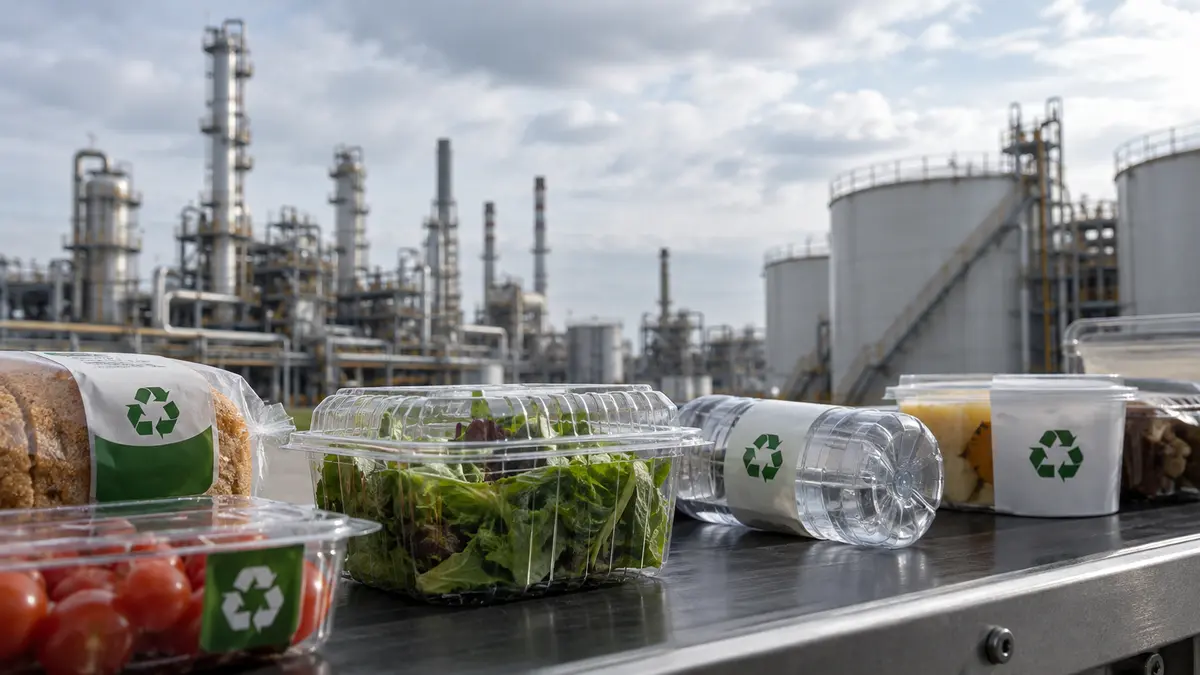
Europe's supermarket shelves are packed with brands billing their plastic packaging as sustainable, yet often only a fraction of the material is truly recovered from waste while the rest is made from petroleum. A cross-border investigation published by the Guardian in January 2026 traced how pyrolysis, mass-balance bookkeeping and avoided-emission accounting let fossil-based plastic carry a recycled label — and how European rules set to take effect in 2026 are on track to legalise the practice.
The claim on the shelf
The investigation starts where the consumer does: at the label. Brands using plastic packaging, from Kraft's Heinz Beanz to Mondelez's Philadelphia, use materials made by the plastic manufacturing arm of the oil company Saudi Aramco. The Saudi state-owned holding opposes production cuts under the UN plastic treaty and is the world's largest corporate greenhouse gas emitter, with more than 70 million tonnes up to 2023. Its petrochemical subsidiary Sabic, along with other big players, devised a successful way to rebrand a harmful business as a planet saver: label plastic as circular and climate-friendly although in practice it remains almost entirely fossil-based, exacerbating global warming and the plastic crisis.
Under industry pressure, Europe is on track to legalise this practice, which independent experts have described as greenwashing, with lax EU rules set to take effect in 2026 and similar United Kingdom regulations to be enforced as of 2027. The timing is what makes the 2026 story: the accounting tricks described by the investigation are not yet fully sanctioned, but the regulatory calendar is about to sanction them.
The chemistry behind the label
To promote so-called sustainable plastic, the petrochemical industry is pushing pyrolysis, the most common type of chemical recycling. It is a highly energy- and carbon-intensive process that converts plastic waste into recycled feedstock, pyrolysis oil. The compound, however, is hazardous: it can make up at most 5 percent of total feedstock and must be diluted with 95 percent virgin naphtha, a petroleum derivative, to avoid damaging the steam-cracking plants that turn the input into new plastic.
The whole process is labelled as plastic recycling while fossil fuel use expands because virgin feedstock must be added, said Helmut Maurer, a former senior expert in the environment department of the European Commission. That single sentence contains the entire economics of the sector: recycling here is not a substitute for virgin production but an additive that requires it.
Mass balance: the accounting that certifies fossil plastic as recycled

To present appealing figures of high recycling rates and low emissions for brands eager to attract customers, the industry relies on two controversial but lawful accounting tricks. The first is mass-balance bookkeeping, which attributes the recycled input to specific output batches. If 5 percent pyrolysis oil mixed with 95 percent naphtha is credited to 5 percent of 100 tonnes, those 5 tonnes can be certified as 100 percent recycled packaging even if they contain only fossil feedstock and no actual recycled material.
This is unfair to consumers, because recycled content should be physically part of the final product, said Lauriane Veillard, a policy officer at the NGO Zero Waste Europe. The certificate travels with the paperwork, not with the molecules: a batch certified as fully recycled may contain none of the recycled input at all, while another batch absorbs all of it.
How the credit moves
- Plastic waste is pyrolysed into oil, a hazardous stream limited to about 5 percent of cracker feedstock.
- The oil is co-fed with virgin naphtha into steam crackers, typically in the Netherlands for Sabic's European operations.
- Mass-balance rules let the recycled share be attributed to chosen output batches.
- Certificates issued by the industry-led platform International Sustainability and Carbon Certification (ISCC) pass from plastic producers to packaged-product brands.
- The brand prints a recycled claim on packaging whose physical molecules may be entirely fossil.
Avoided emissions: the second trick
The second accounting device is the avoided-emissions approach: subtracting the carbon that would have been released if a volume of waste equivalent to that recycled had been incinerated creates apparent savings compared with virgin plastic production. The savings exist on paper, in the counterfactual of a burning landfill stream, not in the measured emissions of the plant.
What matters is not hypothetical emissions from incineration that are avoided on paper, but what is actually emitted in reality, Maurer said. The distinction decides whether chemical recycling is a climate tool or a climate story: measured against real stacks, the process is worse than the fossil route it claims to displace.
The numbers inside Sabic's own documents
Public records suggest that the recycled material or pyrolysis oil used by Sabic, 2,600 tonnes in 2022, to produce plastic may represent even less than 5 percent of the total feedstock, given the huge quantity of naphtha, 4 million tonnes, fed into the company's European cracking plants in the Netherlands. The ratio between the two numbers, roughly one part recycled to more than fifteen hundred parts virgin, is the physical content of the circular claim.
The carbon footprint calculation, or life cycle assessment, by the petrochemical group admits that the full process from pyrolysis to cracking emits 6 to 8 percent more than producing plastic from fossil fuel. Only by counting avoided incineration do the net benefits appear positive: about 2 kilograms of CO2 less per kilogram of recycled plastic. The climate case for the label therefore rests entirely on the second trick.
Who checks the checkers
Sabic's life cycle assessment claims a rigorous critical review by experts, including the co-founder of the London-based Plastic Energy, Sabic's main feedstock supplier. The close business ties between reviewers and Sabic raise questions about the scrutiny's impartiality. Sabic and Plastic Energy declined to disclose full life cycle assessments or answer questions, and the brands named in the investigation also did not respond to requests for comment.
Life cycle assessment documents serve no purpose other than advertising, because companies control the parameters to achieve desired results, said Peter Quicker, a professor of emission control in waste management at Aachen University in Germany. Research on other life cycle assessments has found that they can be selectively framed, masking the real climate footprint, and warns that carbon savings largely disappear when recycled feedstock replaces only a small fraction of fossil-based plastic.
The overestimated carbon savings follow the downstream value chain, amplified by mass-balance credit, to packaged products, potentially making consumer brands' statements unreliable and misleading, said Margaux Le Gallou, the senior programme manager at the NGO Ecos. The chain of certification thus converts a contested engineering assumption into a shelf claim with the authority of a certificate behind it.
Why oil majors need the label
The investigation places the accounting in its strategic context. Over the past three years, petrochemical companies have intensified lobbying of EU institutions to ensure upcoming laws accommodate mass balance, while rushing to secure offtake deals with pyrolysis oil suppliers. Despite brands' pledges, mandatory recycled-content targets intended to curb waste and emissions may technically be met even as big oil expands virgin plastic production, because the targets can be satisfied with certificates rather than molecules.
As demand for fossil fuels declines, replaced by renewables, plastic is set to become a critical growth engine for oil majors' future profits, according to the International Energy Agency. In that light the recycled label is not a marketing accident but an infrastructure: it lets the growth engine of the post-fuel decade run on the same feedstock as the fuel decade, while wearing the uniform of the circular economy. The Saudi Arabia-state-owned parent of Sabic, the world's largest corporate emitter and an opponent of production cuts under the UN plastic treaty, is the clearest illustration of why the uniform matters.
What would make the claim honest
- Physical presence: recycled content counted only where it is physically part of the final product, as Zero Waste Europe demands.
- Measured, not avoided: carbon accounting based on real emissions of the process, not on hypothetical incineration counterfactuals.
- Independent review: life cycle assessments reviewed by experts without commercial ties to the assessed company or its feedstock suppliers.
- Disclosure: full publication of life cycle assessments and mass-balance ledgers, which Sabic and Plastic Energy declined to provide.
- Regulatory clarity: EU rules from 2026 and UK rules from 2027 defining whether certificates or molecules satisfy recycled-content targets.
The regulatory window of 2026 and 2027
The investigation's policy conclusion is a calendar. Europe is on track to legalise the practice under industry pressure, with lax EU rules set to take effect in 2026 and similar UK regulations enforced from 2027. Once those rules accept mass balance as compliance, the gap between the label and the molecules stops being a voluntary overstatement and becomes a regulated fact. Brands that today print circular claims on mostly fossil packaging will be able to point at the rulebook.
That is why the 2026 window matters beyond the packaging aisle. Recycled-content mandates were designed to pull waste into production; mass balance lets production claim waste without pulling it in. The difference between the two outcomes will not show up in certification statistics, which count credits, but in waste-flow data, which count tonnes actually collected, sorted and reprocessed. The investigation's implicit test for the next three years is therefore simple to state and hard to pass: watch the tonnes, not the certificates.
What the investigation changes for buyers and regulators
For procurement and brand teams, the practical lesson is that a recycled claim now carries a methodology question: which accounting rule produced the number, and would the claim survive a physical-content test. For regulators, the lesson is that a target written in certificates can be met while the underlying system stagnates, which converts an environmental instrument into a compliance market. For consumers, the lesson is the oldest one in labelling: the claim describes a bookkeeping entry more reliably than it describes the object in the hand.
The brands between two certificates
The investigation names household products, Heinz Beanz and Philadelphia among them, not to accuse the brands but to show where the certificate chain ends. A brand that buys polymer with an ISCC certificate has, in good faith, purchased a bookkeeping claim; the physical audit that would connect the claim to the package does not exist in the current scheme. That is why the brands' silence in the investigation matters as much as Sabic's: without disclosure of the mass-balance ledgers, nobody downstream can verify what the shelf claim physically means, and the consumer facing the label has no route to the numbers behind it at all.
What falls if one trick falls
The two accounting devices are independent, and the label survives only as long as at least one of them stands. Remove mass balance and the recycled share collapses to the physical fraction of pyrolysis oil in the cracker, five percent at most and, on Sabic's own 2022 numbers, likely far less. Remove avoided emissions and the climate claim turns negative by the group's own life cycle assessment, which admits six to eight percent higher emissions than the fossil route. Regulators in 2026 and 2027 therefore face a binary choice dressed as a technical one: certify molecules or certify ledgers. The investigation's contribution is to show that the ledgers, as they stand, certify a story the molecules do not tell.
The treaty backdrop and the 2026 window
The corporate parent's stance in the UN plastic treaty negotiations gives the accounting its political weight. A holding that opposes production cuts while marketing circular plastic is hedging: if the treaty fails, virgin production continues; if recycled-content mandates succeed, the certificates convert the mandate into demand for its own certified streams. Europe's 2026 rules and the United Kingdom's 2027 rules are the first large markets to decide which side of that hedge becomes law. For waste operators and mechanical recyclers who process real tonnes, the decision determines whether their output competes with certificates or is priced by them, and for the plastic crisis itself it determines whether the recycled-content targets of the next decade move material or move paperwork.
The Guardian investigation was part of a cross-border project supported by the Investigative Journalism for Europe fund and coordinated by the independent journalist Ludovica Jona, with the Guardian, Voxeurop, Mediapart, Altreconomia, Publico, Investigative Reporting Denmark and Deutsche Welle participating. Its central finding is not that chemical recycling exists, but that the distance between 5 percent of feedstock and a 100 percent recycled label is bridged by accounting rather than chemistry — and that 2026 is the year Europe decides whether to build a bridge of law over the same gap.
Just Published

European housing prices and rents

Schneider–PTC: the industrial data integration test behind the deal
Avio USA starts work on its Virginia manufacturing site

One equity market, two currency measures

Russia’s draft budget raises spending and borrowing plans

Russia Sets the 2027 Minimum Wage at 28,935 Rubles, Up 6.8%, on the Way to 35,000 by 2030
Partner news digest
 Qatar LNG expansion: readiness, financing and the production test
 Pennon’s capital plan: turning finance into better water outcomes
 Italy’s diesel relief gap: taxes, price ceilings and implementation
 EU–China hybrid trade: from understanding to measurable implementation
 Schneider–PTC: the industrial data integration test behind the deal
 IKEA’s hybrid resale model: buyback, marketplace liquidity and furniture logistics
 Banking AI beyond the ranking: capability, execution and evidence of value
 Fishing labour beyond the product label: practical protection
 Rhenus and the Middle Corridor: terminals need coordinated connections
 Royal Mail restructuring: the test is reliable delivery
 Fuel Finder on Google Maps: when price transparency becomes useful competition
 Samsung’s memory profit surge: what the preliminary record explains
Leave a comment