
South Korea Puts the President in the Chair: The 30-Million-Visitor Bet and the Overhaul Behind It
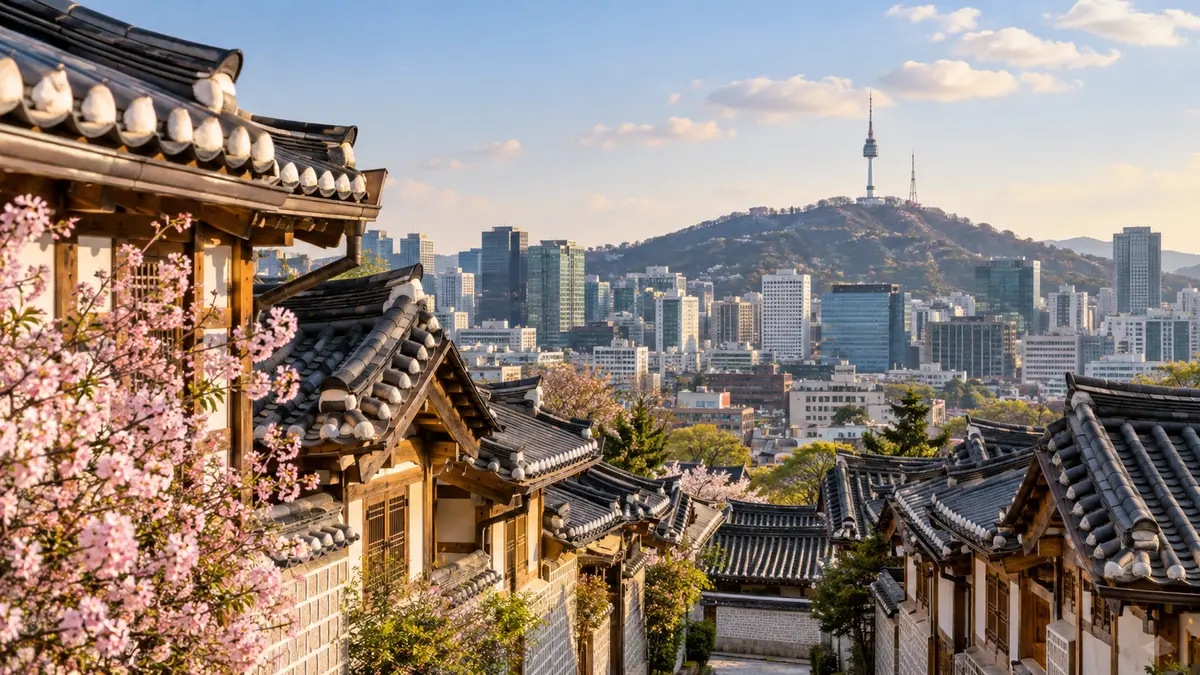
South Korea received a record 18,936,562 foreign visitors in 2025, up 15.7 percent from 16,369,629 the year before, and those visitors spent just over 17.4 trillion won, up 21.1 percent. Against that backdrop, President Lee Jae Myung (Lee Jae Myung) convened the Expanded National Tourism Strategy Meeting at Cheong Wa Dae (Cheong Wa Dae) in Seoul and called for a sweeping overhaul of the country's tourism industry, setting a goal of 30 million inbound visitors by boosting travel demand and spreading tourism beyond Seoul. It was the first time since 2019 that the president personally attended the tourism strategy meeting, a pangovernmental coordinating body launched in 2017 that is typically chaired by the prime minister.
A president takes the chair
The symbolism of the February 2026 session was deliberate. The coordinating body has existed since 2017 and normally meets under the prime minister; Lee's decision to preside himself elevated tourism to the level of a national growth agenda. The session ran under the slogan "K-tourism embraces the world — a major shift in inbound tourism, a great leap in regional tourism," and the president used it to frame tourism as the missing link between the country's cultural exports and its real economy.
"The development of the cultural industry triggered by K-culture must ultimately lead to tourism," Lee said. "Only then can the explosive energy of K-culture translate into growth that our people can feel, and into job creation." In his framing, the global audience won by music, drama and film is an asset only if it converts into visits, stays and spending inside the country: "A key task for the tourism industry's renewed takeoff is to boldly expand the horizons of tourism across the entirety of the Republic of Korea," he added, referring to South Korea by its official name.
The numbers behind the ambition
The statistical base for the meeting was the strongest in the country's history. Inbound foreign visitors reached 18,936,562 in 2025, up 15.7 percent from 16,369,629 in 2024, according to Korea tourism statistics released in February 2026. Tourist spending rose even faster: total foreign tourist expenditure came to just over 17.4 trillion won, up 21.1 percent from nearly 14.4 trillion won the year before. Spending growing ahead of arrivals means revenue per visitor increased as well, the combination policymakers cite as evidence that the market is maturing rather than merely expanding.
Yet the distribution of that growth is the problem the overhaul is meant to solve. "If we are satisfied with the reality that 80 percent of foreign tourists are concentrated in Seoul, the growth of the tourism industry is bound to hit a ceiling," Lee said. "For tourism-led growth to be sustainable, the opportunities and benefits must be shared by local alleyway commercial districts across the country and by small business owners in the regions." The concentration figure turns a success story into a capacity and distribution question: the capital absorbs the arrivals while regional airports, ports and hotels remain underused.
The target itself was restated in qualitative terms. "We must move beyond quantitative expansion and make a major transition to qualitative growth to usher in the era of 30 million foreign visitors by 2030 that we are aiming for," Lee said. The culture minister, Chae (Chae), presented the measures for a major shift in inbound tourism and a leap in regional tourism, underscoring that "this is the golden time for us to make a decisive push to become a global tourism powerhouse." His headline commitment was calendar-based: "Starting today, K-tourism will run harder and faster. We will first revise our target — bringing forward by one year the goal of attracting 30 million foreign visitors by 2030," moving the milestone to 2029.
Two pillars: demand expansion and regional revitalization

To meet the target, the ministries rolled out a two-pillar strategy — expanding inbound demand and revitalizing regional tourism — backed by reforms to immigration procedures, regional airports, lodging systems and higher value-added tourism content. The division of labour presented at the meeting was unusually concrete. Vice Justice Minister Lee Jin-soo (Lee Jin-soo) laid out plans to improve immigration convenience; the land minister outlined a strategy to turn regional airports into inbound tourism hubs; the acting oceans minister presented measures to improve cruise tourism readiness; and the finance minister briefed participants on steps to eradicate price gouging.
Lee urged officials to scrutinize the visitor experience from end to end — from regional airports and cruise infrastructure to immigration and entry procedures — and to examine the system from the demand side rather than the supply side. He also pressed for innovation in regional tourism, using each area's unique assets to turn destinations nationwide into compelling content and experiences. The consumer-protection strand was blunt: "The thing we must be most wary of is unfair practices that cause travelers to turn away," Lee said. "The price gouging, unfriendliness and excessive touting that we know all too well are malicious abuses that ultimately inflict great damage on local economies, and they must be rooted out in advance."
The private sector sat at the table as well: participants included Hotel Shilla CEO Lee Boo-jin (Lee Boo-jin), alongside related ministers and senior officials from Cheong Wa Dae. Her presence signalled where the strategy expects capacity to come from — hotel operators and duty-free and retail infrastructure that convert arrivals into spending — while the government side concentrates on visas, airports, ports and enforcement.
The infrastructure pillars carry the heaviest load in the regional half of the strategy. The land minister's plan to turn regional airports into inbound hubs and the acting oceans minister's cruise-readiness measures target the two gateways that determine whether arrivals can physically land outside the Seoul-Incheon axis; without scheduled seats and berths, regional content has no transport. The August "golden route" linking five regional airports is the operational expression of this pillar — not merely added capacity but a route product designed to give airlines a scheduling reason to serve secondary cities, and to let cruise itineraries plug into land-based programs.
The enforcement pillar is the quiet counterpart of the visa pillar. The finance minister's briefing on eradicating price gouging, and Lee's warning about unfriendliness and excessive touting, treat consumer trust as infrastructure: unfair practices damage local economies and, once viral, deter repeat visits more effectively than any visa rule. The August decision to tighten oversight of licensed agencies sponsoring group-tour visa waivers — with legal grounds to sanction violations and prevent visa-waiver visitors from going missing — applies the same logic to the entry side of the funnel.
From 30 million to 40 million: the August update
Six months later, at a presidential briefing on August 5, 2026, the Culture Ministry confirmed that the trajectory had held and raised the stakes again. The ministry now expects to reach its previous target of 30 million annual visitors a year earlier than its 2029 deadline, and set a new long-term target of 40 million. It expects 23 million visitors in 2026 after arrivals rose 21 percent in the first half of the year.
The ministry's broader second-half push targets airport, port and hotel capacity and aims to lower entry barriers with wider multiple-entry visas, more group-tour visa waivers and smoother immigration processing. It plans a "golden route" linking five regional airports to draw visitors beyond Seoul, alongside a shift toward higher-margin travel — medical tourism, beauty tourism and high-end packages. To manage the risk that comes with wider visa waivers for group tours, the ministry says it will tighten oversight of the licensed agencies that sponsor them and create legal grounds to sanction violations, aiming to prevent visa-waiver visitors from going missing.
Content is the third leg. The ministry is banking on "content tourism" — 110 travel routes and 444 sites tied to K-pop concerts and K-drama or film locations, marketed directly to inbound visitors — plus new tourism zones anchored to regional airports outside Busan and Jeju, paired with support for areas facing population decline. The most visible capital project is a domed venue meant to double as a sports and K-pop arena; officials ruled out building more than one or two nationwide, saying a 30,000-to-50,000-seat dome cannot be filled by concerts alone. The plan remains preliminary: a feasibility study, whose contractor was selected only in April 2026, is still narrowing two candidate sites and has not finalized bidding criteria.
The dome sits inside a wider culture bundle presented in the same August briefing: groundwork for a possible artist basic income, expanded health and pension support for artists, an anti-scalping law taking effect on Aug. 28, 2026, and a punitive-damages bill against illegal game servers submitted in July. The package treats content industries and tourism as a single pipeline — the same pipeline Lee described in February, in which K-culture energy must convert into visits — and prices the dome accordingly: a venue for the content that feeds the routes.
The qualitative pillar also has a measurable baseline. Dividing the ministry's own figures, foreign-visitor spending of just over 17.4 trillion won across 18,936,562 arrivals implies roughly 920,000 won per visitor in 2025, against about 880,000 won across 16,369,629 arrivals in 2024: spending per head rose even before the 2026 push for medical, beauty and high-end packages. With first-half 2026 arrivals up 21 percent toward a 23 million expectation, the strategy's test is not only how many visitors arrive but whether per-visitor spending keeps climbing as the mix shifts to higher-margin travel, and whether the regions capture a rising share of it.
The 2024 comparison also shows the price of the ceiling: at 16.37 million guests the industry was already hitting immigration-control slots at peak, Seoul hotel capacity in high season and guide shortages — the bottlenecks the strategy addresses through multiple-entry visas, smoother immigration processing and airport and port capacity. In other words, 30 million is not only a demand target but a capacity project: without a second echelon of infrastructure, record arrivals would turn into queues rather than revenue.
The measure set on the table
- Wider multiple-entry visas and more group-tour visa waivers, paired with tighter oversight and sanction powers over sponsoring agencies.
- A "golden route" linking five regional airports to redirect arrivals beyond Seoul.
- 110 content-tourism routes and 444 K-culture sites marketed directly to inbound visitors.
- A shift to higher-margin segments: medical tourism, beauty tourism and high-end packages.
- New tourism zones anchored to regional airports outside Busan and Jeju, with support for declining-population areas.
- A preliminary 30,000-to-50,000-seat domed arena doubling as a sports and K-pop venue, limited to one or two nationwide.
What to watch
The strategy's internal logic is a conversion funnel: K-culture attention becomes arrivals through visas and air connectivity; arrivals become spending through hotels, dining and retail; spending becomes regional income only if flows leave Seoul. Each link has a visible failure mode. Visa waivers expand demand but create overstay risk, which is why the August package couples waivers with sponsor oversight and sanction powers. Regional airports gain hub status only if airlines schedule them, which is why the "golden route" matters more than any single incentive. And the dome's economics depend on sharing the calendar with sport, which is why officials insist on dual use.
The institutional design deserves its own line: the coordinating body was launched in 2017 and has met under the prime minister except in 2019 and now 2026. Presidential attendance is the mechanism by which four ministries — justice, land, oceans and finance — presented deliverables at a single table with the culture ministry in the lead; the strategy's execution risk is therefore not only market risk but the ordinary risk of cross-ministerial follow-through between summits.
Seoul's 80 percent share also defines where the benefits argument bites. The president's alleyway commercial districts are the micro-geography of the regional pillar: guesthouses, restaurants and guides in cities that currently see a fraction of arrivals. The ministry's new tourism zones anchored to regional airports outside Busan and Jeju, paired with support for areas facing population decline, convert that rhetoric into zoning and subsidy — and create a second, domestic constituency for the inbound target, since the same zones serve Korean travellers in the off-season.
A further layer is service quality: the February lodging-system reforms and the August oversight of sponsoring agencies target the shoulder of the offer that the president called the condition of repeat visits. For the industry this means capacity growth will be accompanied by checks on licensed intermediaries and on service standards in regions where the guest economy is only forming — navigation, language environment, refund rules. There, in the package's logic, the 2025-2026 funnel either becomes a durable growth model or remains a one-off K-culture spike.
The 2025 numbers show the funnel working at the top: arrivals up 15.7 percent, spending up 21.1 percent, a record year on both lines. The 2026 numbers — 21 percent first-half growth toward a 23 million full-year expectation — suggest momentum rather than saturation. The open question is distribution: whether the 80 percent Seoul concentration bends before the 30 million line is crossed, and whether the benefits reach the alleyway commercial districts the president named. The chair at the table has changed; the test is whether the coordination follows.
Just Published
European housing prices and rents

Schneider–PTC: the industrial data integration test behind the deal
Avio USA starts work on its Virginia manufacturing site

One equity market, two currency measures

Russia’s draft budget raises spending and borrowing plans
Russia Sets the 2027 Minimum Wage at 28,935 Rubles, Up 6.8%, on the Way to 35,000 by 2030
Partner news digest
 Qatar LNG expansion: readiness, financing and the production test
 Pennon’s capital plan: turning finance into better water outcomes
 Italy’s diesel relief gap: taxes, price ceilings and implementation
 EU–China hybrid trade: from understanding to measurable implementation
 Schneider–PTC: the industrial data integration test behind the deal
 IKEA’s hybrid resale model: buyback, marketplace liquidity and furniture logistics
 Banking AI beyond the ranking: capability, execution and evidence of value
 Fishing labour beyond the product label: practical protection
 Rhenus and the Middle Corridor: terminals need coordinated connections
 Royal Mail restructuring: the test is reliable delivery
 Fuel Finder on Google Maps: when price transparency becomes useful competition
 Samsung’s memory profit surge: what the preliminary record explains
Leave a comment