
Caterpillar Triples Its Power Bet: Gigawatt Data-Center Orders Rewrite a Machinery Company's Growth Plan
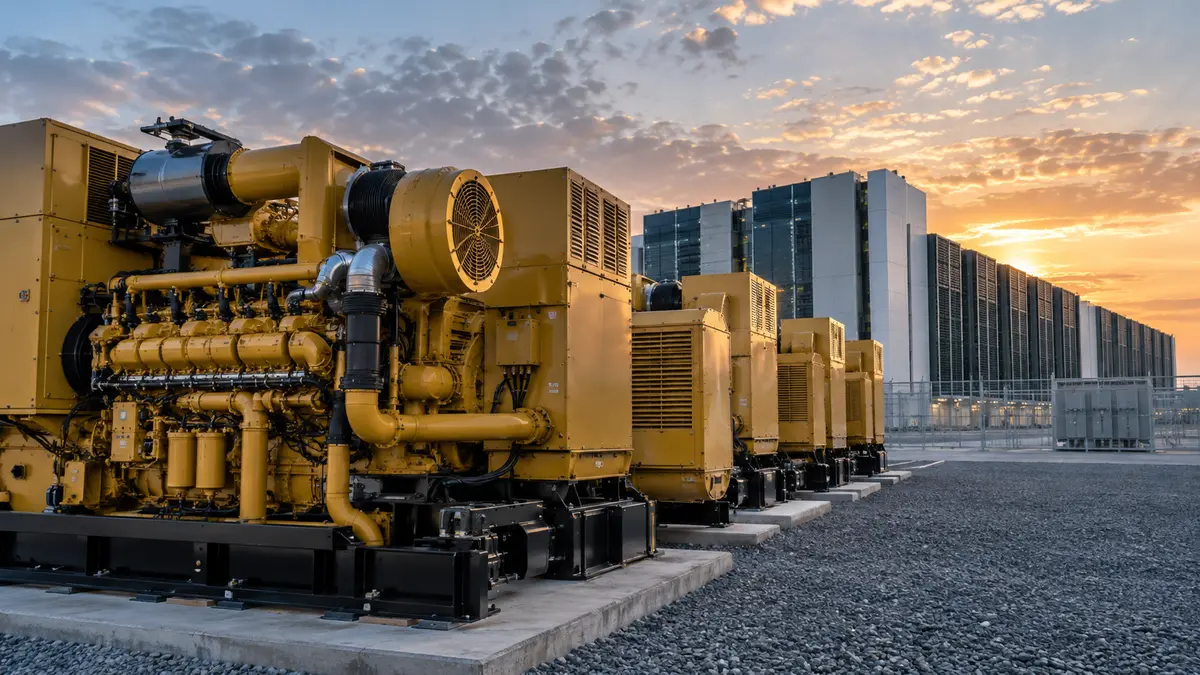
Caterpillar is tripling its large reciprocating engine capacity from 2024 levels and raising its 2030 growth targets, betting that data centers, oil and gas producers and mining companies will keep ordering power equipment at gigawatt scale for the rest of the decade. The announcement, made by chief executive Joseph Creed on the first-quarter 2026 earnings call, converts the machinery group's strongest growth story - an order backlog for large reciprocating engines that has grown more than 3.5 times since January 2024 - into a capital program that runs from 2027 through 2029.
From doubling to tripling in sixteen months
The scale change deserves attention because it is the second upgrade inside roughly a year and a half. In January 2024, Caterpillar announced plans to double its power generation capacity. Speaking on the earnings call Thursday, Creed said the company will now triple its large reciprocating engine capacity from 2024 levels to meet growing demand from data center and oil and gas customers. The additional investment, he added, will begin as soon as possible.
The Irving, Texas-based equipment manufacturer, whose home market is the United States, plans to invest heavily in the area from 2027 through 2029, Creed said. He did not disclose a specific dollar amount but expects a "positive cash payback" on the entire investment by the end of 2030. As a result of the additional power generation capacity, Caterpillar raised its 2030 growth targets: it now expects a compound annual growth rate for sales and revenue of between 6% and 9% from 2024 to 2030.
The mechanics are worth restating because tripling engine capacity is not a marketing gesture. Large reciprocating engines are among the slowest things in industrial manufacturing to scale: castings, forgings, machining lines, test cells and the supplier base behind them all lengthen the runway. The investment window Creed described - heavy spending in 2027-2029, cash payback by the end of 2030 - tells how management reads the durability of demand. A company that expects a cyclical blip does not underwrite a multi-year capacity program with a payback deadline inside the same decade.
The gigawatt customer
The clearest evidence of how the order book has changed is the unit of measurement. Over the past year, Caterpillar has seen data center customers increase their capital spending for backup and primary power generation, Creed said. The latest example: ProPetro's ProPWR business recently struck a deal to purchase up to 2.1 gigawatts of power generation assets from Caterpillar over the next five years to support growing energy demand.
That is Caterpillar's sixth agreement with a customer seeking at least 1 gigawatt of power generation equipment, Creed said - a threshold that barely existed in the company's order book before the data-center buildout began. In addition to data center customers, the company is seeing growth in power generation demand from oil and gas as well as mining. The demand stack now looks like this:
- data centers buying both backup and primary generation, in packages measured in gigawatts;
- oil and gas customers extending field power and electrification of operations;
- mining operations ordering power equipment alongside the critical-minerals cycle;
- the service and parts tail that follows every installed engine for decades after delivery.
When six customers each want a gigawatt or more, the manufacturer's problem stops being whether orders arrive and becomes whether capacity can follow. That is the question the tripling answers, and it is why the backlog statistic matters as much as the headline: orders for large reciprocating engines have grown more than 3.5 times since January 2024, the month Caterpillar first promised to double capacity. The promise has been chasing the queue ever since.
"The invisible layer of the tech stack"

Creed framed the strategy in unusually explicit terms for an equipment maker: "We continue to see attractive growth opportunities across all our segments due to our role in providing the invisible layer of the tech stack, the critical minerals, the reliable power and physical infrastructure that the modern world depends on."
The sentence is positioning language, but it is also an accurate description of where the revenue now comes from. Engines that run beside server halls are not information technology, yet they have become a dependency of information-technology capital spending. Every gigawatt of compute that a hyperscaler orders must be matched with reliable power: grid connection where it is available, on-site generation where it is not, and backup in every case. Caterpillar sells the machine that makes the pairing physical, and its power and energy division has become one of the company's more lucrative equipment divisions - in line with construction and well above mining.
That ranking is itself a structural fact. A century-old machinery group now earns as much from generating equipment in a single quarter as it does from the construction machines that built its brand, while its mining division - historically the cyclical engine of the company - trails both. The invisible layer, in other words, is already visible in the segment tables.
What the quarter said
The first-quarter numbers give the scale of the boom. Caterpillar reported $17.4 billion in sales and revenue, up 22% from a year ago, and made a profit of $2.5 billion, up 27% over last year. The power and energy division alone generated $7 billion in sales and revenue during the quarter, up 22% year on year. The order backlog grew to a record $63 billion during the quarter, up $28 billion from a year ago, Creed said.
The $28 billion backlog increase in twelve months is the single most consequential figure in the report, because it is the variable that underwrites the capacity program. Tripling engine capacity is only rational if the queue keeps growing while new lines come online; Caterpillar's own backlog says the queue is currently growing faster than the company can ship. Higher sales volume and favorable pricing, together with dealers increasing inventories in the construction division, drove the earnings improvement on top of the power generation momentum.
The internal pecking order changed with it. Power and energy "has become one of Caterpillar's more lucrative equipment divisions, in line with construction and well above mining," the earnings coverage notes. For a group whose identity was forged in earthmoving and mining cycles, an engine division standing level with construction in a single $7 billion quarter is a milestone - and the capacity program is designed to make that position permanent rather than episodic, because every line added in 2027-2029 locks in output that the backlog has already queued.
Construction's quiet tailwind
Power generation took the headline, but construction ran faster in the quarter. Sales and revenue at the division surged 38% to $7.2 billion compared with last year. Activity in North America was better than expected due to nonresidential construction, Creed said, including offices, warehouses and factories.
That triad - offices, warehouses, factories - is itself the footprint of the data-center economy: the commercial buildings, logistics halls and manufacturing plants that cluster around large compute and electrification projects. The same infrastructure wave is therefore lifting both the engines that power the facilities and the earthmoving machines that prepare the ground for them. Read together with the ProPetro agreement for up to 2.1 gigawatts, the quarter describes a company whose two biggest divisions are being pulled forward by one physical buildout.
The tariff arithmetic inside the boom
The growth program is being executed inside a trade-policy fog. Tariff costs during the first quarter totaled $600 million, better than the company expected due to accounting adjustments, Creed said. "The situation around tariffs remains fluid while we continue to execute our mitigation plans," he told the call.
Kyle Epley, who took over as chief financial officer effective Friday, said Caterpillar expects tariff costs for the full year to be between $2.2 billion and $2.4 billion, slightly lower than previous estimates provided in January. "We expect to ramp up our actions to mitigate our tariff costs in the back half of the year," Epley said.
The tariff bill matters for a capacity program in a specific way. Tripling engine output means buying more steel, castings, forgings and components, each line carrying a duty exposure that policy can move. A $2.2-2.4 billion annual cost is absorbable inside a quarter that produced $17.4 billion of sales, but it prices mitigation into the investment case: the back-half ramp of countermeasures that Epley described is now part of the arithmetic of tripling, not a side quest. Investors get a clean read on execution because management has already anchored the full-year range.
The economics of tripling
Why does a machinery company - not a utility, not a technology group - become the bottleneck-breaker of the compute buildout? Because large reciprocating engines sit at the intersection of three constraints: they can be ordered at gigawatt scale, deployed faster than grid interconnection in many regions, and fueled flexibly across gas and other sources. A customer that needs a gigawatt or more within five years has a short list of suppliers to call, and Caterpillar's backlog suggests the list is getting shorter.
The financial architecture of the decision is unusually transparent for an industrial capital program. Management has published the investment window (2027 through 2029), the payback test (positive cash payback on the entire investment by the end of 2030) and the growth consequence (a 6% to 9% compound annual growth rate for sales and revenue from 2024 to 2030, raised as a result of the additional capacity). Together the three statements form a discipline: capacity is added only if it pays for itself inside the decade, and the raised targets make the promise auditable by investors year by year.
There is also a structural consequence beyond the P&L. Engines sold into backup and primary power are among the most service-intensive assets in the portfolio; they run on standby contracts, maintenance schedules and parts consumption for decades. The $63 billion backlog is a production queue, but the installed base it creates is a service annuity that outlives the capacity program itself. Tripling capacity is therefore also a decision about the shape of revenue in the 2030s, not just about 2027-2029 output.
Outlook: low double-digit growth, raised margins
Looking ahead, Caterpillar is expecting "low, double-digit growth" in sales and revenue for the full year, citing "resilient end markets" despite higher energy prices and increased geopolitical and tariff uncertainty, Creed said. The company also raised its operating profit margin expectations - a signal that pricing and volume are currently outrunning policy costs.
Higher energy prices cut both ways in this story. Geopolitical disruptions are squeezing energy prices higher, which raises costs across the economy - and simultaneously strengthens the case for customers to own their generation. The same headline that threatens margins elsewhere in industry adds urgency to the order book for engines. Whether the balance holds depends on variables the company does not control: the pace of data-center capital spending, tariff policy, and the energy prices themselves.
What to watch next
- the dollar figure: Creed declined to size the 2027-2029 investment, and the first concrete number will calibrate the program against the $63 billion backlog;
- the seventh gigawatt agreement: each new 1+ GW contract tests whether the ProPetro pattern repeats or was exceptional;
- backlog trajectory: the record book must keep growing for tripling to look conservative rather than aggressive;
- tariff mitigation in the back half: whether full-year costs land inside the $2.2-2.4 billion range;
- margin delivery: the raised operating profit margin expectation is the cleanest test of whether pricing power is outrunning policy cost.
Each of these markers is observable within four to six quarters - unusually fast feedback for a capacity program whose physical assets arrive across 2027-2029. Few industrial bets of this size come with such a short verification loop.
The strategic conclusion
In January 2024, Caterpillar promised to double its power generation capacity. Sixteen months later it promises to triple it, to invest heavily across three years, to earn the cash back by the end of 2030 and to grow sales and revenue at 6% to 9% a year through the end of the decade, as Manufacturing Dive reported from the call. The machinery company that spent a century selling iron to building sites and mines now sells the reliable power layer underneath the digital economy as well.
The tripling says Caterpillar believes that layer is a structural market, not a spike. The 2030 payback test says it intends to prove the belief with cash rather than narrative. For competitors, suppliers and customers, the message is the same: The next sixteen months will show whether that bet ages as well as the last one: in January 2024 doubling looked bold; by the spring of 2026 it looked like an under-forecast. If the queue behaves the same way again, tripling will turn out to be the conservative reading of the decade's most physical growth story.
Just Published

European housing prices and rents
Schneider–PTC: the industrial data integration test behind the deal
Avio USA starts work on its Virginia manufacturing site

One equity market, two currency measures

Russia’s draft budget raises spending and borrowing plans

Russia Sets the 2027 Minimum Wage at 28,935 Rubles, Up 6.8%, on the Way to 35,000 by 2030
Partner news digest
 Qatar LNG expansion: readiness, financing and the production test
 Pennon’s capital plan: turning finance into better water outcomes
 Italy’s diesel relief gap: taxes, price ceilings and implementation
 EU–China hybrid trade: from understanding to measurable implementation
 Schneider–PTC: the industrial data integration test behind the deal
 IKEA’s hybrid resale model: buyback, marketplace liquidity and furniture logistics
 Banking AI beyond the ranking: capability, execution and evidence of value
 Fishing labour beyond the product label: practical protection
 Rhenus and the Middle Corridor: terminals need coordinated connections
 Royal Mail restructuring: the test is reliable delivery
 Fuel Finder on Google Maps: when price transparency becomes useful competition
 Samsung’s memory profit surge: what the preliminary record explains
Leave a comment