
The Triple Lock on Trial: Britain's 154 Billion Pound State Pension Promise Faces Its Toughest Budget Test
Few promises in British social policy are as simple to state and as expensive to keep as the state pension triple lock. It guarantees that the state pension rises each year by whichever is highest: inflation, average wage growth or 2.5%. In April 2026 that formula lifted the full new state pension from 230.25 to 241.30 pounds a week, a 4.8% increase worth up to 575 pounds a year for more than 12 million pensioners across the United Kingdom. Six months later, with the budget of October 28 approaching, the same formula has become the centre of a fiscal and political argument: the British Chambers of Commerce has called for it to be scrapped and the money redirected to youth unemployment, the Institute for Fiscal Studies has put this year's state pension bill at 154 billion pounds, and the Resolution Foundation has branded the policy, without mincing words, a terrible one.
What the triple lock actually guarantees
The mechanism is a three-way comparison performed once a year. The state pension rises by the highest of three figures: consumer price inflation measured the previous September, the average increase in wages over the previous May to July period, or a floor of 2.5%. Announced in the June 2010 budget and fully in effect from 2012, the lock was designed to stop the state pension losing ground in years when prices or earnings ran hot.
Its political ancestry is contested. A Guardian opinion piece once described George Osborne, Conservative chancellor from 2010 to 2016, as the most deliberately, intentionally, knowingly poverty-causing chancellor of modern times, yet it was under his tenure that the lock arrived. In reality the policy was the Liberal Democrats' baby: a key demand in the coalition negotiations with the Conservatives, which is why many Lib Dems still claim it as theirs. The charity Age UK credits the lock with having rebuilt the value of the state pension and helped improve the living standards of some of the poorest pensioners.
The April 2026 rise in numbers
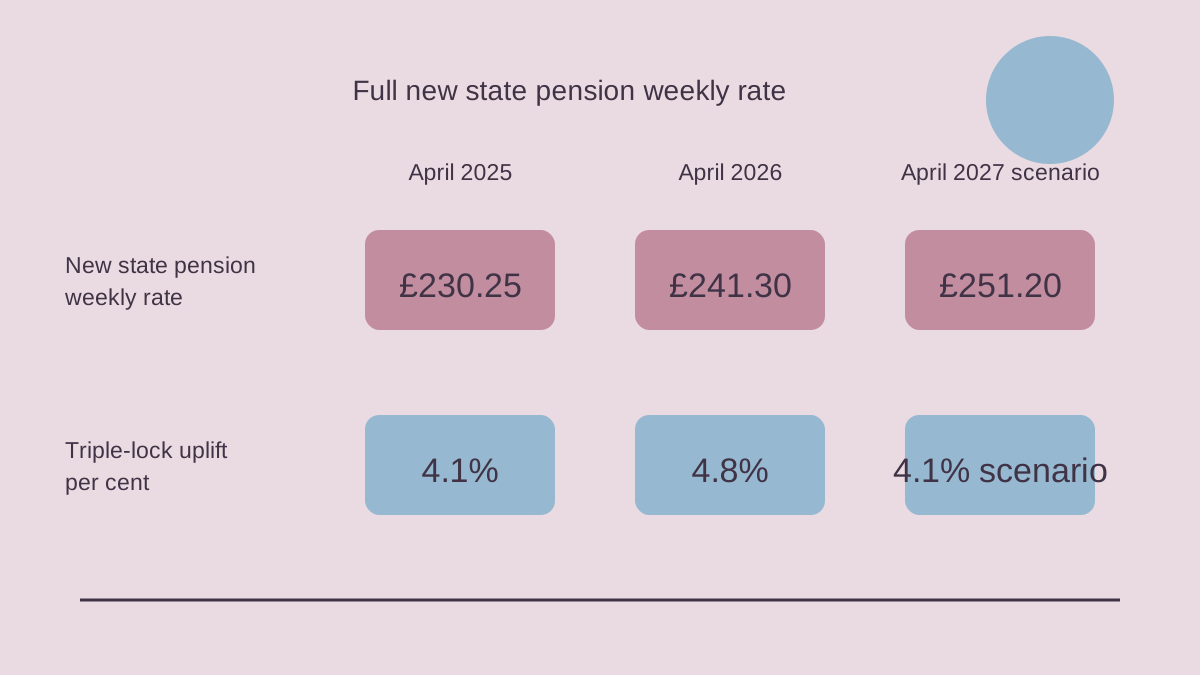
The uprating that took effect on April 6, 2026 followed the formula exactly. The relevant CPI rate was 3.8% and average wage growth was 4.8%, so the earnings figure was used. More than 12 million people received a boost worth up to 575 pounds a year. The full rate of the new state pension moved from 230.25 to 241.30 pounds a week, and the full basic state pension, which covers those who reached state pension age before April 6, 2016, rose from 176.45 to 184.90 pounds a week.
Placed in series, the April increases show why the lock bites hardest in volatile years: the state pension rose 10.1% in 2023, 8.5% in 2024, 4.1% in 2025 and 4.8% in 2026, a sequence the government-backed MoneyHelper website summarises with the phrase costing billions. Each of those steps was set by whichever component ran hottest, and in two of the four years that component was wages rather than prices.
A cost that outran its forecast
The fiscal critique rests on the gap between what the lock was expected to cost and what it costs. Last year the Office for Budget Responsibility, the government's economics watchdog, said the triple lock had cost around three times more than initial expectations because of economic volatility. Volatility is precisely the lock's design feature: in a normal year the three components sit close together, but after a pandemic and an inflation shock they diverged, and the lock paid out on the highest of them every time.
The IFS supplied the current arithmetic. The state pension bill this year is expected to reach 154 billion pounds, and spending is now 16 billion pounds a year higher than it would have been had the triple lock never existed. Looking further ahead, the thinktank estimates that by 2050 keeping the lock would probably cost about 20 billion pounds a year in today's terms, while stressing that the high uncertainty puts the actual bill anywhere between 5 billion and 40 billion pounds a year. That range is the honest version of the argument: nobody can price the lock precisely, because nobody can price four decades of wage and inflation surprises.
Who wants it gone, and why now
The latest intervention came from the British Chambers of Commerce, which called for the policy to be scrapped and the money saved to be put towards tackling the youth unemployment crisis. The business lobby's framing converts a pension question into a generational budget trade-off: the same billions that uprate pensions could, in its telling, fund labour market policy for the young.
Thinktanks have supplied the intellectual ammunition. The Resolution Foundation did not mince its words earlier in 2026, branding the triple lock a terrible policy. The IFS numbers give the critique its scale. And Jim O'Neill, the former economic adviser to Andy Burnham, argued that the bond markets, which have the power to make or break governments, would respond favourably if the chancellor were to take credible action to deal with the excesses of the triple lock or the excesses of welfare spending. In that framing the lock is no longer only a social contract but a signal to creditors.
The fairness argument across generations
Supporters answer with a different intergenerational claim. They say the lock is vital for maintaining the value of the state pension particularly for future pensioners, many of whom do not have access to the generous workplace schemes that older cohorts were able to join and are not saving enough for their retirement. On this reading, cutting the lock would shift risk onto exactly the generations with the thinnest private provision.
The budget of October 28 and the bond market's verdict
The chancellor, John Healey, could say something about the triple lock in his budget on October 28. Legally, the government is only required to increase the state pension in line with the average increase in wages, which means it could decide to scrap the lock in the future. MoneyHelper's own guidance notes the political caveat: such a decision would be very political, so an overnight change is unlikely.
The realistic menu is therefore gradual. In theory Healey could set out a timetable for change or put forward an alternative, for example moving to a double-lock system, linking the pension to just prices or just earnings, or adopting some other formula that aims to smooth out the volatility. Each option trades the lock's simplicity against its cost, and each would be judged by the market test O'Neill described as much as by the pensioner test Age UK describes.
The data calendar that will set April 2027
Before any of that is decided, the next uprating will be set by two published numbers. The wages figure for May to July, one of the three lock components, is due on the Tuesday after the Guardian's September 12 report, and the September CPI inflation figure will be published the week before the budget. The most recent available readings frame the contest: the April to June wages figure, announced in August, was 4.1%, while the July CPI figure was 2.9%.
The arithmetic of the scenario is straightforward. If the May to July wages figure also comes in at 4.1% and is the component used, it would add 9.90 pounds a week to the full new state pension, lifting it to 251.20 pounds. That single number will dominate the pre-budget debate, because it determines both the size of the April 2027 rise and the political temperature around the lock.
What to watch in the coming weeks
- The May to July average earnings figure, due Tuesday, and whether it confirms the 4.1% reading from the April to June period.
- The September CPI publication in the week before the budget, the second of the three lock components.
- Any reference to the triple lock in the October 28 budget statement by chancellor John Healey.
- Whether an alternative formula enters official discussion: a double lock, prices-only or earnings-only indexation, or another smoothing mechanism.
- Reaction in gilt markets to whichever signal emerges, given the argument that credible action on pension or welfare excesses would be rewarded.
Four ways the argument can end
Four coherent endings organise the uncertainty. In the first, the lock survives untouched: the October budget says nothing, the April 2027 rise lands near 4.1%, and the 154 billion pound bill keeps compounding toward the IFS's 2050 range. In the second, the lock is reformed prospectively: a timetable or a double lock is announced, preserving past gains while capping future volatility, the option most consistent with MoneyHelper's observation that change is unlikely to be overnight. In the third, the lock is scrapped outright and the saving is redirected, the BCC's demand, with the political cost falling on the party that removes a benefit 12 million households have just seen rise by 4.8%. In the fourth, the lock is quietly eroded: no announcement, but a technical change to the earnings measure or the reference months that lowers the average payout without touching the headline promise.
Each ending has a different winner and loser. Survival protects current and future pensioners without workplace schemes but entrenches a cost the OBR says ran at three times expectations. Reform protects the promise while trimming its volatility premium, at the price of a political fight over what replaces it. Scrapping frees billions for other priorities, starting with the youth unemployment programmes the BCC names, and immediately converts pensioner income into a campaign issue. Quiet erosion avoids the headline but risks the credibility cost of changing a formula that voters understand precisely because it is simple.
Why volatility is the lock's expensive ingredient
The sequence of April increases — 10.1% in 2023, 8.5% in 2024, 4.1% in 2025 and 4.8% in 2026 — is a record of volatility itself. In calm years the three components of the lock sit within a point or so of each other, and the formula costs little more than the earnings indexation the law requires anyway. In volatile years the components diverge by several points, and the lock converts the divergence directly into Exchequer cost: whichever series spikes, the pension follows it. That is why the Office for Budget Responsibility found the policy had cost around three times initial expectations, and why the Institute for Fiscal Studies' 2050 estimate comes with a range of 5 to 40 billion pounds rather than a single number. The lock does not create volatility; it prices it, at the highest available rate, every year.
The political economy of who defends the lock
The alignment of defenders and critics is as instructive as the arithmetic. Age UK, a charity, defends the lock as the instrument that rebuilt the value of the state pension for the poorest pensioners. The Liberal Democrats claim it as their coalition-era property, since it was a key demand of theirs in the negotiations with the Conservatives. The British Chambers of Commerce attacks it as a budget line that could fund youth unemployment policy, and two thinktanks, the IFS and the Resolution Foundation, supply the cost estimates and the verdicts, from three times expectations to a terrible policy. Into that map drops a purely political question the Guardian flags: the lock was introduced by Conservatives, has been consistently popular with many on the left, and now sits on the desk of a Labour chancellor, which adds extra spice to the speculation about whether it will be a Labour chancellor that gets rid of it.
What a double lock would and would not fix
The alternatives in circulation — a double lock, prices-only or earnings-only indexation, or another smoothing formula — each remove one of the three components and with it one source of surprise. A prices-only lock would pay the September CPI figure each year and miss the wage-driven steps; an earnings-only lock would drop the 2.5% floor that protects pensioners in low-inflation years; a double lock keeps two of the three components and therefore keeps part of the volatility premium while trimming its peak. What none of the alternatives fixes is the underlying exposure: a state pension bill of 154 billion pounds that grows with the number of pensioners and with the level of wages and prices in the economy. Reform changes the slope of the lock's cost curve, not its direction.
The practical consequence for an observer is simple: watch the two data publications and the wording of the October 28 statement rather than the rhetoric. If the statement contains a timetable or an alternative formula, bond markets get their signal and pensioners get a transition; if it does not, April 2027 runs on the existing formula and the lock's bill keeps moving toward the upper part of the IFS range, whichever component runs hottest.
The strategic conclusion
The triple lock debate of autumn 2026 is not really about 2.5%, CPI or average earnings. It is about whether a formula designed for stable times can survive the fiscal arithmetic of volatile ones, and who bears the adjustment when it cannot. The April 2026 rise showed the lock working exactly as designed for pensioners: 4.8%, up to 575 pounds a year, 12 million households. The IFS bill of 154 billion pounds and the 16 billion pound annual excess show the same mechanism working exactly as designed for the Exchequer's critics. Between those two truths sits the October 28 budget, and a wages figure of 4.1% that will decide whether the next chapter of the story is written by the chancellor or by the formula.
Just Published

European housing prices and rents

Schneider–PTC: the industrial data integration test behind the deal

Avio USA starts work on its Virginia manufacturing site

One equity market, two currency measures

Russia’s draft budget raises spending and borrowing plans

Russia Sets the 2027 Minimum Wage at 28,935 Rubles, Up 6.8%, on the Way to 35,000 by 2030
Partner news digest
 Qatar LNG expansion: readiness, financing and the production test
 Pennon’s capital plan: turning finance into better water outcomes
 Italy’s diesel relief gap: taxes, price ceilings and implementation
 EU–China hybrid trade: from understanding to measurable implementation
 Schneider–PTC: the industrial data integration test behind the deal
 IKEA’s hybrid resale model: buyback, marketplace liquidity and furniture logistics
 Banking AI beyond the ranking: capability, execution and evidence of value
 Fishing labour beyond the product label: practical protection
 Rhenus and the Middle Corridor: terminals need coordinated connections
 Royal Mail restructuring: the test is reliable delivery
 Fuel Finder on Google Maps: when price transparency becomes useful competition
 Samsung’s memory profit surge: what the preliminary record explains
Leave a comment