
Blue Granaries: How China Is Building Marine Ranches to Feed 1.4 Billion People
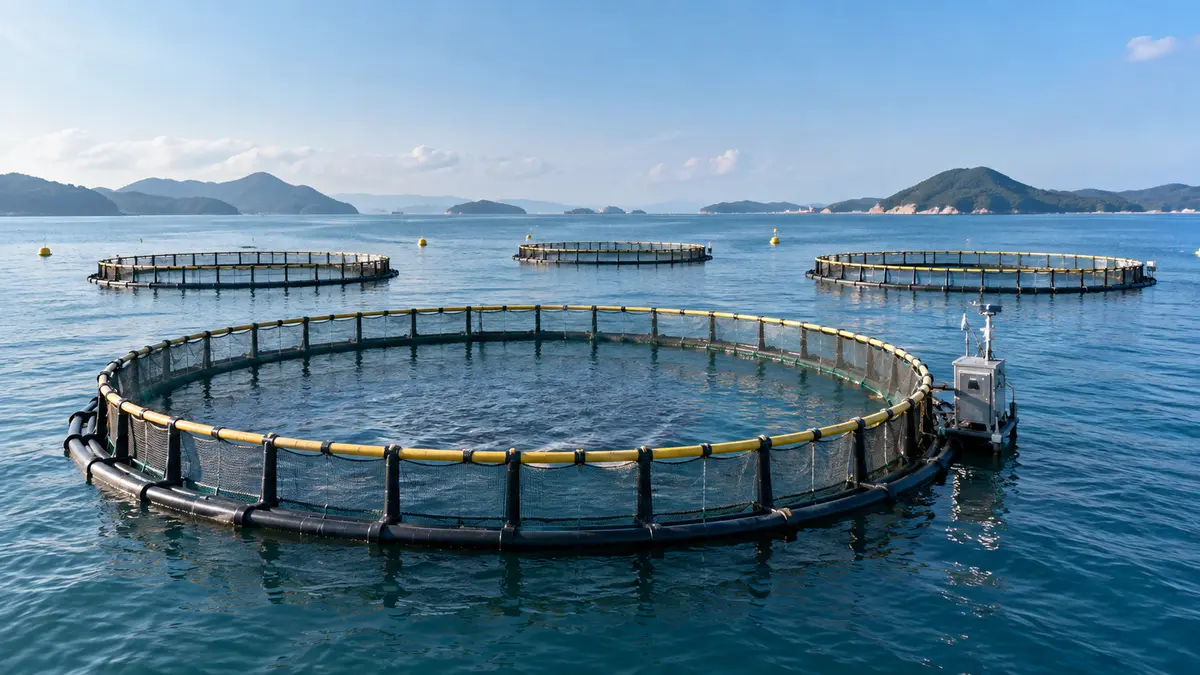
With an extensive coastline and a population of more than 1.4 billion, China is turning to the ocean to bolster food security by building modern marine ranches, constructions that official discourse dubs blue granaries in the vast blue ocean. By March 2025 the country had built more than 180 national-level marine ranches, the eastern province of Shandong ranked first with 71 of them, and this year's No. 1 central document had placed deep-sea and far-sea aquaculture among the channels through which the food supply system must be diversified. This is the anatomy of a food security strategy that runs on cages, sensors and weekend tourists.
The policy frame: food from land and sea
Chinese leaders have underscored the importance of utilizing both land and sea resources to enhance food production, and the policy instrument of 2025 makes the maritime part explicit. This year's No. 1 central document, the annual statement that sets the rural and agricultural agenda, stresses that work must be done to build a diversified food supply system and adopt an all-encompassing approach to agriculture and food. It says that efforts will be made to expand food resources through multiple channels, including promoting the high-quality development of fisheries and supporting the development of deep-sea and far-sea aquaculture and the construction of marine ranches.
The wording matters because it converts marine ranching from a local industry experiment into a national food security line. A ranch is not a fishing ground and not a fish farm in the pond sense: it is an engineered water area where cages, reefs and monitoring systems produce biomass under management. When the central document names it, budgets, provincial programs and bank lending follow.
180 national-level ranches and a Shandong core
In recent years marine ranching has gained momentum along the Chinese coast. In 2024 the city of Shanwei, in the southern province of Guangdong, invested more than 2 billion yuan, about 279 million U.S. dollars, to build eight marine ranches as well as cold chain and sales facilities, a single municipal commitment of the size of a mid-sized industrial program. To date, China has built more than 180 national-level marine ranches, and the eastern province of Shandong ranked top with 71 national-level marine ranches, accounting for 38 percent of the country's total, said Zhang Jiandong (Zhang Jiandong), head of the Oceanic Administration of Shandong Province.
The Shandong concentration is not accidental. The province combines a long rocky and sandy coastline, cold and clean currents, and a fishing industry with shipbuilding and processing capacity. A national-level designation is a quality and monitoring standard as much as a subsidy line, and holding 38 percent of the national total means Shandong effectively sets the operational template that other provinces copy.
Inside the cage: 94,000 cubic meters of Class I water

As the spring aquatic farming season started in March 2025, Liu Yulei (Liu Yulei) began his work on a marine ranch with eight giant aquaculture cages located 42 nautical miles off the coast of Yantai. Each cage, 68 meters long and wide, could enclose 94,000 cubic meters of seawater, providing an optimal environment for 1 million fish with an annual fish catch of 1,000 tonnes. The fish farm is built here with Class I water quality and suitable temperature and salinity, Liu said, adding that with strong currents moving at 1.5 meters per second, the water in the cage could be completely refreshed within dozens of seconds, much more frequently than in traditional aquaculture facilities.
The physics of that sentence is the core of the ranch model. Water exchange is the limiting factor of every aquaculture system: waste, heat and pathogens accumulate where exchange is slow. A cage placed 42 nautical miles offshore, in a current of 1.5 meters per second, outsources water treatment to the ocean itself, and the density of 1 million fish per cage becomes sustainable without the antibiotics and mortality spikes of sheltered inshore farming.
Four workers and one million fish
Work on the marine ranch is busy but far easier than traditional fish farming, Liu noted: only four workers can oversee a cage. Each giant cage is equipped with advanced sonar, lidar and binocular vision systems that allow workers to monitor the fish population, distribution and health, equipment, water quality, hydrology and meteorological conditions in real time. The labor ratio, four people per million fish, is the number that separates the ranch from the pond: it is an industrial staffing level, not an agricultural one.
Automation also changes the risk profile. A storm that would destroy an inshore pen is met offshore by a cage designed for open water and by sensors that report its state continuously; a disease event is detected in the distribution data before it becomes a mortality event. The ranch converts biological risk into monitored engineering risk.
The economics of a cage
The arithmetic of the Yantai ranch is simple enough to read as a business plan. Eight cages of 1 million fish each, with an annual catch of 1,000 tonnes per cage, give a single ranch an annual output of about 8,000 tonnes of fish, a volume comparable to a large onshore processing plant's intake, produced by a crew measured in dozens rather than hundreds. Shanwei's eight new ranches, funded by the 2 billion yuan commitment of 2024, would add roughly ten times that figure to Guangdong's farmed output once fully stocked, before counting the cold chain and sales facilities built alongside them.
These are arithmetic implications of the published cage parameters, not company forecasts, but they show why provincial governments compete for national-level designations. A cage is a fixed asset with ocean-scale throughput: once moored, its marginal cost is feed, juveniles and four salaries, while its marginal product is a thousand tonnes a year. Few assets in the food economy offer that ratio, which is why the ranch pipeline, not the fishing fleet, is where Chinese aquaculture capital now accumulates.
Feeding science: from waste to precision
The second transformation is less visible and equally important. We used to lack proper feeding knowledge, which led to excessive food waste accumulating on the seabed, said Luan Jianguo (Luan Jianguo) from another marine ranch off Changdao Island of Yantai. Now, with scientific breeding, we have significantly improved both quality and output while also protecting the marine environment. Feed is the largest operating cost of aquaculture and its largest pollutant: uneaten pellets settle, consume oxygen and degrade the seabed. Precision feeding, guided by the same sensor stack that watches the fish, attacks the cost line and the environmental line at once.
The environmental argument is also the political one. Marine ranching is presented as the sustainable alternative to both overfishing and dirty inshore farming, and the seabed under a cage is the evidence regulators and neighbors check first. A ranch that cannot keep its floor clean loses its social license faster than one that loses money.
The monitoring stack as a production asset
It is worth naming what the sensor stack actually replaces. In traditional inshore farming, the farmer's knowledge of the stock is indirect: feeding response, surface behaviour and occasional net checks. On the ranch, sonar measures biomass and distribution, lidar resolves the geometry of the school, and binocular vision systems read health indicators at the surface, while water quality, hydrology and meteorology streams close the loop. The cage becomes a measured production unit, and management decisions move from intuition to data with a latency of seconds.
That shift has a financial expression. Measured biomass is financeable biomass: a bank that can verify 1 million fish in a cage through monitoring data can lend against them, and an insurer can price storm and disease risk on recorded parameters rather than on claims history. The ranch model therefore pulls capital into aquaculture through the same door as precision farming pulled it into agriculture a decade earlier, and the 180 national-level ranches are the visible part of that credit story.
The partnership layer: juveniles from coastal farmers
A local fishing company purchases juvenile fish of certain sizes from local seafood farmers, and the partnership means a faster return on investment, lower financial risks and a larger seafood production with better quality. The division of labor is deliberate: hatchery and nursery stages, the most delicate and the most exposed to disease, stay with small coastal operators close to shore; the grow-out stage, which needs volume of clean water, moves to the offshore cages. The ranch becomes the anchor buyer of a coastal supply chain rather than a competitor of the small farmer.
This layer explains why provincial governments support ranching beyond its direct output. Each cage of 1 million fish creates demand for juveniles, feed, logistics, maintenance and processing on the coast, and the employment it sustains is distributed across dozens of small enterprises rather than concentrated in one company.
A template that travels
The Shandong share of 38 percent of national-level ranches makes the province the de facto author of the operating template: cage geometry, monitoring standards, juvenile procurement contracts and tourism decks are first proven off Yantai and then copied by Guangdong, Fujian and Liaoning programs. Zhang Jiandong's figure is therefore more than a ranking; it is a measure of how much of the national learning curve sits in one province's waters. When the next hundred ranches are built, the question will not be whether the model works but whether the copy preserves the parts that make it work: the distance from shore, the current speed and the discipline of the feeding regime.
The second revenue line: tourism on the ranch
Marine ranching also creates new business opportunities as some ranches offer travel services to tap into the consumer market better. Off the coast of Yantai's Laishan District, the Genghai No. 1 ecological marine ranch complex integrates aquaculture and tourism facilities to generate additional revenues. On weekends, tourists visit the complex for an immersive marine experience: on the main deck, visitors can engage in interactive activities such as a deep-sea elevator simulation using VR and AR devices, participate in recreational fishing and enjoy the sea view.
Genghai No. 1: 71 rooms above the cages
We provide 71 sea-view hotel rooms, and guests can also enjoy freshly caught seafood at our canteen, said Yan Haidong (Yan Haidong), deputy general manager of Shandong Ocean Harvest Corporation (Shandong Ocean Harvest Corporation), which operates the complex. Low carbon is also at the core of the complex's operation: our total installed solar and wind power capacity is 426 kW, with power generation of approximately 500,000 kWh annually, Yan added. The tourism line does two jobs at once. It adds a revenue stream that does not depend on fish prices, and it turns consumers into visitors who see, taste and therefore trust the product, a marketing channel no advertising budget can buy.
The wild stock context: what the moratorium adds
The ranch expansion runs parallel to a disciplined regime for wild stocks. On Sept. 1, 2025, hundreds of fishing vessels set sail from Shidao port in Shandong as a four-month fishing moratorium ended in the Bohai Sea and the Yellow Sea north of latitude 35 degrees; boat owner Wang Jie (Wang Jie), whose vessel targets Spanish mackerel and hairtail, reported a single voyage capable of yielding about 25,000 to 40,000 kilograms of fish. Thanks to the seasonal fishing ban, both the size and quality of catches have improved significantly in recent years, he said. Xue Ying (Xue Ying), a professor at the Ocean University of China (Ocean University of China), noted that since the moratorium was implemented in 1995, catches of species such as hairtail and anchovy have remained stable while Spanish mackerel, pomfret and squid have shown steady growth, and the average daily catch per vessel has also increased.
Two weeks later, on Sept. 16, 2025, more than 4,000 vessels set sail for the East China Sea as its four-and-a-half-month summer moratorium ended, with 81 patrol boats, 38 aircraft and over 700 law enforcement officers dispatched to patrol key routes; the ban there had been partially lifted on Aug. 5 for licensed trawlers and cage fishing boats. The combination of a protected wild stock and a growing farmed stock is the full shape of the blue granary policy: the moratorium defends the natural capital, the ranches add the incremental protein.
What the ranch model changes
The 2025 picture can be summarized in a short list of structural shifts:
- Scale: more than 180 national-level marine ranches, with Shandong holding 71, or 38 percent of the total.
- Engineering: cages of 68 by 68 meters enclosing 94,000 cubic meters of Class I water, 42 nautical miles offshore, each holding 1 million fish for an annual catch of 1,000 tonnes.
- Labor: four workers per cage, supported by sonar, lidar and binocular vision monitoring in real time.
- Environment: precision feeding that cuts seabed waste, and offshore currents refreshing cage water within dozens of seconds.
- Supply chain: juveniles purchased from coastal farmers, spreading investment risk and returns across the coast.
- Revenue mix: tourism complexes such as Genghai No. 1 with 71 sea-view rooms, VR experiences and a canteen, powered in part by 426 kW of solar and wind capacity.
- Wild stocks: summer moratoriums in place since 1995, with 2025 seasons reopening in September under patrol by 81 boats and 38 aircraft in the East China Sea.
Outlook: the ocean as a managed asset
The logic of the blue granary is that a country of 1.4 billion people cannot feed itself from arable land alone, and that the sea, unlike land, can be engineered vertically. The ranch model of 2025 shows the three ingredients the policy needs: capital, visible in Shanwei's 2 billion yuan commitment; technology, visible in the sensor stack and the feeding science; and social acceptance, visible in the tourism decks and the coastal partnerships. What remains unproven is the behavior of the model under stress: a typhoon season that tests the cages, a disease event that tests the monitoring, a price cycle that tests the tourism cross-subsidy.
The answer will come from the provinces that copy Shandong. If the template travels, the national-level count will keep climbing and the phrase blue granary will stop being a metaphor; if it does not, the 180 ranches will remain a coastal archipelago of excellent pilots. Either way, 2025 is the year the ocean entered China's food security arithmetic as a managed asset rather than a hunting ground.
The labor dimension deserves its own line in the outlook. Four workers per cage is not only a cost figure; it is an answer to the ageing of China's fishing communities. The ranch offers coastal youth a job with sensors, shifts and a deck that returns to port, instead of a berth on a trawler that does not, and the tourism layer adds service jobs that families can hold without leaving their districts. Food security policy that cannot recruit labor is a plan on paper; the ranch is currently the only marine format that recruits.
Just Published

European housing prices and rents

Schneider–PTC: the industrial data integration test behind the deal

Avio USA starts work on its Virginia manufacturing site

One equity market, two currency measures

Russia’s draft budget raises spending and borrowing plans

Russia Sets the 2027 Minimum Wage at 28,935 Rubles, Up 6.8%, on the Way to 35,000 by 2030
Partner news digest
 Qatar LNG expansion: readiness, financing and the production test
 Pennon’s capital plan: turning finance into better water outcomes
 Italy’s diesel relief gap: taxes, price ceilings and implementation
 EU–China hybrid trade: from understanding to measurable implementation
 Schneider–PTC: the industrial data integration test behind the deal
 IKEA’s hybrid resale model: buyback, marketplace liquidity and furniture logistics
 Banking AI beyond the ranking: capability, execution and evidence of value
 Fishing labour beyond the product label: practical protection
 Rhenus and the Middle Corridor: terminals need coordinated connections
 Royal Mail restructuring: the test is reliable delivery
 Fuel Finder on Google Maps: when price transparency becomes useful competition
 Samsung’s memory profit surge: what the preliminary record explains
Leave a comment