
The Goods Recession: How Tariff Frontloading Left U.S. Freight Facing a December Cliff
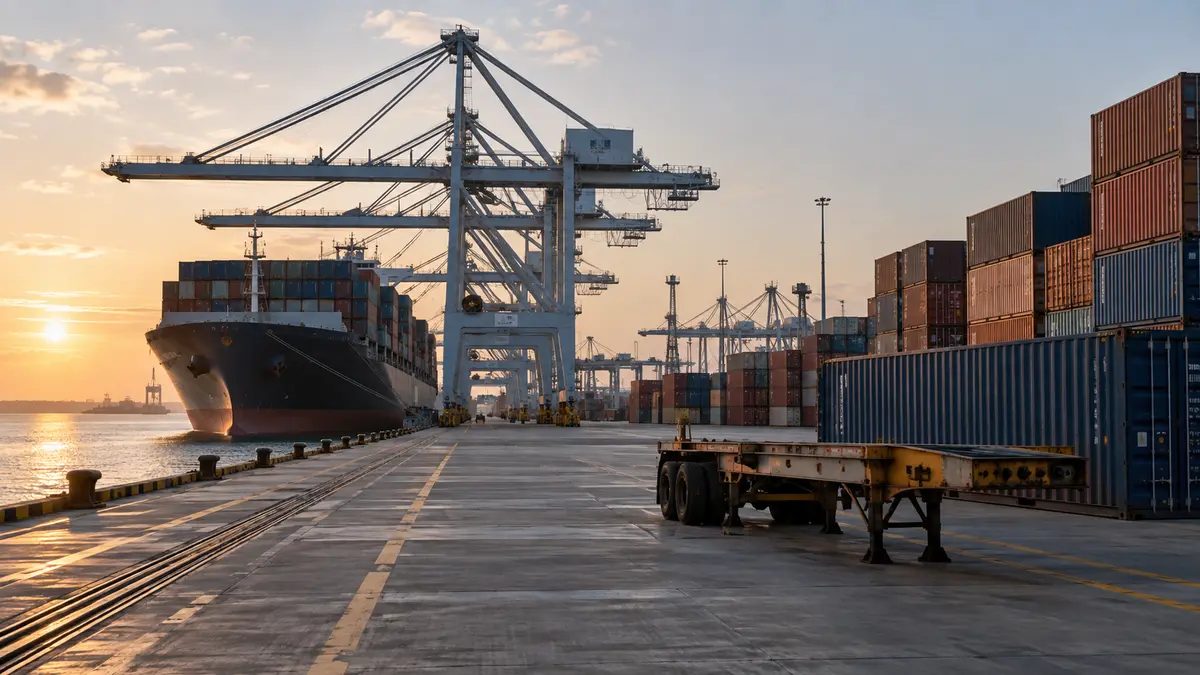
The impact of President Donald Trump's tariffs continues to rip through the logistics and transportation sectors of the United States: major ports are experiencing a steep drop in imports after records were set earlier this year, and volumes throughout the supply chain are rolling over. What began as a tariff story has become a freight story, and the freight story now has a name in the industry's own vocabulary - a goods recession.
October: the first month everything fell at once
For the first time in 2025, rates for van, flatbed, and refrigerated loads in October were all lower on both a month-over-month and year-over-year basis, according to the DAT Truckload Volume Index. Van truckloads were down 3% compared with September and 11% year over year; refrigerated truckloads were down 2% month over month and 7% year over year; flatbed truckloads were down 4% month over month and 3% year over year. The reduced level of dry van and temp-controlled loads moving through the supply chain is goods moving from distribution centers to retailers - the last, most demand-sensitive leg of the import chain.
Ken Adamo (Ken Adamo), DAT's chief of Analytics, read the numbers as a mirror of the wider goods economy: freight volumes in the third quarter and October reflect what is happening in the broader goods economy, with shippers drawing on inventory built up earlier in the year to reduce their exposure to tariffs and weak consumer demand. As a result, the traditional peak holiday shipping season looks virtually non-existent this year.
The census number behind the truck numbers
The trucking data sits on top of a trade shock. The latest U.S. Census Bureau data, released after a more than month-long delay due to the government shutdown, showed a significant decline in imports in August after additional tariffs went into place: $18.4 billion less than the level of July imports. The import drop contributed to a decline of more than 23% in the nation's trade deficit, according to Census.
A shrinking trade deficit is usually reported as good news. In freight terms it is the opposite: the deficit is, among other things, the measure of how much physical stuff arrives to be moved, stored and delivered. When August imports fall by $18.4 billion in a single month, the trucking, warehousing and port-labor economies that monetize movement feel the hole within weeks.
Ports: the 16 percent hole from China

At the Port of Long Beach, the nation's second-busiest port, recent freight container tracker data shows that tariffs will continue to chip away at ocean freight heading to the U.S. You're looking at a 16 percent decrease in Chinese imports coming to the United States, said Mario Cordero (Mario Cordero), the port's chief executive. The decrease is across the board, he added. The Port of Los Angeles also recorded a dip in container volumes in October.
Electronics, furniture, and toys have been identified in this freight pullback. U.S. grain exports have also been hit by trade policy, with China increasing its purchase of soybeans from Brazil during the trade war - although, as part of an easing of trade tensions, China did recently commit to buying more U.S. soybeans.
Frontloading: the boom that built the bust
The decrease in containers follows a period of trade frontloading during which retailers and manufacturers brought in freight early as they attempted to navigate multiple tariff deadlines and rate changes, leading to big jumps in port traffic. Frontloading is rational for an individual importer and destructive for the system: it converts a year of demand into a quarter of arrivals, fills warehouses, and then leaves the following months with nothing to move because the goods are already onshore.
The residue of that boom is still visible in the route data. Global containers to the West Coast are up 10% year-over-year, according to the real-time container tracking platform Vizion, and containers from China to the U.S. West Coast are up 4.6% year-over-year - the most popular route for Chinese goods coming to the U.S. because it has the shortest travel time. East Coast ports, including Houston, have seen a modest 2 percent increase year over year in container volumes, while China containers on that side are down 12 percent. The averages still carry the spring surge; the monthly flow has already turned.
December: 430,000 missing TEUs
The forward book makes the turn explicit. We are now forecasting nearly a 16.6 percent year-over-year decline for U.S. imports in December, after a 12% decline in Q3, said Ben Tracy (Ben Tracy), vice president of strategic business development at Vizion. There is no bounce back in sight, he said. Containers set to arrive at U.S. ports in December 2025 number 2.19 million twenty-foot-equivalent units versus 2.62 million TEUs last December - a volume loss of over 430,000 TEUs causing a knock-on effect throughout the supply chain.
For the first time since March 2023, we're seeing monthly import volumes consistently fall below 2 million TEUs, said Kyle Henderson (Kyle Henderson), Vizion's chief executive. This isn't just a seasonal dip or temporary correction: the data shows a structural goods recession driven by the convergence of tariff uncertainty, frozen housing markets, and a fundamental shift in consumer spending away from physical goods.
What the category data says about the consumer
The category detail is where the structural claim gets its evidence. When furniture imports collapse 33 percent and toy imports - which historically surge 40-50 percent ahead of the holidays - barely rise 17 percent, Henderson argued, that tells you retailers are betting on the weakest consumer season in years. Vizion data also shows container utilization has dropped from 100 percent to 91 percent.
Retail earnings of the same week told a mixed but consistent story. Retailers and manufacturers have put a pause on robust freight orders because of fears of a consumer pullback due to food and consumer product inflation; reports from Home Depot and Target were downbeat, while Walmart posted strong results and said more consumers are focused on value, with more of its sales coming from upper-income shoppers. A consumer trading down buys fewer big-ticket physical goods - exactly the cargo classes that fill containers and flatbeds.
Spot rates, utilization and the overcapacity decade
The price side confirms the volume side. Along with spot rates at two-year lows, we're staring down a decade of overcapacity, Henderson said. This isn't a volume blip - it's a major reset of freight demand fundamentals. The freight market is already feeling the pain, he added. Overcapacity is what a fleet built for the frontloaded spring meets when the winter book shrinks by 430,000 TEUs: too many assets chasing too few loads, which is precisely the configuration in which spot rates at two-year lows stop being a cycle and start being a baseline.
Who absorbs the missing volume
The knock-on effect of the missing TEUs runs through every business model that monetizes movement and storage:
- Railroads, whose intermodal segments price off port gate volumes.
- Trucking, where October's van, reefer and flatbed declines already show the retail replenishment leg thinning.
- Warehouses, whose storage revenue followed the frontloaded inventory and now follows it down.
- Port labor: less freight means a reduced need for daily longshoremen to move the containers.
Labor is absolutely concerned, Cordero said. It goes back again to job decreases, job anxiety: when you have reduced volume, you're going to have an impact on the jobs in the supply chain, certainly on the docks at the Port of Long Beach. The International Longshoremen's Association, the port labor responsible for the movement of freight, receives a yearly container bonus based on the amount of freight moved - a contractual link between trade policy and dock pay.
The India channel: a second collapsed lane
In addition to the China tariffs, tariffs on India have collapsed the freight market servicing this trade, according to Vizion. The Global Trade Research Initiative reported a massive 37.5% drop in overall Indian export value to the U.S. between May and September 2025; India's exports face a 50% tariff. A lane that disappears does not merely shrink a route: it strands the vessels, chassis, drivers and warehouse slots configured for it, adding to the overcapacity Henderson describes.
Still in the black - for now
The good news is we're still in the black, Cordero said of Long Beach. While he said a fourth-quarter decline was expected, what comes next is pivotal: it remains to be seen, the resilience of the American consumer and their spending activity, and the next two months will be really telling about the diminishment of that growth. That is the honest summary of the moment: annual totals still carry the frontloaded spring, monthly flows have already turned, and the industry's own trackers are pricing a December that has no seasonal rescue in it.
West Coast, East Coast: one shock, two readings
The route split shows how the shock redistributes rather than simply removes volume. Global containers to the West Coast are up 10% year-over-year and China-to-West-Coast boxes are up 4.6%, because that lane has the shortest travel time and absorbed the frontloading first; East Coast ports including Houston show a modest 2% rise in total volumes while China containers there are down 12%. The West Coast carries the memory of the spring surge; the East Coast already shows the China-specific hole. Read together, the two coasts describe a market in which the aggregate has not yet caught up with the marginal flow.
Why the holiday season disappeared
The vanished peak is the consumer-facing face of the same mechanism. Toy imports historically surge 40-50% ahead of the holidays; this year they barely rose 17%, and furniture imports collapsed 33%. Retailers that frontloaded spring arrivals entered autumn with warehouses full and orders paused; retailers that did not frontload face tariff costs on replenishment they would rather defer. Both behaviours produce the same October: no seasonal build, because the seasonal inventory was bought in March.
The labor link: daily hires and the container bonus
The dock is where the volume hole becomes a household hole. Less freight means a reduced need for daily longshoremen, and the International Longshoremen's Association receives a yearly container bonus on the amount of freight moved - so a 430,000-TEU December gap subtracts twice from dock incomes: once from daily hours, once from the annual bonus base. Cordero's formulation - labor is absolutely concerned - is the port's way of saying that trade policy has entered payroll.
The census delay and the data gap
One technical detail deepens the uncertainty: the August census print arrived after a more than month-long delay due to the government shutdown. Freight planners priced October and November against stale official data while their own trackers - DAT's volume index, Vizion's arrival books - filled the gap in real time. The episode shows how a goods recession is governed in practice: private telemetry leads, official statistics lag, and decisions about drivers, chassis and dock gangs are made on the former.
Who wins in a goods recession
Every reset has beneficiaries, and November's data highlights them. Spot rates at two-year lows favour shippers who still have cargo to move: their tender prices fall exactly when carriers need loads. Warehouses that signed long spring contracts on space sell scarcity that no longer exists until those contracts expire. And East Coast ports, where China containers are down 12% but total volumes are up 2%, show how route diversification cushions the blow: a lane that lost China still stands on the rest of its trade. A goods recession hits the average but pays those holding options on other people's distress.
What would reverse the reset
Three observable developments would change the picture: tariff clarity that lets retailers resume steady ordering instead of lumpy frontloading; a thaw in housing that returns durable goods to the container mix; and consumer spending that stops trading down away from physical goods. Until at least one appears, the industry's own language - structural goods recession, decade of overcapacity, no bounce back in sight - remains the operating assumption for 2026 planning.
For port executives the question is narrower and closer: Cordero's next two months of consumer data decide whether the fourth-quarter decline is a trough or a step. For carriers and warehouses it is narrower still - how much of the frontloaded spring's capacity to keep paid through a winter that the arrival books already describe.
Reading the reset
Three mechanisms, all visible in the same dataset, produce the goods recession. Tariff uncertainty converts steady ordering into lumpy frontloading and then into pause. A frozen housing market removes the durable-goods backbone of container demand. A consumer shift away from physical goods removes the rest. None of the three is a shipping problem, and all three settle on shipping's income statement first, because freight is the first place where a cancelled order stops paying anyone.
The strategic conclusion for the logistics sector is uncomfortable but clear: capacity added for a frontloaded boom is capacity idle in a structural reset. The next two months of consumer data, in Cordero's framing, decide whether 2026 opens as a recovery year or as the second year of the goods recession.
Just Published

European housing prices and rents

Schneider–PTC: the industrial data integration test behind the deal
Avio USA starts work on its Virginia manufacturing site

One equity market, two currency measures

Russia’s draft budget raises spending and borrowing plans

Russia Sets the 2027 Minimum Wage at 28,935 Rubles, Up 6.8%, on the Way to 35,000 by 2030
Partner news digest
 Qatar LNG expansion: readiness, financing and the production test
 Pennon’s capital plan: turning finance into better water outcomes
 Italy’s diesel relief gap: taxes, price ceilings and implementation
 EU–China hybrid trade: from understanding to measurable implementation
 Schneider–PTC: the industrial data integration test behind the deal
 IKEA’s hybrid resale model: buyback, marketplace liquidity and furniture logistics
 Banking AI beyond the ranking: capability, execution and evidence of value
 Fishing labour beyond the product label: practical protection
 Rhenus and the Middle Corridor: terminals need coordinated connections
 Royal Mail restructuring: the test is reliable delivery
 Fuel Finder on Google Maps: when price transparency becomes useful competition
 Samsung’s memory profit surge: what the preliminary record explains
Leave a comment