
The 50% Letter: How a Tariff Threat Met a Disease-Scarced Orange Juice Market
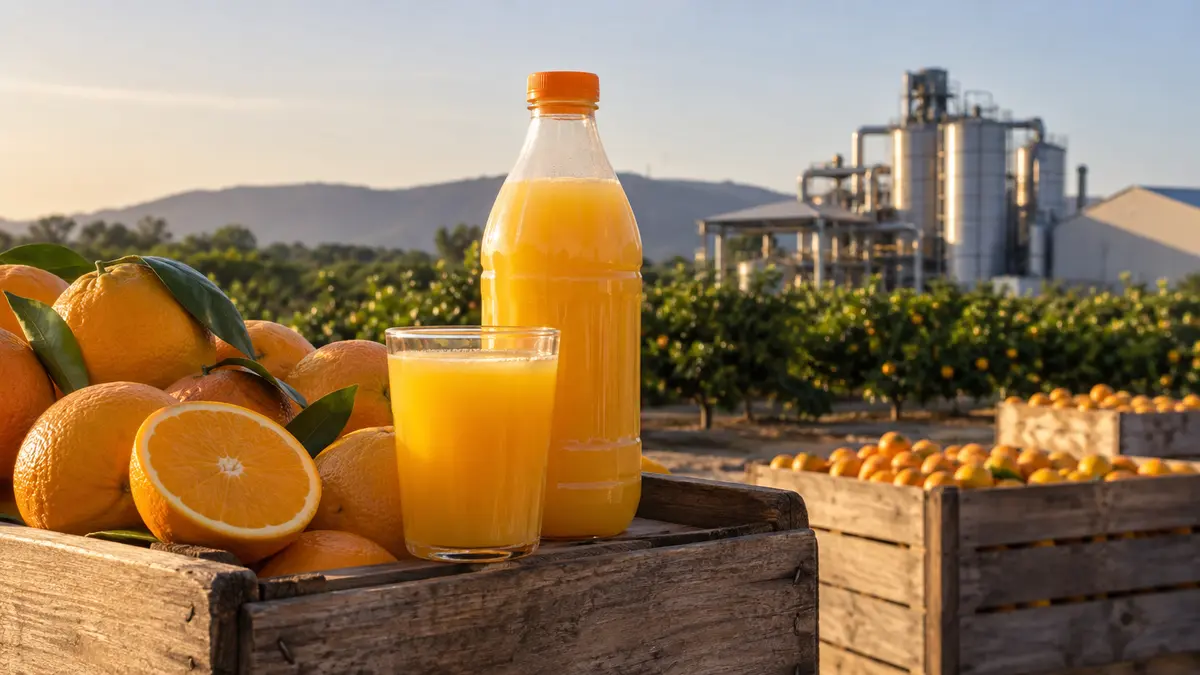
In July 2025 the world's most traded breakfast commodity collided with trade politics: frozen concentrated orange juice futures jumped nearly 40% in a month, most of it after President Donald Trump's July 9 letter threatening a 50% tariff on all Brazilian imports from August 1. In the United States, Johanna Foods — the supplier of nearly three quarters of private-label not-from-concentrate juice — sued the White House, warning of a 20-25% price rise. In the United Kingdom, a one-litre own-label carton that cost 76p in 2020 now sells for 1.79 pounds. This feature traces how a disease, a drought and a tariff letter turned a staple into a case study of pass-through economics.
The lawsuit that put a tariff on the breakfast table
Johanna Foods is not a household name, but its product is on millions of tables: the company says it supplies nearly 75% of all private-label not-from-concentrate orange juice to U.S. customers, including Walmart, Aldi, Wegmans, Safeway and Albertsons. In July 2025 it filed suit against the White House over the threatened Brazil tariff, arguing that the president's July 9 letter to President Luiz Inacio Lula da Silva cites no legal or statutory authority, is not an executive order, and identifies no national emergency or unusual and extraordinary threat as required by the International Emergency Economic Powers Act. The company asked the Court of International Trade to declare that IEEPA does not grant the power to impose the tariff.
The commercial stakes in the filing are concrete. Chief executive Robert Facchina said the duty would deliver an estimated 68 million dollar hit, exceeding any single year of profit since the company was created in 1995. Layoffs of union manufacturing employees and administrative staff, and reduced production capacity at the company's plants in Flemington, New Jersey, and Spokane, Washington, would be near-certain if the tariffs took effect; Johanna Foods employs almost 700 people across the two states. The company's attorney Marc Kaplin wrote that the Brazil ingredients are not reasonably available from any supplier in the United States in sufficient quantity or quality. The White House responded that the administration is legally and fairly using tariff powers granted by the Constitution and Congress.
The tariff arithmetic
The July 9 letter justified the 50% rate by reference to Brazil's treatment of former president Jair Bolsonaro, to alleged censorship of U.S. social media platforms, and to unsustainable trade deficits. The last claim is the easiest to test: U.S. Trade Representative data show the United States ran a goods trade surplus with Brazil of more than 7 billion dollars last year. U.S. International Trade Commission data put Brazil as the 18th-largest source of U.S. goods imports, at more than 42 billion dollars. For a juice importer, the political rationale matters less than the rate: a 50% duty on the concentrate that cannot be sourced domestically is, arithmetically, a consumer price increase with a legal argument attached.
By the time of the lawsuit the futures market had already priced the threat: orange juice futures, the global benchmark, were up nearly 40% over the previous month, with most of the increase coming after the tariff letter. The Bureau of Labor Statistics showed the average price of a 16-ounce container rising 23 cents, or more than 5%, over the year to 4.49 dollars. Johanna Foods estimated the eventual retail effect of the duty at 20-25%.
A market already at record before politics arrived

The tariff landed on a market that had just lived through its own extreme. In the United Kingdom, the BBC's economics editor Faisal Islam followed one product to tell the wider grocery story: a litre of supermarket own-label orange juice that cost 76p in 2020 reached 1.79 pounds, a 134% rise, and was up 29% in the past year alone. In cafes, 3.50 to 4 pounds became a standard price for a glass; one restaurant bill in Kent charged 5.30 pounds for a freshly squeezed glass.
Behind the carton sits the drum. At Basildon in Essex, Gerald McDonald and Co — a blending house importing concentrate since the 1940s — watched the global price climb from 1 to 1.50 dollars per pound over a decade to a record 5.30 dollars per pound by the end of 2024, with spot offers briefly quoted at 7 dollars per kilogram around September. Maxim McDonald's summary of the move — from 2 dollars to 7 is insane, but it took a while to filter through to consumers — is the cleanest description of pass-through lag available in the trade.
Five bad harvests and one bacterium
The price record was agricultural before it was political. Five years of poor crops, driven by severe drought and by citrus greening, a bacterial disease spread by insects, left Brazil with its worst crop since 1988; in parts of its citrus belt two thirds of orange trees are affected. Florida, the other historical exporter, produced its smallest crop since the Great Depression amid hurricanes and the same disease, which also reduces the sugar content of the fruit and makes oranges less sweet. Not many buyers take Florida fruit any more unless a label requires it, McDonald told the BBC.
The industry's structure amplified the shock. The supply of oranges is concentrated in Brazil even more tightly than crude oil is in the hands of its largest exporters, and within Brazil the market sits with a few industrialized conglomerates. Alternatives exist but are thin: Morocco, Egypt and South Africa grow oranges in limited volumes, while Spain exports its Valencia and Seville fruit mostly as fresh oranges rather than concentrate — and Spain suffered its own weather slumps, including the Valencia floods. A concentrated supply base with no swing producer is precisely the configuration in which a disease becomes a price event.
The corporate casualties
The stress travelled up the brand chain. Tropicana, the marquee U.S. brand, had to restructure its debts in 2025, and Pepsi sold most of its stake; one leading Tropicana supplier sold land earlier in the year to build homes. Tropicana's answer in the U.S. market was an essentials line of blends combining orange, apple and pear juice at a lower price point — product engineering as margin defence.
Substitution: the market's pressure valve
Where price cannot fall, recipes move. British shelves show orange mixed with mango, mandarin and clementine juice; mango puree is especially cheap on the back of a good harvest in India, and mandarin concentrate costs less than its orange equivalent because demand for it is thinner. The blends save money and preserve the traditional sweetness that greening-damaged oranges no longer guarantee. Substitution of this kind is not a consumer choice but a manufacturer's: the taste stays familiar while the fruit behind it changes, and the concentrate invoice shrinks.
Trade wars on both sides of the Atlantic
The tariff layer came from several directions at once. After Canada put counter-tariffs on U.S. exports, American orange juice shipments to Canada slumped to a 20-year low; the then prime minister Justin Trudeau warned Canadians might have to forgo Florida juice. The Trump administration settled on a 10% tariff on Brazilian orange juice, which feeds into U.S. supermarket prices. In the United Kingdom, 2024 tariff eliminations on some fruit-based imports helped at the margin but were vastly outweighed by the underlying price, while new Extended Producer Responsibility packaging rules added a weight-based fee that hits glass bottles hardest; a Bank of England report in August named such regulations among the drivers of food price inflation.
Demand is not waiting
The demand side of the equation is quietly shrinking. Global orange juice consumption is down about 30% from its peak two decades ago, partly on price and partly on perception: parents who do not give juice to young children raise adults who do not drink it, notes Philip Coverdale of GlobalData. Growth survives where middle classes expand — China, South Africa, India — while elsewhere exotic juices such as mango, pear and pomegranate take shelf space. An estimated 2.5 billion gallons are still drunk each year, about a tenth of them in the United Kingdom, where the market keeps growing. A shrinking but habit-loyal demand base is the worst possible customer for a supply shock: it absorbs price rather than abandoning the product.
What the market watches next
- The Brazilian harvest: a continued recovery is the single greatest hope for price normalization, and it coincides with sinking demand.
- The IEEPA litigation: a ruling against the Brazil tariff would remove the 50% tail risk from U.S. private-label juice.
- Concentrate bought at record prices: drums purchased at 5.30 dollars per pound keep retail prices elevated long after futures fall.
- Blend share: every mandarin or mango percentage point is a permanent reduction in orange intensity per carton.
- Harvest volatility: Aldi's UK chief executive Giles Hurley says volatility has reduced and savings will be passed on; parts of the supply chain doubt it.
The pass-through asymmetry
The orange juice story exposes a general law of grocery economics: an upward price shock travels around the world far faster than a downward one. Steve McCorriston, professor of agricultural economics at the University of Exeter, offers one reading of the British data — retailers may not have passed through the full cost increase at first, and current prices are partly recouping margin they would otherwise have earned. The Office for National Statistics context supports a broader squeeze: beef and veal up almost 25% in a year, butter almost 19%, chocolate and coffee around 15%, milk over 12%. Orange juice is the loudest voice in a chorus.
The long game is biological. Major producers including Coca-Cola, owner of Minute Maid and Innocent, fund a Save the Orange project using artificial intelligence to search for a way to combat citrus greening — a multi-year bet whose payoff, if it arrives, will reach grocery bills slowly, if at all. Until then the market remains what the last three years made it: a concentrated supply, a disease with no cure in the field, a demand that shrinks but does not leave, and a tariff regime that can add 50% to the invoice with a single letter.
The Basildon window: how a drum becomes a carton
The mechanics of the lag are visible in one Essex industrial unit. Gerald McDonald and Co, named after a great-grandfather who was importing orange concentrate as far back as the 1940s from what was then British-mandate Palestine, receives green steel drums of frozen concentrate from Brazil, blends them and sells the result to supermarkets and restaurant suppliers. Its managing generation watched the benchmark move from about 1 to 1.50 dollars per pound across a decade, then vertically to a record 5.30 dollars per pound by the end of 2024, with September spot offers at 7 dollars per kilogram. A blending house cannot reprice a supermarket contract overnight; it consumes the drums it already bought. That is why the consumer met the 2024 record through the 2025 shelf, and why a futures correction in the second half of 2025 will reach the carton with the same delay in reverse.
A wartime product in a tariff war
There is a historical irony in the 2025 dispute. Industrial orange juice began as a U.S. Army project of the Second World War: the government wanted transportable vitamin C for troops that did not taste like turpentine, and the answer was gentle evaporation of the water and freezing of the concentrate. The war ended before the troops drank it; the technology was commercialized by the company that became Minute Maid and popularized by Bing Crosby, a shareholder who sang its praises in advertisements. Eighty years later the same concentrate chain — Brazilian grove, frozen drum, blending house, carton — is the object of a lawsuit about emergency presidential powers. An estimated 2.5 billion gallons are drunk each year worldwide, about a tenth of them in the United Kingdom, where the market is still growing.
Regulation as a quiet tax
Beside tariffs and disease, a third layer of cost is administrative. The United Kingdom's Extended Producer Responsibility rules for packaging impose a weight-based fee aimed at improving recycling rates; all juice producers are affected, and those still using glass bottles most of all. A Bank of England report in August 2025 listed such regulations among the drivers of high food price inflation. The 2024 elimination of UK tariffs on some imports produced from fruit grown outside Britain helped only where it applied: certain sweeter, cheaper varieties and blends were left out. For a category whose concentrate cost multiplied several times over, the regulatory additions are small in percentage terms and permanent in direction — the kind of cost that never makes a headline and never leaves the invoice.
The strategic conclusion
Orange juice in 2025 is a complete model of a fragile staple. One country supplies most of the world's concentrate; one bacterium decides that country's harvest; a handful of conglomerates price it; a shrinking but loyal demand absorbs it; and trade policy can reprice it overnight in either direction. The Johanna Foods lawsuit is the sound of a mid-sized importer discovering that its entire cost base is a variable of foreign policy. The British carton at 1.79 pounds is the sound of the same discovery reaching the household. Neither the disease nor the letter can be voted out; both can only be diluted — by harvests, by blends, by courts, and by time.
Just Published

European housing prices and rents

Schneider–PTC: the industrial data integration test behind the deal

Avio USA starts work on its Virginia manufacturing site

One equity market, two currency measures

Russia’s draft budget raises spending and borrowing plans

Russia Sets the 2027 Minimum Wage at 28,935 Rubles, Up 6.8%, on the Way to 35,000 by 2030
Partner news digest
 Qatar LNG expansion: readiness, financing and the production test
 Pennon’s capital plan: turning finance into better water outcomes
 Italy’s diesel relief gap: taxes, price ceilings and implementation
 EU–China hybrid trade: from understanding to measurable implementation
 Schneider–PTC: the industrial data integration test behind the deal
 IKEA’s hybrid resale model: buyback, marketplace liquidity and furniture logistics
 Banking AI beyond the ranking: capability, execution and evidence of value
 Fishing labour beyond the product label: practical protection
 Rhenus and the Middle Corridor: terminals need coordinated connections
 Royal Mail restructuring: the test is reliable delivery
 Fuel Finder on Google Maps: when price transparency becomes useful competition
 Samsung’s memory profit surge: what the preliminary record explains
Leave a comment