
The Tungsten Race: How 2025 Turned a Cheap Industrial Metal Into a Strategic Queue
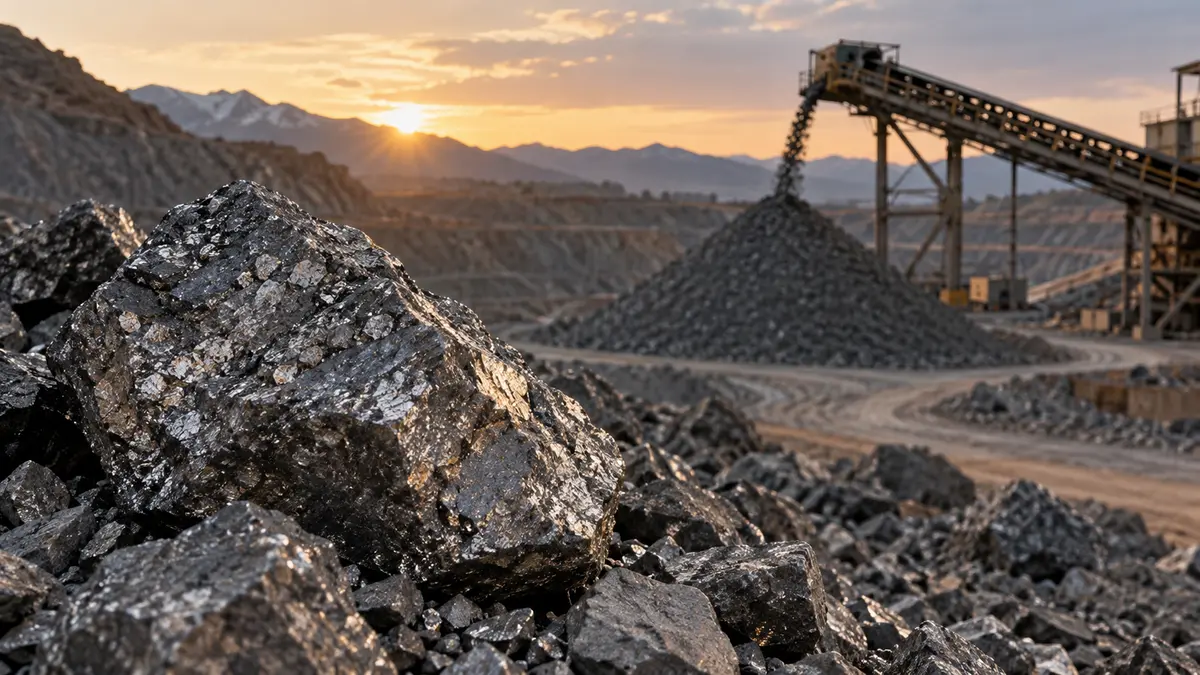
When China placed export controls on tungsten and four other metals in February 2025, the world's hardest, heaviest industrial metal stopped being a commodity and became a bargaining chip; by December the United States had answered with financing letters, bilateral treaties and equity stakes in an attempt to build a supply chain that does not run through Beijing.
A chokehold built over decades
Over a series of decades, China built up its stranglehold on much of the world's critical minerals supply chains, including the 17 rare earths used to make virtually all kinds of high-performance magnets and parts for vehicles, computers, power generation and military defense. The rest of the world deferred to Beijing in exchange for cheap prices. That sentence, from Fortune's December 2025 examination of the race to end the chokehold, is the baseline against which every 2025 tungsten decision has to be read: the dependence was not an accident of geology but a purchased outcome, and unpurchasing it is a multi-year project.
Tungsten sits at the sharp end of that dependence. The heat-resistant metal is used in electronics and military equipment, and the February controls made it one of the five metals - with tellurium, bismuth, molybdenum and indium - whose export from China now requires a licence. The BBC's March 2025 account of the retaliatory package put the share in blunt terms: China has mastered the ability to refine such metals and produced almost 90% of global refined output, and the restricted list includes tungsten, which is difficult to source and a crucial material for the aerospace industry.
February 2025: the controls land
The controls arrived as part of Beijing's answer to the doubling of US tariffs on Chinese imports. Alongside retaliatory levies on American farm goods and energy, China placed 15 US companies onto its Export Control List, which prohibits Chinese firms supplying American companies with dual-use technologies, and 10 American companies onto its Unreliable Entity List. The export controls on 25 rare metals were the minerals leg of the same package.
What the controls do in practice is procedural but powerful. The experience of previous rounds of restrictions suggests exports will drop sharply as companies scramble to get licences, a process that takes several weeks, the BBC noted. A licence queue is a rationing device: it does not ban trade, it prices delay into every contract, and for a metal embedded in cutting tools, armor-piercing munitions and aerospace parts, delay is the damage. Julian Evans-Pritchard of Capital Economics added a telling asymmetry: the critical metals China imports from the United States, used to make high-end chips, semiconductor machinery, pharmaceuticals and aerospace equipment, were not targeted in any measures - a reminder that the controls were calibrated, not maximal.
The Kazakh tungsten bet
The most concrete Western answer of 2025 took shape in Central Asia. Pini Althaus, who left the company he founded, USA Rare Earth, in 2023 to develop critical minerals mining and processing projects in the region, is specifically developing mining and processing facilities for tungsten and rare earths in Kazakhstan and Uzbekistan. In November, the US Export-Import Bank offered his Cove Capital a $900 million financing letter of interest for the $1.1 billion Kazakh tungsten projects, and a separate letter of interest arrived from the US International Development Finance Corp.
The scale matters. A $1.1 billion tungsten development is not a hedge; it is an attempt to stand up an alternative node in a market where the incumbent controls the majority of mine supply and nearly all refining. That it required two US government financing letters of interest before it could be discussed as bankable says as much about the state of Western minerals finance as about the project itself.
What a letter of interest is not
A financing letter of interest is a statement of appetite, not a loan. The Ex-Im Bank's $900 million letter for the $1.1 billion Kazakh tungsten projects, and the separate letter from the U.S. International Development Finance Corp., leave the capital stack unfinished: the projects still need equity, offtake and construction finance before ground breaks. That gap between letters and loans is where most Western critical-minerals projects of the past decade have died, and it is why Dickerson's warning about the absence of a strong pipeline of mature, shovel-ready mineral projects matters more than any single announcement. The letters matter because they signal which projects the U.S. government is willing to carry through that gap - and the Kazakh tungsten file is now explicitly on that list.
Why Central Asia
Althaus's reasoning is geological and archival at once. The Soviets spent many decades exploring and developing mines, and many of their databases have been left and are quite meticulous; this gives companies looking to develop projects in central Asia a jump start compared with the United States, where most opportunities are greenfield - very early stages, very high risk, and very little appetite for investment. In other words, the Soviet legacy that once fed a closed command-economy metals chain now serves as the due-diligence shortcut for an open, allied one.
The archival advantage also carries a constraint: Soviet-era data describes geology as it was understood under a command economy's survey standards, and converting meticulous databases into bankable resource statements still requires modern drilling, metallurgical testwork and permitting. Althaus's jump start is real but partial - it shortens the exploration phase, not the decade between a resource and a refinery. That is precisely the interval the Ex-Im and DFC letters are trying to finance, and precisely the interval where Chinese competitors, operating with state-backed balance sheets and a home refining market, have never needed letters of interest at all.
Allies as supply chain
The Kazakh letters sit inside a treaty network assembled across 2025. In October, Trump inked a deal with Australia for both countries to invest $3 billion in critical minerals projects by mid-2026; Australia is home to Lynas Rare Earths, the largest publicly traded critical minerals miner in the world. A series of bilateral critical minerals deals followed in East and Southeast Asia, including Japan, Malaysia, Thailand, Indonesia and Cambodia, and the US also signed new deals with Ukraine, Argentina, the Democratic Republic of the Congo, Rwanda and Kazakhstan.
Critical minerals increasingly ride inside unrelated negotiations. In the tariff agreement with Indonesia, the Asian nation agreed to lift export bans on nickel. The White House leveraged its military support for Ukraine by demanding the rights to its critical minerals in return - the BBC reported in the spring that the US wants Ukraine to guarantee the supply of more rare earth metals in exchange for $300 billion of support in its fight against Russia, a deal that suffered a setback after a fractious meeting between Trump and Volodymyr Zelensky. And the recent US bailout of Argentina included a partnership on critical minerals mining. Minerals diplomacy in 2025 stopped being a sectoral policy and became a clause.
The clause-ification of minerals has a measurable side effect: it ties mineral supply to the durability of unrelated agreements. A nickel export-ban lift negotiated inside a tariff deal can be reopened when the tariff deal is reopened; a minerals partnership embedded in a bailout travels with the bailout's conditions. For buyers of refined metal, that converts supply security from a geological question into a diplomatic one, and diplomatic calendars move faster than mine plans. The February 2025 controls taught the same lesson from the other direction: a licence queue can appear in weeks, while a replacement refinery takes the rest of the decade.
Price floors and the memory of dumping
Behind the treaties sits a pricing argument. The Trump administration is increasingly making financial partnerships with critical minerals developers - even becoming a majority shareholder in US rare earths miner MP Materials - and offering deals for floor-pricing mechanisms to offset China's recurring dumping practices that aim to eliminate competition. Chinese price dumping has crippled global competition and scared away potential investors, Althaus said.
His case for the floor is an investor's case: by providing a price floor, it removes the question marks, the instability, the most significant risk in funding a project that is about to go into production; it creates a predictability where you can take geology all the way through to profitability, and there should be a global effort to create transparent markets and prices for the key critical minerals. Jeff Dickerson, principal advisor at Rystad Energy, framed the alternative in starker language: only a long-term, coordinated effort - essentially a wartime approach - both domestically and with international partnerships can lead to success, and the challenge is that the US does not have a strong pipeline of mature mineral projects that are shovel ready.
Greenland and the heavy rare earth question
The same logic reaches into the Arctic. In addition to its strategic defense location, rare earths are another reason Trump continues to show interest in annexing Greenland from Denmark. Veteran geologist Greg Barnes, who founded the massive Tanbreez mining project in Greenland, briefed Trump at the White House during his first presidential term; this year Critical Metals acquired 92.5% ownership of Tanbreez, which remains in development, and received a letter of intent for a $120 million Ex-Im Bank loan, with the goal of starting construction by the end of 2026.
Critical Metals CEO Tony Sage stated the objective the whole 2025 architecture serves: there is an absolute need to make sure that more than 50% of the supply of these heavy rare earths come from outside of China - mined and processed outside of China. Processing, not mining, is the operative word: it is the 90% refining share, not the ore, that converts geology into leverage.
The processing gap in numbers
The arithmetic behind the 2025 race is short and brutal. China produced the overwhelming majority of global tungsten supply and refines almost 90% of the world's rare earths, per the BBC's account of the February controls; the Kazakh tungsten projects that the Ex-Im letter targets are valued at $1.1 billion; the Australia-U.S. envelope is $3 billion by mid-2026; the Tanbreez loan letter is $120 million against a construction start targeted by the end of 2026. Set those figures against a single licence queue that can halt exports in weeks and the asymmetry is visible: the West is financing decade-long capacity additions to answer a control regime that operates on the timescale of paperwork.
There is also a demand-side driver the treaty pile understates: military consumption. Both sources describe tungsten as a metal of military equipment - Fortune calls it heat-resistant and used in electronics and military equipment, and the BBC lists it among metals that are key components for many electrical products and military equipment. Stockpiles drawn down by active conflicts are replaced on budget cycles, not price signals, which means defense demand for the metal is among the least price-elastic demand in the entire commodities complex. A licence queue in Beijing therefore meets a buyer that cannot simply switch suppliers or wait for a cheaper quarter.
The calendar problem
Every element of the 2025 race runs on a different clock. The February controls operate in weeks: a licence application, a queue, a halted shipment. The Kazakh tungsten projects run on a construction clock of years between a financing letter and first concentrate. The Australia-U.S. envelope sets a mid-2026 investment date against projects that will produce late in the decade. Tanbreez targets a construction start by the end of 2026 for a deposit that has been known since before Trump's first term, when veteran geologist Greg Barnes briefed the White House. And the price-floor mechanisms under discussion would need to survive multiple budget cycles to change how a bank underwrites a mine.
The mismatch is the strategy's core risk and its core logic at once. If the West believed the control regime would last only a news cycle, none of this financing would make sense; the letters of interest exist precisely because Washington now prices the chokehold as durable. What the calendar problem guarantees is that the answer to February 2025 will arrive as 2028-2030 production, and that the years in between will be covered by stockpiles, scrap flows and diplomatic exemptions - the same improvisations that carried Western industry through the first licence queues of spring 2025.
What the pipeline is missing
- Mature, shovel-ready projects: Dickerson's central complaint about the US domestic pipeline.
- Processing capacity outside China: the refining share, not the mine share, is the chokehold.
- Price predictability: floor mechanisms to survive dumping cycles that have killed previous entrants.
- Allied feedstock: Kazakh, Australian and Greenlandic ore to feed non-Chinese refineries.
- Duration: a coordinated effort measured in decades, not election cycles - the point Dickerson questions whether the US will sustain.
The long game
Althaus reads the treaty pile as progress rather than competition for his own projects: I think it is a positive, and I think we will start to see a lot more happen in the coming months in terms of the US and collaboration with other countries. The tungsten story of 2025 is exactly that sequence in miniature - a February licence regime that turned a cheap industrial metal into a strategic queue, followed by a year of letters of interest, floor-price debates and bilateral clauses attempting to build the queue's exit.
Whether the exit gets built is a question the 2026-2030 construction calendars will answer: the Kazakh tungsten projects at $1.1 billion, Tanbreez at a construction start targeted by the end of 2026, and the $3 billion Australia-US envelope by mid-2026. Until those dates convert into refined tonnes, the 90% share stands, and every tungsten contract outside China carries the memory of February 2025 in its delivery clause.
None of this makes the Chinese position invulnerable. Dumping that kills competitors also kills margins at home, and a licence regime that prices delay into every contract pushes customers toward exactly the substitution and stockpiling behavior the controls were meant to delay. The 2025 race is therefore a contest of calendars: Beijing rationing by paperwork today against Washington and its allies financing tonnes for tomorrow. The metal that started the contest - tungsten, difficult to source and crucial to aerospace - remains the clearest measure of who is winning, because its price and its licence queue move together.
Just Published

European housing prices and rents
Schneider–PTC: the industrial data integration test behind the deal
Avio USA starts work on its Virginia manufacturing site

One equity market, two currency measures

Russia’s draft budget raises spending and borrowing plans
Russia Sets the 2027 Minimum Wage at 28,935 Rubles, Up 6.8%, on the Way to 35,000 by 2030
Partner news digest
 Qatar LNG expansion: readiness, financing and the production test
 Pennon’s capital plan: turning finance into better water outcomes
 Italy’s diesel relief gap: taxes, price ceilings and implementation
 EU–China hybrid trade: from understanding to measurable implementation
 Schneider–PTC: the industrial data integration test behind the deal
 IKEA’s hybrid resale model: buyback, marketplace liquidity and furniture logistics
 Banking AI beyond the ranking: capability, execution and evidence of value
 Fishing labour beyond the product label: practical protection
 Rhenus and the Middle Corridor: terminals need coordinated connections
 Royal Mail restructuring: the test is reliable delivery
 Fuel Finder on Google Maps: when price transparency becomes useful competition
 Samsung’s memory profit surge: what the preliminary record explains
Leave a comment