
Russia's 2024 School Uniform Season: A 10% Price Rise, Wide Regional Gaps and a Marketplace-Led Demand Boom
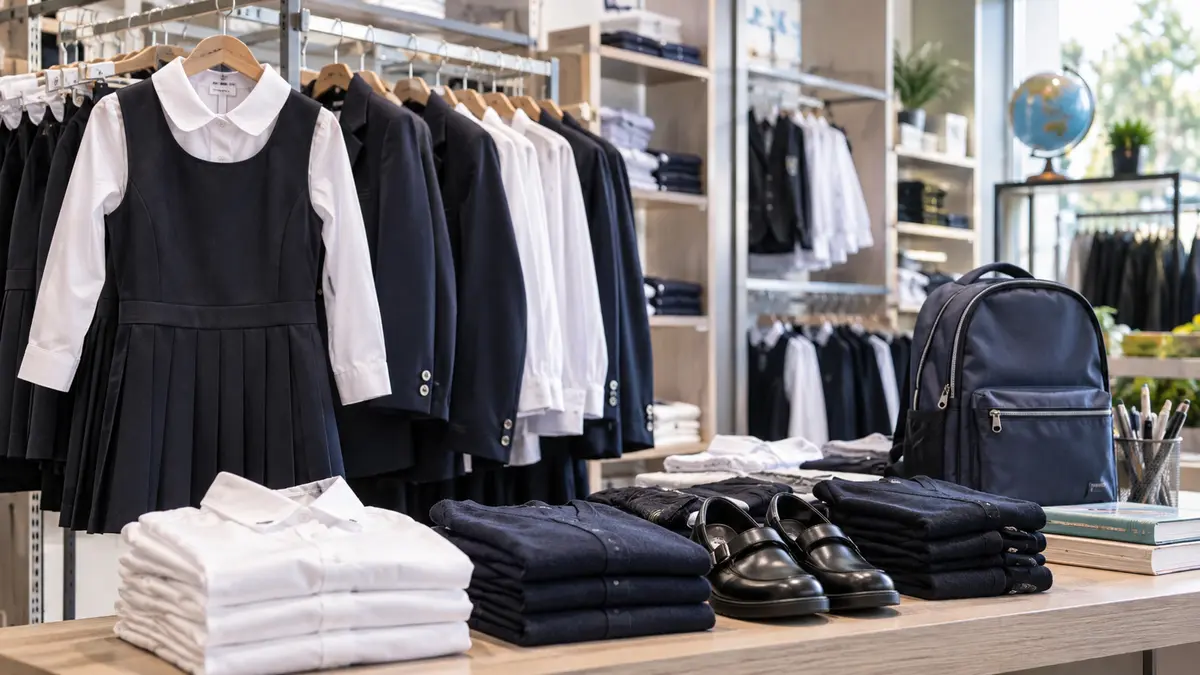
The 2024 back-to-school season in Russia priced a minimal school set at about 14,600 rubles in Siberia, 10% more than a year earlier, while marketplaces recorded unit sales up by as much as two and a half times. Fiscal-data operators, the statistics service and the platforms themselves describe a season in which parents paid more for clothing, saved on part of the list and moved the shopping trip online.
The price of the 2024 school set
The reference point for the season came from the fiscal-data operator Chek Index (Чек Индекс), part of Platforma OFD (Платформа ОФД): in July 2024 the average price of a school set across Siberia reached 14,600 rubles, up 10% against the same month of 2023. The minimal set, as counted by the operator, is not a symbolic basket: it includes a backpack, a shirt, trousers, shoes, sneakers, a T-shirt, a stationery set, a school diary, notebooks and a pencil case. In other words, the double-digit increase describes the full cost of dressing and equipping one child, not a single category.
The nationwide baseline, published on August 22, 2024 from a joint study by the e-payments service YuMoney (ЮMoney) and Chek Index, put the average cost of a basic school set in Russia at 15,361 rubles for 2024. The item-level breakdown shows where the money goes: the uniform itself averaged 3,949 rubles in the first half of August, a blouse or shirt 1,127 rubles, trousers or a skirt 1,503 rubles, children's shoes 1,856 rubles and sneakers 1,313 rubles. The non-clothing part of the list was cheaper but not negligible: a stationery set averaged 963 rubles, a school diary 197 rubles, a backpack 3,443 rubles, a filled pencil case 713 rubles and loose stationery 297 rubles.
- School uniform: 3,949 rubles on average in the first half of August 2024.
- Blouse or shirt: 1,127 rubles; trousers or skirt: 1,503 rubles.
- Children's shoes: 1,856 rubles; sneakers: 1,313 rubles.
- Backpack: 3,443 rubles; filled pencil case: 713 rubles.
- Stationery set: 963 rubles; school diary: 197 rubles.
Stationery was the one part of the list that deflated. The Association of Retail Companies (АКОРТ) reported that the minimum cost of a basic school stationery set fell 7.2% year on year, to 415 rubles in August 2024, helped among other things by pencil cases becoming 23% cheaper, at 91 rubles. The season therefore split into two price stories: clothing and footwear pushing the total up, paper goods quietly pulling a small part of it down.
The Siberian price map: what rose and by how much
Platforma OFD data for the Siberian Federal District show the uniform itself at 4,100 rubles in July-August 2024, up 10% on the same period of 2023, with the number of purchases up 4%. A ready-made stationery set rose 18%, to 1,200 rubles, and a set of pencils and pens 8%, to 326 rubles. Rosstat (Росстат) figures for the category of schoolchildren's clothing in July add granularity: school trousers led the increase at 7.4% year on year, followed by tights at 7%, socks at 6%, a children's jumper at 4%, a boy's shirt at 3% and a girl's blouse at 2%. Backpacks, by contrast, became 2.4% cheaper on average across the district.
The regional dispersion behind these averages was wide. Girls' blouses rose most in the Republic of Altai, by 24%. Boys' trousers became 18% more expensive in Irkutsk Region, which also recorded the largest increase in windbreakers, at 16%. In Kemerovo Region children's tights rose 19%, and in Novosibirsk Region socks and knee-highs became 14% more expensive over the year. A single national average would hide all of this: the 2024 season was priced differently in almost every region of one federal district.
Where prices fell
The same dataset contains a counter-list. School satchels became 14.5% cheaper in Kemerovo Region, children's sports suits 14% cheaper in the Republic of Khakassia, girls' sundresses 11.5% cheaper in Omsk Region and children's shoes 11% cheaper in the Republic of Altai. Deflation in these positions is consistent with parents substituting within the list: buying a satchel instead of a pricier backpack format, or a sports suit instead of a separate jacket-and-trousers combination, and shopping the discounted end of the assortment.
Why the sticker moved: logistics, imports and a quality trade-up

Two explanations sit behind the 2024 price rise, and they point in opposite directions. The first is cost-push. Daria Zhigalina (Дарья Жигалина), an analyst at Kontur.Market (Контур.Маркет), attributes the increase in average prices across most school goods to higher spending on fuel and logistics, adding that some goods may be delivered from abroad, which imports currency and freight costs into the shelf price. The second explanation is a demand-side trade-up. Chek Index experts say that in 2024 parents did not economize on school spending, especially on clothing and footwear, choosing better-quality and more expensive goods, and that this choice is directly visible in the price tags.
Between these two forces sits a third behaviour: deliberate saving where it is possible. Olga Lebedinskaya (Ольга Лебединская), associate professor of the statistics department at Plekhanov Russian University of Economics (РЭУ имени Плеханова), notes that to save on school preparations in 2024 parents more often used promotions, bonuses and discount programmes, and that some families resorted to joint purchases, pooling orders to obtain better prices. The season thus combined a quality trade-up in clothing with active discount hunting around it, which is exactly the combination that produces rising average prices alongside rising unit volumes.
The marketplace season
The volume side of the season belongs to online platforms. Ozon (Озон) calculated that in August 2024 its unit sales of school goods in the Siberian regions grew almost two and a half times year on year, with stationery and school backpacks bought almost one and a half times more; the average check in these categories, the marketplace's press service said, stayed at last year's level. Flat average checks with sharply higher unit counts describe a channel that is winning on assortment and convenience rather than on price inflation.
Wildberries data, analysed by JVO and the marketplace category-analysis system CATAN, show the same direction at item level. In August 2024 demand for girls' school uniforms on the platform rose 34%: blouses sold 18% more, shirts 68% more, suits 35% more and trousers 26% more, while skirt sales grew 2.6 times; girls' dresses, by contrast, were bought 7% less often ahead of September 1. Demand for boys' school wardrobe items rose 15% year on year, with trousers up 45%, shirts up 31% and suits up 24% in August 2024 against August 2023.
What the channel shift changes
Chek Index experts add the structural figure behind these platform numbers: more than 60% of school goods were bought online in the 2024 season, primarily on popular marketplaces. When the majority of a seasonal category migrates online, the economics of the season change for everyone involved. Price comparison becomes instantaneous, promotions and bonus programmes become the main competitive instrument, and regional price gaps become visible to the buyer rather than only to the analyst. For manufacturers and sellers, the marketplace channel converts a six-week offline rush into a managed, promotion-driven campaign with measurable unit economics.
Three mechanisms behind one season
- Cost-push: fuel, logistics and, for part of the assortment, imported supply raised the floor price of school clothing and goods.
- Quality trade-up: parents who could afford it chose better and more expensive clothing and footwear, lifting average prices independently of costs.
- Channel migration: with more than 60% of purchases online, promotions, bonuses and joint purchases became the main way families managed the total bill.
These mechanisms do not cancel each other; they stack. The same family could buy a pricer uniform, a discounted satchel and a bonus-funded stationery set in one order, and each of those choices shows up in a different line of the statistics quoted above. That is why the 2024 season reads simultaneously as an inflation story, a trade-up story and an e-commerce story.
Five datasets, one season
What makes the 2024 season readable is that it was measured by five different instruments at once, and each of them sees a different layer of the same six weeks. The fiscal-data operators, Chek Index and Platforma OFD, see the receipt: what was actually paid at the checkout, item by item, region by region. Rosstat sees the price index of the category, the official thermometer of schoolchildren's clothing as a statistical good. The marketplaces, Ozon and Wildberries with their JVO and CATAN analytics, see units and demand curves: how many blouses, skirts and trousers changed hands, and how fast the curve bent in August. The retailers' association, AKORT, sees the minimum viable basket, the floor price of sending a child to school with a pencil case. And the payments service YuMoney sees the online money flow that ties the other four together.
Read jointly, the instruments agree on the direction and differ on the magnitude, which is exactly what a healthy measurement ecosystem looks like. The receipt data say the Siberian set cost 14,600 rubles and rose 10%; the payments study says the national basic set averaged 15,361 rubles; the statistics service says individual clothing items rose between 2% and 7.4%; the platforms say units multiplied. No single dataset could produce that picture, and no two of them contradict each other. For an analyst of the Russian consumer market, the school season of 2024 is a rare case where price, volume, channel and regional structure were all observed simultaneously.
The household arithmetic behind the averages
Behind every average in this story stands a household budget exercise. A family buying the full minimal set in Siberia in July 2024 paid roughly a tenth more than the same family a year earlier for the same list; a family shopping the national average paid 15,361 rubles across clothing, shoes, backpack and stationery. The deflating positions, satchels, sports suits, sundresses, pencils, are the levers such a family pulls to keep the total manageable, while the inflating positions, uniforms, blouses, trousers, shoes, are the ones where quality and school requirements leave little room for substitution. The joint-purchase behaviour described by Plekhanov University's statistician is the collective version of the same arithmetic: if the list cannot be shortened, the order can be pooled.
From season to industry: what the numbers mean for sellers
For the manufacturers and sellers of school clothing, the 2024 dataset contains three commercial signals. First, the demand is inelastic in structure but elastic in channel: parents must buy the list, but they increasingly choose where, and more than 60% of them chose online. Second, the price increase was accepted without a collapse in units: purchases of uniforms in Siberia grew 4% while the price grew 10%, and marketplace units grew far faster, which means the category absorbed inflation through volume and channel rather than through demand destruction. Third, the regional dispersion is a pricing opportunity as much as a statistic: a 24% blouse increase in one republic against an 11% shoe decrease in another describes markets that can be served, and priced, differently.
None of these signals is a forecast. They are the measured shape of one season, and the season repeats every year with the same calendar and a different economy. The 2024 measurement gives the industry a baseline against which the 2025 season will be read: the same operators will publish the same indicators, and the comparison will show whether the marketplace share, the quality trade-up and the regional gaps were a one-year configuration or a new normal for the Russian school-goods market.
What to watch after September 1
- Whether the July-August price increases in school clothing persist into the autumn or correct once seasonal demand ends.
- Whether the online share above 60% holds for the next season, and how offline children's clothing chains respond in price and assortment.
- The gap between clothing inflation and stationery deflation: AKORT's falling minimum stationery set against Rosstat's rising clothing prices marks the two ends of the list.
- Regional dispersion: the 24% blouse increase in one region against double-digit falls in shoes in another shows how uneven the national average really is.
The 2024 back-to-school season did not produce a single dramatic number; it produced a consistent set of them. A 10% rise in the Siberian set price, a 15,361-ruble national baseline, item-level increases of 2-7% in clothing, double-digit regional outliers in both directions, and unit sales up to 2.5 times on marketplaces together describe a market that is growing in money and in volume at the same time, while the place where the money is spent keeps moving online.
Just Published

European housing prices and rents

Schneider–PTC: the industrial data integration test behind the deal

Avio USA starts work on its Virginia manufacturing site

One equity market, two currency measures

Russia’s draft budget raises spending and borrowing plans

Russia Sets the 2027 Minimum Wage at 28,935 Rubles, Up 6.8%, on the Way to 35,000 by 2030
Partner news digest
 Qatar LNG expansion: readiness, financing and the production test
 Pennon’s capital plan: turning finance into better water outcomes
 Italy’s diesel relief gap: taxes, price ceilings and implementation
 EU–China hybrid trade: from understanding to measurable implementation
 Schneider–PTC: the industrial data integration test behind the deal
 IKEA’s hybrid resale model: buyback, marketplace liquidity and furniture logistics
 Banking AI beyond the ranking: capability, execution and evidence of value
 Fishing labour beyond the product label: practical protection
 Rhenus and the Middle Corridor: terminals need coordinated connections
 Royal Mail restructuring: the test is reliable delivery
 Fuel Finder on Google Maps: when price transparency becomes useful competition
 Samsung’s memory profit surge: what the preliminary record explains
Leave a comment