
The Eastern Polygon's Third Stage: Why Russia Is Rebuilding the BAM for a 270-Million-Tonne Decade
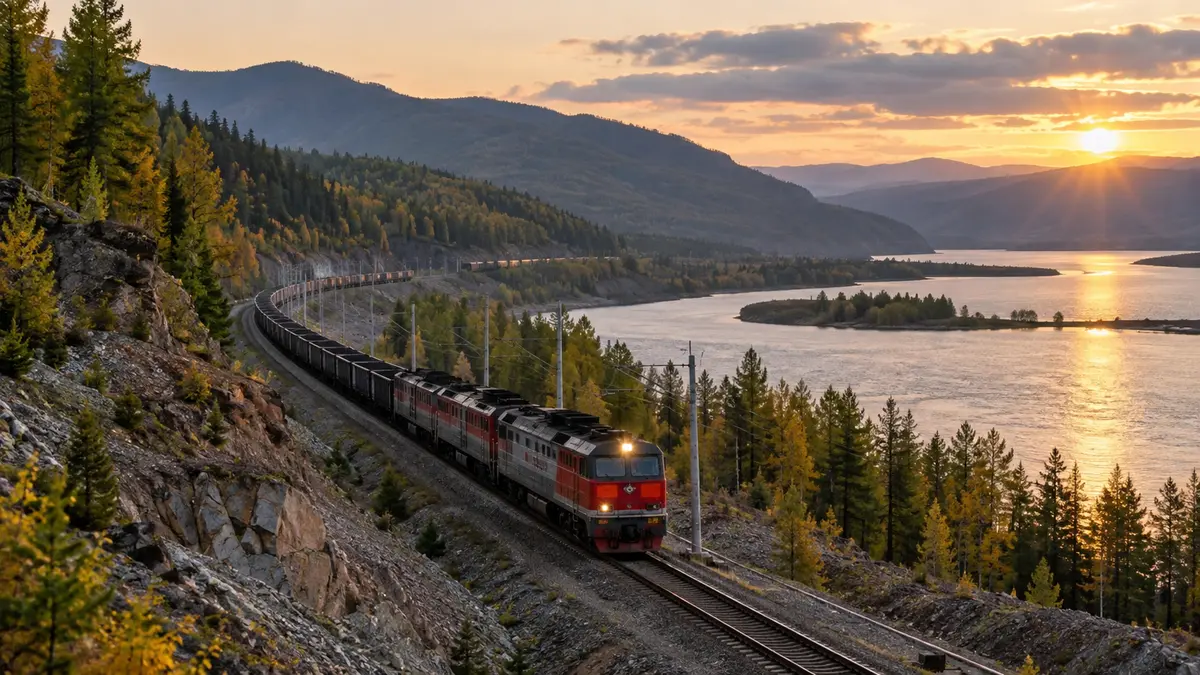
On the evening that marked fifty years since the first spade went into the Baikal-Amur Mainline, Russia's president used the anniversary not for nostalgia but for a programme: the third stage of BAM and Trans-Siberian development is under way, and in ten years the Eastern Polygon of Railways is to carry 270 million tonnes a year. Between those two numbers - a mainline whose capacity reached almost 42 million tonnes this year and a target many times larger - sits the entire logic of Russia's eastern rail policy.
A half-century mainline meets a third stage
Speaking at a gala evening to mark the 50th anniversary since the start of BAM construction, Vladimir Putin (Владимир Путин) called the mainline one of the world's biggest infrastructure projects of the whole 20th century and thanked those who worked on it. At the turn of the century, he recalled, BAM helped open Asia-Pacific markets to the Russian economy, and together with the Trans-Siberian Railway it has become a truly strategic transit corridor of both national and global importance.
The anniversary date matters less than the sequence it frames. The first stage of the modern era rebuilt a line whose Soviet-era capacity had been left behind by trade. The second stage, running through the early 2020s, widened the worst bottlenecks. The third stage, launched in the anniversary year, is described by the president himself as something larger: not only widening bottlenecks, but building what are essentially continuous secondary routes along the entire length of the BAM mainline and more than 300 infrastructure sites.
The 42-million-tonne baseline
The starting point of the new stage is a specific number. This year, Putin said, the mainline's capacity reached almost 42 million tonnes - three times what it was more than 12 years ago. That tripling is the measurable output of the previous stages, and it is also the argument for the next one: capacity that has tripled once can be planned to multiply again, because the binding constraint has moved from the mere existence of track to the geometry of the network.
A capacity figure of this kind is not traffic. It is the ceiling under which traffic can grow, and the distance between the ceiling and the actual flow is where export and transit policy lives. When the president says the mainline will be further developed to expand Russia's export and transit capabilities, he is describing the conversion of ceiling into flow.
What tripling in twelve years implies
If today's almost 42 million tonnes are three times the level of more than 12 years ago, the earlier level was roughly a third of the current one - a corridor that could barely serve the export ambitions now attached to it. Reading the two figures together shows what the previous stages actually bought: not a faster railway, but a railway whose ceiling stopped being the first constraint on eastern trade. The third stage inherits a line where the next constraint is structural - single-track sections, meets, maintenance windows - and structural constraints are exactly what continuous second routes remove.
What the third stage actually builds
The physical content of the stage was set out in unusually concrete terms. What must be done, Putin said, is not only to widen bottlenecks: the tasks are far bigger, along the entire length of the BAM mainline essentially continuous secondary routes are to be built, together with over 300 infrastructure sites. A continuous second route changes the operating logic of a single-track-dominated corridor: meets, overtakes and maintenance windows stop being the binding constraint on the timetable, and the line begins to behave like a double-track system rather than a chain of passing loops.
The administrative side was described with equal directness: a strategic decision was made, the government released the necessary normative documentation, and now it is to be implemented in practice - essentially, the president noted, this work is already underway. In infrastructure policy that phrasing marks the boundary between a plan and a programme: money, land, design and contractors follow the normative documents, not the announcement.
Why bottlenecks are no longer the whole task
The explicit rejection of bottleneck-widening as the sole objective is the most informative sentence of the anniversary speech. Bottleneck projects are point solutions: a tunnel, a loop, a station throat. They raise capacity where the line was weakest, but the next weakest point immediately becomes the constraint. A continuous secondary route is a system solution: it raises the capacity of the corridor as a whole and makes the remaining point constraints visible and schedulable.
For a railway whose stated purpose is export and transit, the difference is commercial. Point capacity sells slots. System capacity sells schedules - and schedules are what bulk exporters and transit operators actually buy, because they determine whether a cargo plan can be promised to a customer on the other side of the continent.
The 270-million-tonne horizon
The target attached to the stage is explicit: in ten years' time the volume of traffic through the Eastern Polygon of Railways should reach 270 million tonnes a year. Set against this year's almost 42 million tonnes of BAM capacity, the figure describes the scale of the ambition - and the scale of the industrial bet behind it, because traffic of that order cannot be conjured by better scheduling alone. It requires cargo: coal, ore, timber, containers and transit flows sufficient to fill a corridor several times the size of today's mainline capacity.
That is why the anniversary speech tied the railway to the ground it crosses. Broader use of natural resources in the BAM and Trans-Siberian zone, the president said, will provide a powerful impetus to open new production facilities and create new jobs. The railway is presented not as a service to existing industry but as the instrument that makes new industry addressable.
Demand for Russian machinery, steel and construction
A programme of 300-plus infrastructure sites and continuous second tracks is also an industrial order. The project uses the most advanced technologies, Putin said, creating additional demand for domestically-produced machinery and metallurgical products, for services in the construction sector and a host of other industries. In other words, the third stage is a demand programme for the domestic capital-goods complex at the same time as it is a transport programme.
This dual character changes how the stage should be read economically. Every kilometre of second track consumes rails, sleepers, ballast, electrification and signalling. Every tunnel and bridge consumes steel and concrete. Every station reconstruction consumes machinery and labour. The multiplier the president described is not a forecast of indirect effects; it is close to the bill of materials of the programme itself.
Resources, plants and jobs along the line
The resource argument has a geographic edge. The BAM and Trans-Siberian zone contains deposits and forests whose economics depend entirely on haulage cost to a port or a border crossing. Where capacity is scarce, marginal tonnes are rationed by price and queue. Where capacity is abundant, marginal deposits become bankable. The promise that further development will enable broader use of natural resources in the zone is therefore a promise about investment geography: which fields, quarries and logging areas enter the development pipeline in the 2030s.
New production facilities and new jobs follow the same logic. A processing plant locates where its inbound and outbound tonnage can move. The Eastern Polygon's capacity curve is, in that sense, a map of where Russian industry is invited to settle.
The social contract of the BAM towns
The anniversary speech devoted a separate passage to people. Particular attention, Putin stressed, will be paid to raising the quality of life in the population centers tied to BAM, including further development of the hubs - the BAM capitals, Tynda and Severobaikalsk, to whose people the country is greatly indebted.
That indebtedness is historical and practical at once. Single-industry rail towns carry the operating culture of the line: depots, dispatching, maintenance brigades, schools that feed them. A decade-long construction programme that ignored them would have to import and house a workforce from elsewhere. A programme that develops them converts gratitude into labour supply.
Transit in the Eurasian transport system
The external frame of the speech was equally explicit: further BAM development will serve to increase the export and transit capabilities of Russia as an important link in the Eurasian transport system. Transit is the part of the 270-million-tonne target that does not depend on Russian mines. It depends on whether continental freight chooses rail over sea and air, and on whether the corridor can promise reliability at scale.
Here the system-versus-point distinction returns. Transit customers compare corridors end to end: border processing, gauge changes, terminal capacity, schedule integrity. A corridor with continuous double track and 300 renewed sites can publish a transit product. A corridor of widened bottlenecks can only publish hopes.
What the anniversary framing signals
Anniversaries are cheap; programmes are not. The choice to announce a stage, a site count and a tonnage target from an anniversary stage suggests the government wants the third stage read as settled policy rather than as an aspiration - the normative documentation, in the president's own words, has already been released, and the work is described as already underway.
How capacity becomes traffic
The mechanism linking the two headline numbers is worth stating plainly, because it is where the programme will succeed or fail:
- Ceiling first: continuous second routes and 300-plus sites raise the physical capacity of the corridor as a system, not point by point.
- Cargo second: broader use of natural resources in the BAM and Trans-Siberian zone converts ceiling into contracted tonnage.
- Industry third: new production facilities locate along the line because the tonnage can move, adding non-resource cargo.
- Transit fourth: schedule integrity attracts continental freight that never touches a Russian mine.
- Towns fifth: Tynda and Severobaikalsk supply the people who keep the previous four running.
Each step depends on the previous one, and each has its own clock. Track is built in years. Deposits are licensed and opened in longer years. Plants are commissioned in longer ones still. The ten-year horizon of the 270-million-tonne target is tight against that sequence, which is precisely why the stage had to begin in the anniversary year rather than after it.
The execution test
Because the normative base exists and work is described as already underway, the relevant questions for the coming years are execution questions: whether the 300-plus sites are commissioned in the order the timetable needs, whether domestic machinery and metallurgical supply keeps pace with the construction peak, and whether the social programme in the BAM towns holds the workforce in place through a decade of disruption.
None of these questions is answered by the anniversary speech. All of them are implied by it. A programme that names its site count, its tonnage target and its towns has chosen to be measured against them.
The anniversary as a policy instrument
It is worth noting what the choice of venue accomplished. A gala evening for construction veterans is a ceremonial space; using it to name a stage, a site count and a tonnage target converts ceremony into commitment, because the audience includes the very ministries, regions and contractors who must now deliver. The president's closing sentence - I am certain we will implement all these plans - reads differently in that room than it would in a decree: it is a promise made in front of the people whose work it schedules.
There is a second function. Fifty years of institutional memory sit in that hall: the engineers and brigades who built the first BAM and the managers who rebuilt it twice since. A third stage announced there recruits that memory as an asset, signalling continuity of method as well as of purpose.
What the third stage changes for shippers
For an exporter or a transit operator the difference between the second and the third stage is practical. The second stage removed the sharpest bottlenecks but left the corridor as a network of points where the timetable breaks: meets, maintenance windows, station throats. The third stage, described as continuous secondary routes along the entire length of the mainline, promises a different property - predictability of running time across the whole line, not on selected sections. Predictability, not peak capacity, is what sells a transit product: a continental route contract is signed against a schedule, and a schedule lives only where bottlenecks have stopped being surprises.
Hence the logic of the target: 270 million tonnes a year in ten years is not a demand forecast but a capacity commitment, against which shippers can plan decade-long programmes. Capacity announced in advance attracts cargo by itself: a deposit that needs evacuation in 2032 begins engineering in 2025 precisely because the corridor has publicly named its future size.
Three constraints the reporting will test
The reporting of the coming years will test the programme against three constraints. The first is constructional: more than 300 sites and continuous second tracks require a peak of building capacity that domestic machinery and metallurgy must reach through the order itself, as the president's own demand argument implies. The second is cargo: a ceiling becomes a flow only when the deposits and plants of the BAM and Trans-Siberian zone sign the tonnage. The third is human: Tynda and Severobaikalsk must hold and grow people through a decade of construction. None of the three is solved by announcement; all three are solved by commissioning order, and that order will be the Eastern Polygon's main storyline into the early 2030s.
Reading the decade ahead
Fifty years after the first construction crews, the BAM enters its third modern stage with a tripling already banked - almost 42 million tonnes of capacity against the level of more than 12 years ago - and a far larger ambition ahead. The distance between those two numbers is the content of the decade: continuous second tracks, 300 infrastructure sites, new deposits and plants, a transit product for Eurasia, and two rail towns whose people the state has publicly called itself indebted to.
I am certain we will implement all these plans, Putin said. Certainty is a political register; capacity is an engineering one. The Eastern Polygon will report which of the two was right, in tonnes, every year of the next ten.
Just Published
European housing prices and rents
Schneider–PTC: the industrial data integration test behind the deal
Avio USA starts work on its Virginia manufacturing site

One equity market, two currency measures

Russia’s draft budget raises spending and borrowing plans

Russia Sets the 2027 Minimum Wage at 28,935 Rubles, Up 6.8%, on the Way to 35,000 by 2030
Partner news digest
 Qatar LNG expansion: readiness, financing and the production test
 Pennon’s capital plan: turning finance into better water outcomes
 Italy’s diesel relief gap: taxes, price ceilings and implementation
 EU–China hybrid trade: from understanding to measurable implementation
 Schneider–PTC: the industrial data integration test behind the deal
 IKEA’s hybrid resale model: buyback, marketplace liquidity and furniture logistics
 Banking AI beyond the ranking: capability, execution and evidence of value
 Fishing labour beyond the product label: practical protection
 Rhenus and the Middle Corridor: terminals need coordinated connections
 Royal Mail restructuring: the test is reliable delivery
 Fuel Finder on Google Maps: when price transparency becomes useful competition
 Samsung’s memory profit surge: what the preliminary record explains
Leave a comment