
Butter at 1,040 Rubles: How Russia's Most Expensive Staple Lost Its Cheap Shelf
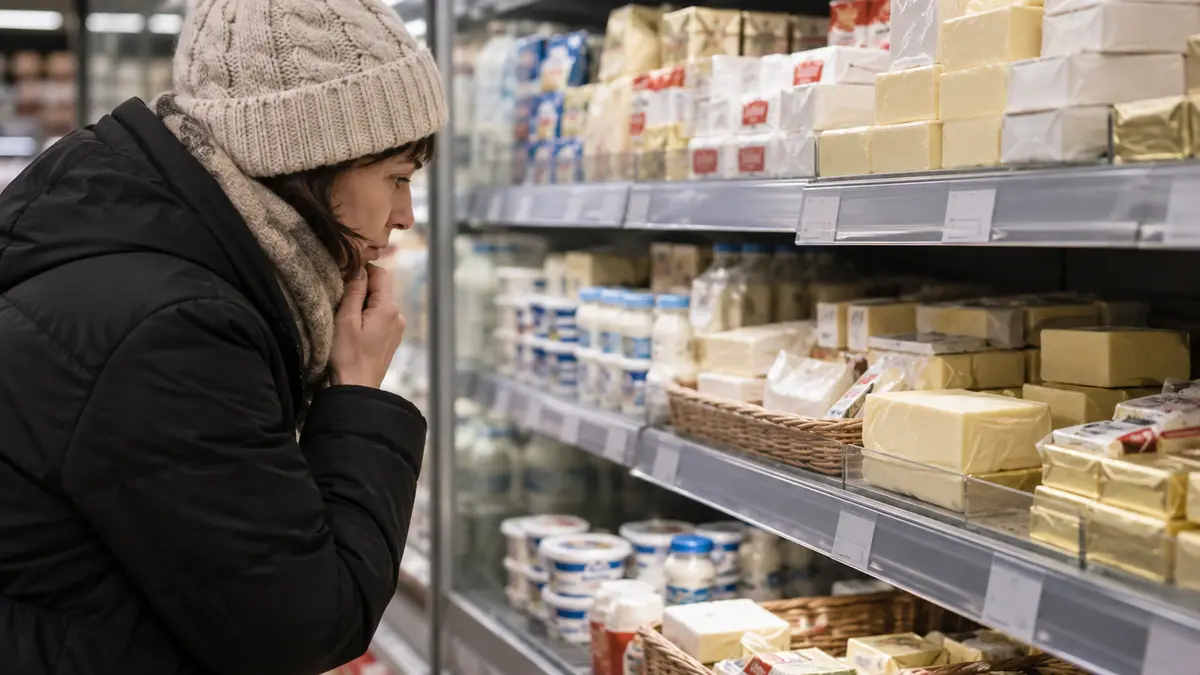
Butter became the most expensive staple on the Russian shelf in 2024: by October 7 the average retail price reached 1,040 rubles per kilogram, up 20.2% since the start of the year and 25.9% year on year, while food prices overall rose 9.2%. It was also the only significant dairy category whose physical retail sales fell. By December the pressure turned global: the FAO dairy price index printed a fresh all-time high for butter, the fourteenth consecutive month of increases. This feature reconstructs the mechanics of the squeeze — from milk-fat hunger and the import hole of 2022 to the demand response of households and the state's late entry into the market.
A quarter of price in a single year
The numbers that defined the year are blunt. According to Rosstat, the average price of butter in Russia on October 7, 2024 stood at 1,040 rubles per kilogram, 20.2% above the level of early January and 25.9% above the same date a year earlier. Over the same twelve months, food prices in the country rose 9.2%, which means butter outran the grocery basket by almost three times. The labeling system operator CRPT reported that in August 2024 butter cost on average 850 rubles per kilogram, 24% more year on year, while adjacent categories moved far more slowly: ice cream and curd snacks added 15-16%.
Margarine, the traditional substitute, stayed almost flat: Rosstat put its average price in early October 2024 at 245.2 rubles per kilogram, only 3.1% higher year on year. The gap between the two products — roughly a factor of four per kilogram — is the quiet background of the whole story. Substitution on paper looks obvious; in practice, as the market's own participants argue, butter has no real replacement on the shelf.
Demand bends but does not break
The price surge began to bite consumption. Physical retail sales of butter and margarine across Russia fell 1.3% between October 2023 and September 2024, according to NielsenIQ. Almost every other significant dairy category grew over the same window: pasteurized milk by 3.2%, sour cream by 3.8%, cottage cheese by 9.6%, cream by 17.9%. Butter and margarine were the exception, the only meaningful dairy line in decline.
Retail chains describe the same picture in softer words. At Magnit, demand for butter in January-August 2024 grew but restrainedly, at a slower pace than a year earlier. The channel structure explains why retail data matters so much: the Soyuzmoloko association estimates that retail networks account for 70-80% of total butter consumption in the country. For margarine, retail is traditionally a less dominant channel, a nuance that makes the combined NielsenIQ decline a conservative measure of the butter-specific demand shock.
Why the price rose: milk-fat hunger and the import hole

The head of Soyuzmoloko, Artyom Belov (Артем Белов), describes the root cause as a demand-side shift that met a supply-side hole. Over the last several years, consumption of milk fats in general — including curd cheeses and ice cream, and including the foodservice segment — has been growing. That growth collided with the abrupt contraction of imports in 2022, when producers from South America and New Zealand left the Russian market. In 2023, Soyuzmoloko spoke of supplies from far-abroad countries falling tenfold.
The hole has since been filled, but not by domestic cows. According to Belov, the lost volume was substituted with milk fats from Belarus, India, Kyrgyzstan, Azerbaijan and Iran. Today, about 20% of the butter consumed in Russia is imported, and the share is rising. An import-dependent fifth of the market means the domestic price carries the logistics, currency and contract risk of five foreign supply chains on top of its own cost base.
The herd cannot be re-engineered quickly
Domestic production of milk fat is a slow variable. Belov notes that Russian players are increasing output of milk fats, but the process is long: about 60% of the country's cow herd is of the Holstein breed, whose milk averages 3.8% fat, while Jersey cows with 5.5-5.6% fat milk remain unpopular because of lower productivity. The economics of the dairy plant push the same way: growth in fat production concentrates in cream, a more profitable product than butter. The statistics confirm the squeeze: in January-July 2024, butter output in Russia fell 2.5% year on year to 193,000 tonnes, while margarine output grew 1.7% to 253,000 tonnes.
Costs travel up the chain
The retail association AKORT, which unites the largest chains, reported that in September 2024 butter in procurement had risen 31% since the start of the year because of growing producer costs. Igor Karavaev (Игорь Караваев), chairman of the AKORT presidium, lists the components: the cost of production and of dairy farming has grown, and milk fats have become more expensive. The chain does not stop at the invoice.
Because of those costs, producers stopped the marketing programs that used to fund butter promotions in retail, a retailer source told Kommersant. Promotional depth is one of the main demand drivers in dairy; its disappearance means the shelf price moved closer to the true cost, and the consumer felt the full amplitude of the increase. Alexey Popovichev (Алексей Поповичев), executive director of Rusbrand, the association of food producers and suppliers, adds the demand-side logic: price growth always remains a factor of lower consumption. Yet he doubts that these fluctuations will seriously hurt producers, because there is simply nothing to replace butter with. A possible additional brake, he allows, is the population's gradual turn away from fried food and bakery — the two uses where butter is consumed in the largest volumes.
The state enters the market
By autumn the price line had become a policy line. The Agriculture Ministry told TASS it was considering additional stimulation of butter supplies from friendly countries to saturate the domestic market and stabilize prices. In late November 2024, the council of the Eurasian Economic Commission approved a tariff preference for butter imports into Russia. On December 6, 2024, the Federal Antimonopoly Service announced anti-cartel checks of butter producers. The sequence — import incentive first, competition scrutiny second — shows how the state read the same data as the market: a supply problem with a price symptom.
A global record as backdrop
The Russian squeeze coincided with a world record. In November 2024 the FAO dairy price index rose 0.6% month on month, and butter prices reached a new historical high on strong demand and limited stocks in Western Europe, the organization wrote. World butter prices had then been rising for fourteen consecutive months. Cheese prices also increased, tied to limited export capabilities, while the FAO cereal index fell 2.7% in the month, rice cheapened by 4% and sugar by 2.4%.
For the Russian consumer the global record translated into a domestic one: according to Rosstat, butter had become 33% more expensive since December 2023. A market that imports a fifth of its consumption cannot decouple from a world price that prints records month after month; the tariff preference approved in November was, in effect, an attempt to lower the cost of that coupling.
What the market watches next
- Whether the tariff preference and friendly-country supplies add visible volume to the import fifth of the market.
- Whether producers restart promotional programs, and at what price level the shelf can absorb them.
- The pace of domestic milk-fat capacity growth, constrained by herd structure and by the cream-versus-butter margin split.
- The FAO trajectory: a fifteenth month of world increases would keep the imported component of the Russian price elevated.
- Retail volumes: whether the 1.3% physical decline deepens into a structural shift toward margarine and blends.
The consumer arithmetic
The substitution argument deserves precision. At 245 rubles per kilogram for margarine against 1,040 for butter, the price signal screams substitution; the sales data whisper it. Butter and margarine volumes fell together, not apart, which suggests the decline is driven by total spending restraint and by the end of promotions rather than by a clean switch between the two fats. Popovichev's point — that butter has no substitute in the consumer's mind — is the reason the category can lose volume without losing its price: the buyer who cannot pay simply buys less, or buys nothing, and the buyer who can pay keeps the habit.
Five import directions, one price
The geography of the import fifth deserves a closer look, because each direction carries its own contract logic. Belarus remains the historical base supplier, a member of the same customs union and the closest milk basin. India, Kyrgyzstan, Azerbaijan and Iran are newer lines, built in a hurry after 2022, and each of them prices its fat against alternative buyers rather than against the Russian shelf. When Soyuzmoloko says the import share is around 20% and rising, it describes a market in which one kilogram in five is priced by a seller who can turn elsewhere. That is precisely the structure in which a world record, as printed by the FAO in November and December 2024, stops being foreign news and becomes a domestic invoice.
The state's answer to that structure was tariff engineering. The Eurasian Economic Commission's council approved a preference for butter imports in late November 2024, and the Agriculture Ministry had earlier signalled to TASS that it was weighing further stimulation of friendly-country supplies. A tariff preference cannot create milk; what it can do is shave the cost of the imported fifth and slow the pass-through into retail. Whether that shaving is visible on the shelf depends on volumes, and volumes depend on sellers who watch the same FAO index as the buyers.
The margarine paradox
The production statistics contain a quiet paradox. In January-July 2024 Russian plants made 253,000 tonnes of margarine against 193,000 tonnes of butter: the substitute is produced in larger volume than the product it is supposed to replace, and it grew 1.7% while butter shrank 2.5%. Margarine's price, at 245.2 rubles per kilogram in early October, moved only 3.1% year on year. If substitution were the consumer's real escape route, 2024 would have shown margarine volumes rising as butter volumes fell. NielsenIQ shows both falling together.
The explanation lies in use, not in price. Margarine serves industrial bakery and cooking applications where butter is a cost line; the household breakfast and the home bakery are butter's territory, and there the habit dominates the arithmetic. When the butter price jumped a quarter in a year, the household did not switch to margarine; it bought less butter, or waited for a promotion that never came back. The combined decline of the two fats is therefore a story about total spending and about the disappearance of promotional depth, not about a migration between products.
The promotion vacuum as a price event
Promotions are the hidden currency of the dairy shelf. A retailer source told Kommersant that producers, squeezed by input costs, stopped the marketing programs that used to fund butter sales actions in retail. In a category where the shelf price is routinely set below the invoice through promotional compensation, the withdrawal of that compensation is itself a price increase: nothing changes in the producer's cost, yet the consumer's receipt rises by the full depth of the former discount. This is why the AKORT procurement figure — plus 31% since the start of the year in September — understates what the household experienced at the till.
The vacuum also explains the asymmetry between categories. Cream, cottage cheese and sour cream kept growing in physical sales because their promotional machinery kept working and their cost pressure was milder. Butter, the category with the steepest cost curve and the highest fat intensity per ruble of output, lost its discount first. The demand decline of 1.3% is thus not a verdict on butter as a product; it is the measurement of a subsidy being removed from the shelf.
The breed arithmetic and the cream detour
On the supply side, the constraint is biological before it is financial. About 60% of Russia's cows are Holsteins with 3.8% milk fat; the Jersey alternative at 5.5-5.6% fat loses on productivity, so the herd composition changes only over many seasons. Meanwhile the plant-level margin directs new fat into cream, the more profitable line, which is why fat production grows while butter output falls. The result is a market where the raw material for butter exists but is being sold in a different, richer form. Until the cream-butter margin split narrows, or until imported fat undercuts it, the domestic butter line will keep losing the internal competition for milk fat.
December as a coda
The year closed with three December signals that frame 2025. The FAO recorded a new all-time high for butter on Western European stock scarcity, the fourteenth consecutive monthly increase. Rosstat's cumulative reading put the Russian butter price 33% above December 2023. And the Federal Antimonopoly Service opened anti-cartel checks of producers on December 6, adding a regulatory variable to a market already carrying a tariff preference and an import program. A price line that ends the year under antitrust scrutiny begins the next one with producers watching their discount policies as carefully as their costs.
The strategic conclusion
The 2024 butter story is a compact model of an import-exposed staple market. A demand shift toward milk fats met a supply base that had lost its foreign component in 2022 and could not rebuild it at home within two years, because cows, breeds and fat content are multi-year variables. The gap was closed with imports from five new directions, which imported their own cost and risk. Producers, squeezed by input costs, withdrew the promotional subsidy that had softened the shelf price, and the consumer met the true cost for the first time. Demand responded exactly as economics predicts — it fell, but modestly, because the product is habit-bound. The state responded with the two tools it had: cheaper imports and antitrust scrutiny. And above all of it, the world market printed a record of its own, reminding everyone that in butter, as in any globally traded fat, the domestic price is only partly a domestic story.
Just Published

European housing prices and rents

Schneider–PTC: the industrial data integration test behind the deal

Avio USA starts work on its Virginia manufacturing site

One equity market, two currency measures

Russia’s draft budget raises spending and borrowing plans

Russia Sets the 2027 Minimum Wage at 28,935 Rubles, Up 6.8%, on the Way to 35,000 by 2030
Partner news digest
 Qatar LNG expansion: readiness, financing and the production test
 Pennon’s capital plan: turning finance into better water outcomes
 Italy’s diesel relief gap: taxes, price ceilings and implementation
 EU–China hybrid trade: from understanding to measurable implementation
 Schneider–PTC: the industrial data integration test behind the deal
 IKEA’s hybrid resale model: buyback, marketplace liquidity and furniture logistics
 Banking AI beyond the ranking: capability, execution and evidence of value
 Fishing labour beyond the product label: practical protection
 Rhenus and the Middle Corridor: terminals need coordinated connections
 Royal Mail restructuring: the test is reliable delivery
 Fuel Finder on Google Maps: when price transparency becomes useful competition
 Samsung’s memory profit surge: what the preliminary record explains
Leave a comment