
Russia's Egg Market After the Price Shock: Six Months of Falling Output and a Stabilization Nobody Could Rush
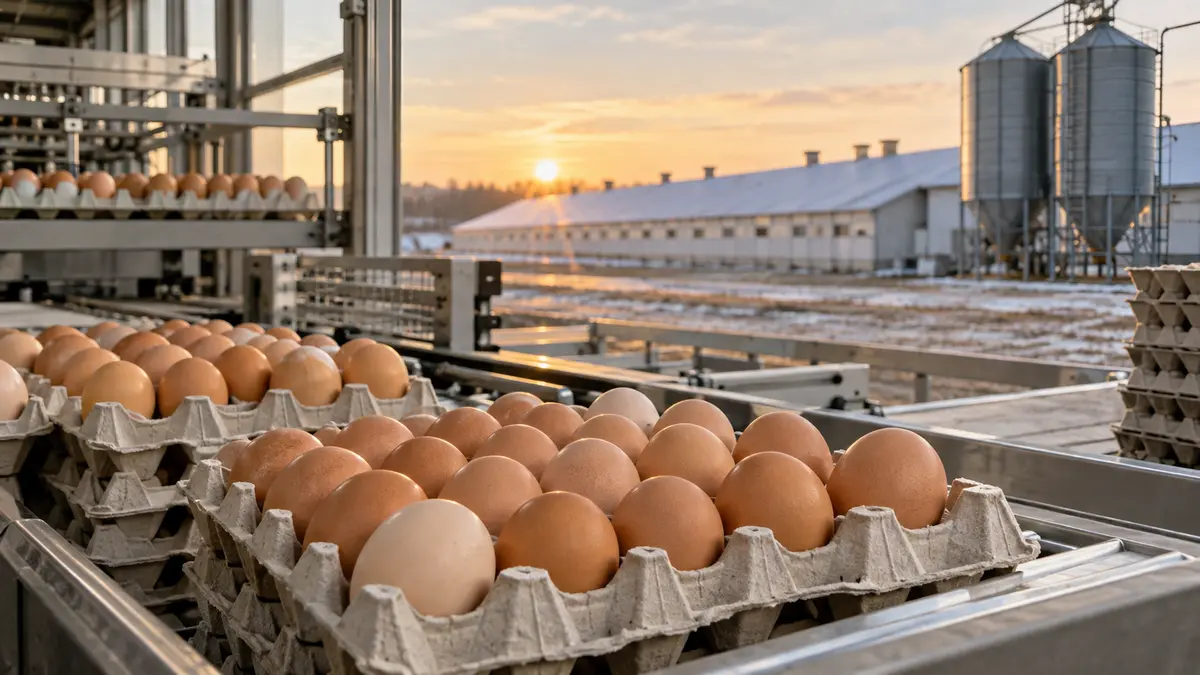
Russia entered 2024 with its egg market still digesting the price shock of the previous year: consumer prices had risen 1.6-fold over 2023, the president publicly called the episode a failure of the government, and a duty-free import quota of 1.2 billion eggs was opened as an emergency valve. By late March 2024 the picture had inverted in a different way — production was falling for the sixth consecutive month, bird flu outbreaks were still suppressing laying flocks, and the industry was waiting for the Easter season to show whether supply and demand had finally found a new balance. This is the anatomy of a stabilization that was never going to be quick.
The hangover of the 2023 price shock
To understand the spring of 2024, one has to start with the winter of 2023. According to Rosstat, average consumer prices for chicken eggs rose 1.6 times between January and December 2023, reaching 132.45 rubles per ten pieces. The spike was unusual even by the standards of a high-inflation year: eggs, a staple of the cheapest protein basket, became one of the most expensive items on the food market. President Vladimir Putin described the situation as a "failure in the government's work", explaining the dynamics by demand growth against constrained supply.
That diagnosis shaped the policy response. The state reached for two levers at once: an external one, in the form of duty-free imports, and an internal one, in the form of production support and contractual discipline between farms and retailers. By February 2024, Rosstat put the average retail price of ten eggs at 129.17 rubles — below the December peak, but still a level that kept the topic on the political agenda.
Six months of decline: what the numbers show
The supply side, however, was moving in the wrong direction. In January and February 2024, chicken egg production in Russia fell 1.8% year on year to 6.11 billion pieces, according to materials of the Rosptitsesoyuz poultry union; in physical terms the decline amounted to 110.1 million eggs. February alone was down 1.5% year on year and 7.5% month on month. Crucially, the monthly volume of egg production had remained below the previous year's level since September 2023 — the decline of early 2024 was not a new shock but the continuation of a trend that began exactly when prices were peaking.
The full-year 2023 comparison shows how narrow the margin was: for the whole of 2023, Rosstat recorded egg output growth of 1.8%, to 38.05 billion pieces. The market therefore entered the price crisis not with a collapse of production but with a demand surge that outran a slowly growing supply base — and then, as the crisis unfolded, the supply base itself began to shrink.
Bird flu as the supply-side culprit

Albert Davleev, president of Agrifood Strategies, links the year-on-year decline in egg production directly to bird flu outbreaks. In January 2024 the disease was detected at the Vladimirskaya poultry farm in the Astrakhan region, an enterprise specialized in egg production. As Agrifood Strategies had noted earlier, laying-hen farms are structurally more vulnerable to avian influenza than broiler operations: an outbreak in a laying flock destroys the productive asset itself, not just one batch of animals.
The aggregate statistics confirm the pressure. As of March 1, 2024, agricultural enterprises of the country held 465.3 million head of poultry, 1.2% less than a year earlier, according to Rosptitsesoyuz materials. Poultry meat production, by contrast, grew 0.4% year on year to 1.06 million tonnes in January-February 2024 — a reminder that the problem was concentrated precisely in the egg segment.
Sergey Yushin, head of the National Meat Association, points out that not all poultry farms where bird flu outbreaks were detected in 2023 have restored production. The recovery process, he says, can take from several months to a year and a half. That range is the single most important number of the story: it converts a veterinary event into a multi-quarter economic cycle.
The import valve: 1.2 billion duty-free eggs
The government's answer to the 2023 spike was to open the border. Duty-free import quotas for 1.2 billion eggs were introduced for 2024, and the Agriculture Ministry reported plans to increase production and to move producers and retail chains onto long-term contracts. The logic of the quota was to add a flexible external supply layer while domestic flocks were being rebuilt.
By March 2024 the effect of that valve was visible less in prices than in the behaviour of market participants. An industry source of Kommersant noted that many large egg producers had signed agreements to restrain wholesale prices, while food manufacturers had partly switched to imported egg products. The second channel matters more than it looks: industrial buyers of melange and powder are the most price-sensitive segment, and their partial exit to imports removed part of the pressure from the table-egg market.
Why retail shelves did not empty
The most counter-intuitive fact of the spring was the calm on the retail side. A retailer source told Kommersant that the reduction in egg supply was noticeable but was not translating into prices. Lenta reported that chicken eggs were available in full volume. Davleev's explanation is demand-side: there is no visible impact on the market and on prices from the decline in egg production because demand for the product has stabilized.
Stabilized demand after a price shock is a classic adjustment: part of the 2023 surge in consumption was elastic, and the 1.6-fold price rise pushed that part out of the market. What remained was a smaller but firmer base of consumption — exactly the kind of demand that a shrinking supply can serve without new price spikes. The 2024 market was therefore balancing at a lower volume and a higher price level than 2022, and the political question was whether that equilibrium was acceptable.
The recovery clock runs in months, not weeks
Alexey Kletsko, director of Yakov i partnery, expects that the return to operation of poultry farms hit by outbreaks in the Yaroslavl and Vologda regions, combined with production growth at enterprises in the Rostov and Leningrad regions, will most likely allow the industry to surpass last year's levels in the medium term. The geography of that sentence is the geography of the recovery: damaged regions return, growing regions add, and the sum crosses the previous year's line only after both processes complete.
Yushin's recovery window — several months to a year and a half per affected farm — implies that the national aggregate will not V-shape. Each restored flock adds supply with a biological lag: hens must be reared, placed, and reach peak lay. The industry's own expectation was that the Easter season of high demand would become the indicator period showing where the balance of supply and demand actually stood.
The policy toolkit beyond quotas
The Agriculture Ministry told Kommersant that January-February egg production volumes "fully meet the market's needs", and listed the workstreams around poultry farms: biosecurity, modernization, resource provision. One instrument deserves separate attention because it changes the economics of rebuilding: the lending term for the construction of laying-hen poultry farms has been extended to 15 years.
A 15-year loan for a laying hen
Long credit is the only way to finance an asset whose payback is measured in laying cycles. A 15-year horizon converts a speculative expansion decision into an infrastructure decision, and it signals that the state expects the egg sector to add capacity structurally rather than cyclically. Together with the duty-free quota, it forms a two-handed policy: imports cap the price today, long money builds the supply of tomorrow.
Easter as the industry's stress test
The seasonal peak around Easter is the annual moment when the egg market reveals its true tightness: household demand concentrates into a few weeks, and any hidden deficit surfaces as a price jump. Market participants explicitly waited for that test. If shelves stayed full and prices stayed flat through the peak, the stabilization narrative would be confirmed; if not, the quota and the contracts would have to be revisited.
The design of the test also explains why producers accepted price-restraint agreements: a visible spike in the most politically sensitive week of the year would invite administrative measures far harsher than voluntary discipline.
The contract layer: who carries the price risk
Beyond quotas and credit, the third instrument of the 2024 stabilization was contractual. The Agriculture Ministry reported work on transferring producers and retail chains to long-term contracts, and an industry source described a parallel, voluntary layer: many large egg producers had signed agreements to restrain wholesale prices. Both layers address the same defect of the 2023 crisis — the absence of any mechanism that distributes price risk between the farm gate and the shelf.
A long-term contract converts a spot auction into a schedule: the retailer obtains volume visibility, the farm obtains a demand guarantee that justifies flock investment. The voluntary restraint agreements played a different role — they were the industry's pre-emptive answer to the threat of administrative price control during the most sensitive weeks of the consumption year. In both cases the direction of travel was the same: away from a market that clears daily and toward one that clears on a calendar.
The regional arithmetic of the flock
The geography of outbreaks and recoveries explains why the national aggregate moved the way it did. The January 2024 outbreak at the Vladimirskaya farm in the Astrakhan region hit a specialized egg enterprise; the farms still returning to operation in the Yaroslavl and Vologda regions were the residue of the 2023 wave; and the growth expected in the Rostov and Leningrad regions was the offsetting force Kletsko relied on for the medium term. An egg market is a sum of regional flocks, and in 2024 that sum was being recomputed region by region on a biological timetable.
The aggregate flock data frame the scale: 465.3 million head of poultry on agricultural enterprises as of March 1, 2024, 1.2% below the previous year, while poultry meat output still grew 0.4% to 1.06 million tonnes in January-February. The divergence between meat and eggs inside the same industry is the cleanest evidence that the constraint was specific to laying flocks — and therefore specific to the recovery horizons Yushin described.
What the quota could not do
The duty-free quota of 1.2 billion eggs was a ceiling instrument, not a floor instrument: it could cap the price by adding supply, but it could not rebuild a flock or shorten a laying cycle. Its visible effect ran partly through an adjacent market — imported egg products absorbed part of industrial demand — which eased the table-egg segment without ever appearing in retail egg statistics. For policymakers that was a feature; for forecasters it was a warning that the quota's impact would show up in the wrong places first.
There was also a shelf constraint. Imported table eggs compete with domestic ones not only on price but on logistics, packaging and retail placement; a quota opens the border, not the shelf. The calm reported by retailers in March 2024 therefore reflected a combination of stabilized demand, restrained wholesale prices and a quota that mostly worked through the industrial channel — a more delicate construction than the headline "1.2 billion duty-free eggs" suggests.
The balance sheet of stabilization
By late March 2024 the Russian egg market could be described by a short list of moving parts:
- Production: down 1.8% year on year in January-February, to 6.11 billion eggs, with monthly output below the prior year since September 2023.
- Prices: retail at 129.17 rubles per ten eggs in February, against a December 2023 level of 132.45 rubles after a 1.6-fold rise over 2023.
- Imports: a duty-free quota of 1.2 billion eggs for 2024, plus a partial shift of food manufacturers to imported egg products.
- Contracts: price-restraint agreements by large producers and a push toward long-term producer-retailer contracts.
- Investment: a 15-year lending term for new laying-hen farms, alongside biosecurity and modernization workstreams.
- Biology: recovery of flu-hit flocks taking from several months to a year and a half per farm.
Outlook: a market learning to live with biological risk
The deeper lesson of the 2023-2024 egg cycle is that the sector's main risk has moved from economics to biology. Demand is stable and predictable; feed economics are manageable; but a single outbreak can remove a specialized laying farm from the market for a year or more. In such a market, stabilization policy cannot be only about prices — it has to be about the resilience of the flock base: biosecurity standards, regional diversification of capacity, and a financial system willing to fund reconstruction on biological, not quarterly, horizons.
The 15-year loan and the duty-free quota are two ends of that logic. The first accepts that supply rebuilds slowly; the second accepts that consumers cannot wait for it. Between them sits the Easter test of spring 2024 — the moment when the market, rather than the ministries, would say whether the balance had been found.
Just Published

European housing prices and rents

Schneider–PTC: the industrial data integration test behind the deal
Avio USA starts work on its Virginia manufacturing site

One equity market, two currency measures

Russia’s draft budget raises spending and borrowing plans

Russia Sets the 2027 Minimum Wage at 28,935 Rubles, Up 6.8%, on the Way to 35,000 by 2030
Partner news digest
 Qatar LNG expansion: readiness, financing and the production test
 Pennon’s capital plan: turning finance into better water outcomes
 Italy’s diesel relief gap: taxes, price ceilings and implementation
 EU–China hybrid trade: from understanding to measurable implementation
 Schneider–PTC: the industrial data integration test behind the deal
 IKEA’s hybrid resale model: buyback, marketplace liquidity and furniture logistics
 Banking AI beyond the ranking: capability, execution and evidence of value
 Fishing labour beyond the product label: practical protection
 Rhenus and the Middle Corridor: terminals need coordinated connections
 Royal Mail restructuring: the test is reliable delivery
 Fuel Finder on Google Maps: when price transparency becomes useful competition
 Samsung’s memory profit surge: what the preliminary record explains
Leave a comment