
Hanwha Aerospace Wins U.S. Army Contract Worth Up to $262.9 Million for K9-Based Artillery Prototypes
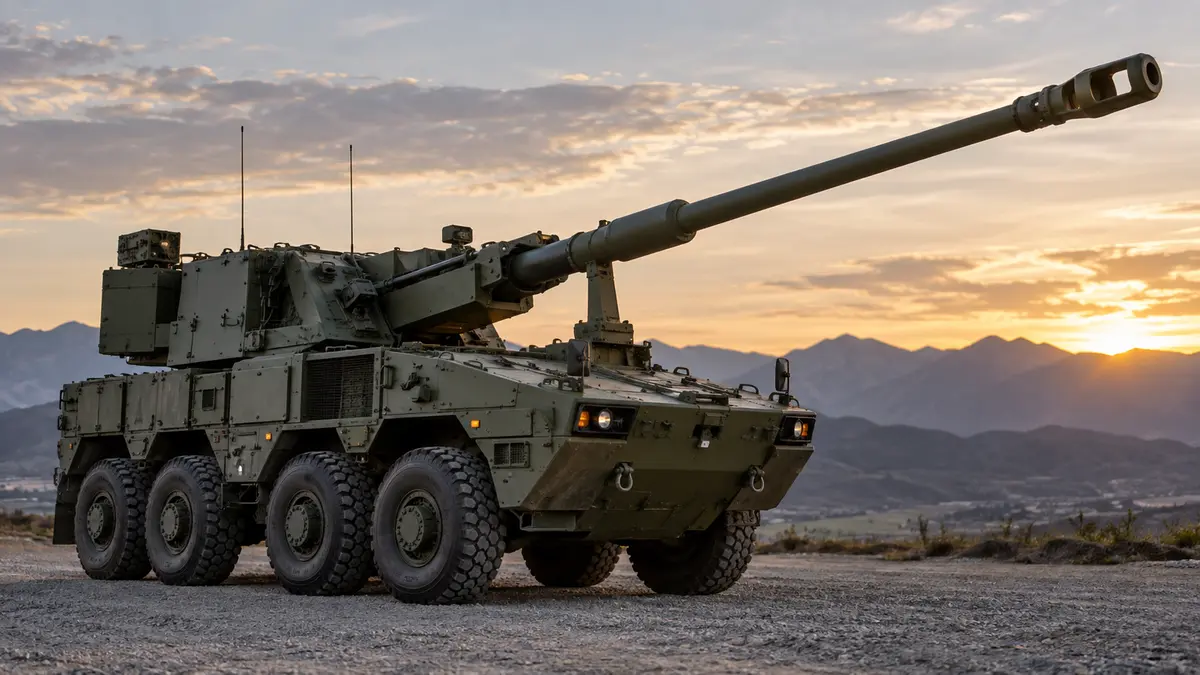
Summary: South Korean defense firm Hanwha Aerospace Co. said on August 19, 2026 that its U.S. unit has won a contract to deliver K9 self-propelled howitzer prototypes for the U.S. Army's Mobile Tactical Cannon (MTC) program, a deal with a cumulative value of up to US$262.9 million.
The contract
Hanwha Defense USA was selected to provide prototypes based on a wheeled variant of the bestselling K9 Thunder self-propelled artillery for the Army's Mobile Tactical Cannon (MTC) program, which aims to develop a highly mobile 155 mm artillery system to replace the Army's aging M777 towed howitzers, Yonhap News Agency reported. The contract calls for the delivery of six MTC prototypes, with an option for an additional 12 systems, and has a cumulative value of up to US$262.9 million, according to a separate U.S. Army statement.
Operational experiments ahead
"Soldiers will use these platforms in a series of operational experiments to assess performance, reliability, and supportability in realistic combat conditions," the U.S. Army said in a statement. The MTC program's purpose - a highly mobile 155 mm system to succeed the towed M777 generation - makes those experiments the decision gate: the prototypes will be judged not only on firing performance but on how quickly they can move, survive and be sustained in the field.
Localization in the United States
Hanwha Aerospace said the contract marks the K9 system's first entry into the U.S. defense market, the world's largest, and pledged to establish a stable production base as part of its localization strategy. In April 2026, Hanwha Defense USA signed a three-year lease for an idle facility in Opelika, Alabama, as part of efforts to localize production in the United States, according to the company. The arms manufacturer said it also plans to invest in the U.S. self-propelled howitzer supply chain to expand its presence in the combat vehicle market and establish itself as a long-term partner in the U.S. Army's modernization efforts.
The K9 family footprint
- The contract covers six wheeled MTC prototypes with an option for 12 more, cumulative value up to US$262.9 million.
- The MTC program targets a highly mobile 155 mm artillery system to replace aging M777 towed howitzers.
- The tracked version of the K9 is already in service or under contract in a number of countries, including NATO members such as Poland, Romania, Norway and Finland.
- Localization steps: a three-year lease of an idle facility in Opelika, Alabama (April 2026), and planned investment in the U.S. self-propelled howitzer supply chain.
What the order changes for both sides
For Hanwha, the MTC award converts a proven export product into a foothold in the largest defense market: prototypes built and tested in the American program, a leased Alabama facility and supply-chain investment position the company as a domestic producer rather than a foreign seller. For the U.S. Army, the wheeled K9 derivative offers a mature 155 mm base - already in service or under contract across multiple NATO countries in tracked form - adapted to the mobility requirements of the MTC program, with operational experiments to validate the fit before any production decision.
Company information
Hanwha Aerospace Co. is a South Korean defense and aerospace manufacturer, part of Hanwha Group, and the developer of the K9 Thunder family of self-propelled howitzers and other land systems. Corporate website: https://www.hanwhaaerospace.com.
Contact
Hanwha Aerospace Co., Seoul, South Korea. Media and investor relations enquiries are handled through the corporate website https://www.hanwhaaerospace.com.
Just Published

European housing prices and rents
Schneider–PTC: the industrial data integration test behind the deal
Avio USA starts work on its Virginia manufacturing site

One equity market, two currency measures

Russia’s draft budget raises spending and borrowing plans

Russia Sets the 2027 Minimum Wage at 28,935 Rubles, Up 6.8%, on the Way to 35,000 by 2030
Partner news digest
 Qatar LNG expansion: readiness, financing and the production test
 Pennon’s capital plan: turning finance into better water outcomes
 Italy’s diesel relief gap: taxes, price ceilings and implementation
 EU–China hybrid trade: from understanding to measurable implementation
 Schneider–PTC: the industrial data integration test behind the deal
 IKEA’s hybrid resale model: buyback, marketplace liquidity and furniture logistics
 Banking AI beyond the ranking: capability, execution and evidence of value
 Fishing labour beyond the product label: practical protection
 Rhenus and the Middle Corridor: terminals need coordinated connections
 Royal Mail restructuring: the test is reliable delivery
 Fuel Finder on Google Maps: when price transparency becomes useful competition
 Samsung’s memory profit surge: what the preliminary record explains
Leave a comment