
Russian Helicopters to Deliver 21 Mi-171 Helicopters to Iran's Red Crescent Society
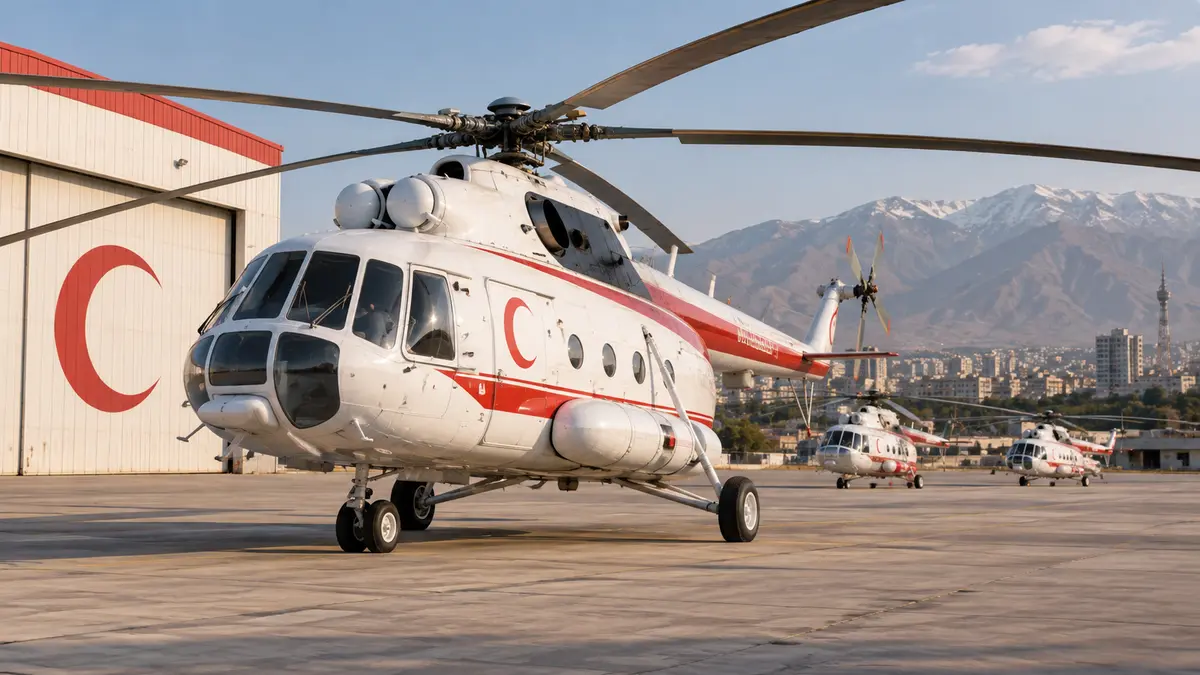
Summary: the Russian Helicopters holding, part of Rostec, has signed documents to supply 21 Mi-171 helicopters to the national Red Crescent Society of the Islamic Republic of Iran, with the first aircraft to be handed over to the customer in 2027, the holding's press service said on June 17, 2026.
The contract
The documents were signed on Wednesday, June 17, 2026, for the delivery of 21 Mi-171 machines to the national Red Crescent Society of the Islamic Republic of Iran, Interfax reported citing the holding's press service. "Today documents have been signed for the supply of 21 machines to the national Red Crescent Society of the Islamic Republic of Iran, the first of which are planned to be handed over to the customer in 2027," said Nikolay Kolesov, director general of the holding, as quoted by the press service.
Planned uses of the fleet
According to the press service, the helicopters will be used in sanitary operations, for performing transport functions and for solving other socially significant tasks. For a humanitarian operator such as the Red Crescent Society, that mix means the fleet will work both as air ambulances and as utility transport - missions that value the Mi-171 family's combination of payload, range and tolerance of unprepared landing sites.
Iran as a long-standing customer
"Iran is a long-standing partner of Rostec and the Russian Helicopters holding. Dozens of civil helicopters of our production are operated in the republic, used in key sectors of the economy and performing vitally important socially significant functions," Kolesov noted. The new order therefore extends an installed base rather than opening a new market: service chains, crew training and maintenance practices for the Mi-8/Mi-171 family already exist in the country.
What the Mi-171 is
- The Mi-171 is the export version of the most mass-produced twin-engine medium helicopter in aviation history, the Mi-8 family.
- The machine combines high reliability and versatility and can be operated in any climatic zones.
- Helicopters of the family remain in demand thanks to multifunctionality, maintainability and extensive operating experience in more than 100 countries of the world.
- The contracted batch: 21 aircraft, first deliveries in 2027, customer - the national Red Crescent Society of Iran.
What the order changes for both sides
For the holding, a 21-aircraft order from a single humanitarian operator is a serial batch that loads production slots with a configuration already certified and familiar: sanitary and transport roles use standard Mi-171 capabilities without bespoke development. For the Iranian Red Crescent, the batch renews a fleet segment that works on socially significant tasks - from medical evacuation to transport support - with machines whose logistics and repair base in the country is already established through decades of Mi-8 family operation.
The delivery schedule, with the first machines in 2027, also indicates that the contract enters production planning rather than off-the-shelf stock: the batch will be built against the holding's serial schedule alongside its other civil and state customers.
Company information
Russian Helicopters JSC is a Russian helicopter-building holding, part of the Rostec state corporation; it unites design bureaus and production plants and develops and manufactures helicopters of the Mi and Ka families, including the Mi-8/Mi-171 family. Corporate website: https://www.russianhelicopters.aero.
Contact
Russian Helicopters JSC (part of Rostec), Moscow, Russia. Press service enquiries are handled through the corporate website https://www.russianhelicopters.aero.
Just Published

European housing prices and rents
Schneider–PTC: the industrial data integration test behind the deal
Avio USA starts work on its Virginia manufacturing site

One equity market, two currency measures

Russia’s draft budget raises spending and borrowing plans

Russia Sets the 2027 Minimum Wage at 28,935 Rubles, Up 6.8%, on the Way to 35,000 by 2030
Partner news digest
 Qatar LNG expansion: readiness, financing and the production test
 Pennon’s capital plan: turning finance into better water outcomes
 Italy’s diesel relief gap: taxes, price ceilings and implementation
 EU–China hybrid trade: from understanding to measurable implementation
 Schneider–PTC: the industrial data integration test behind the deal
 IKEA’s hybrid resale model: buyback, marketplace liquidity and furniture logistics
 Banking AI beyond the ranking: capability, execution and evidence of value
 Fishing labour beyond the product label: practical protection
 Rhenus and the Middle Corridor: terminals need coordinated connections
 Royal Mail restructuring: the test is reliable delivery
 Fuel Finder on Google Maps: when price transparency becomes useful competition
 Samsung’s memory profit surge: what the preliminary record explains
Leave a comment