
Scottish Sea Farms Wins Approval for Fish Holm, Set to Become Scotland's Largest Salmon Farm
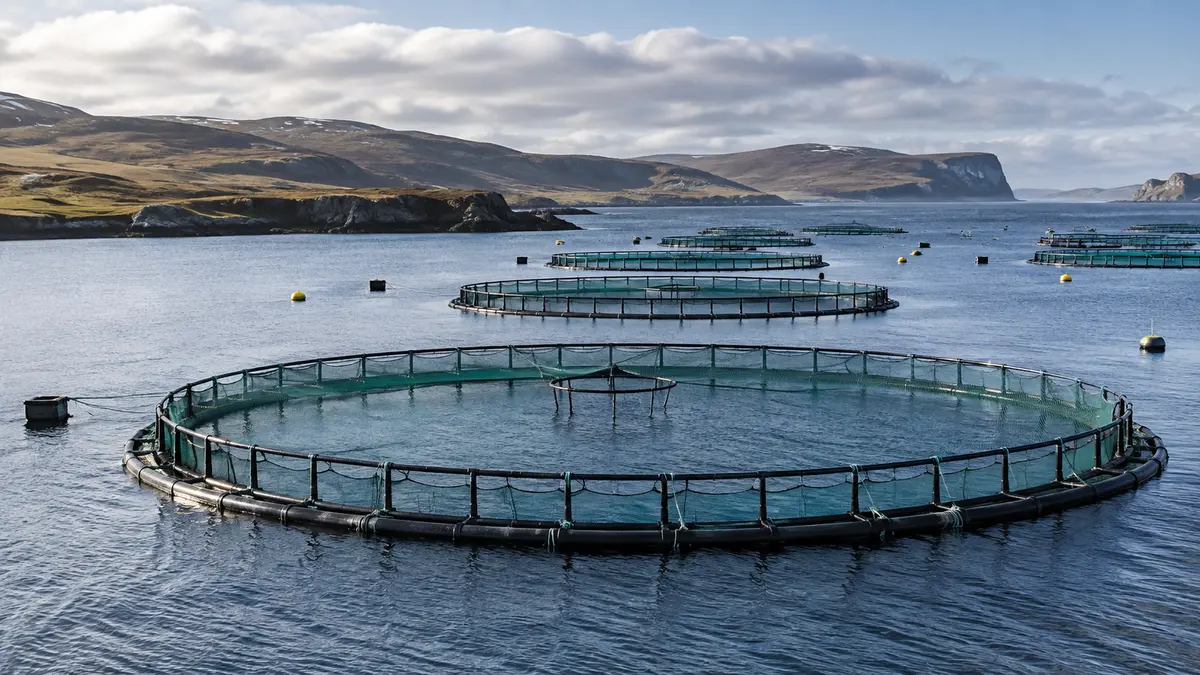
Summary: Plans to build what has been called Scotland's largest salmon farm off the coast of Shetland have been given the go-ahead, with Shetland Islands Council approving an 8 million pound redevelopment of Scottish Sea Farms' sites in Yell Sound into a single farm, the Fish Holm, designed to hold up to 6,000 tonnes of salmon at any one time.
The approval
Shetland Islands Council approved the 8 million pound redevelopment in Yell Sound, a strait running between the mainland and the island of Yell, despite opposition from wildlife campaigners, BBC News reported on Feb. 12, 2026. Scottish Sea Farms' plans include expanding some of its existing sites in the strait into one bigger farm, the Fish Holm, and the company said it would contain up to 6,000 tonnes of salmon at any one time. Salmon is the biggest food export of the United Kingdom, with about 111,000 tonnes of Scottish salmon produced in 2025.
What changes at Fish Holm
The current farm already had permission for eight 100-metre circular pens, but the new proposals replace existing pens with 12 new ones of 520 ft, or 160 m, circumference. Maximum allowed biomass at Fish Holm is expected to increase from about 2,000 tonnes to about 6,000 tonnes if the proposed conditions to mitigate and monitor impacts are approved. Conditions include a time limit of three years for work to start and a moorings survey to locate any large horse mussels clumps in the area.
The geometry of the change is the story: three times the biomass in pens of larger circumference means fewer, bigger units in deeper water, which is the direction the industry's engineering has been moving as sea lice and welfare pressure made shallow inshore sites harder to operate.
Conditions and objections
NatureScot, the public agency which advises the Scottish government, had submitted an initial objection expressing concern that developing the farm would have a significant effect on bird species, and it said records of wildlife entanglements and entrapment must be kept. No other official objections were filed, and the Scottish Environment Protection Agency, SEPA, did not file an objection to the new farm, saying the risk to wild salmon and sea trout from sea lice will be assessed and managed.
NatureScot, SEPA and WildFish
The non-governmental opposition was sharper. Anti-salmon farming organisation WildFish said it was deeply disappointed by the council's decision. The proposed 6,000-tonne biomass raises serious concerns about cumulative impacts on wild sea trout, particularly from sea lice, said the charity's Scotland director Nick Underdown (Nick Underdown), adding that sea lice from salmon farms are widely recognised by government scientists as posing a risk to wild salmon and sea trout, that several nearby farms have recently recorded elevated lice levels and high mortalities, and that approving a larger site carries a significant environmental risk while challenging SEPA's sea lice controls intended to protect wild fish.
The company's logic
Scottish Sea Farms said it welcomed the decision. A spokesperson said the decision relates to the expansion and consolidation of the company's existing farm and reflects its move towards fewer, larger sites in deeper, higher-energy waters that support fish health and welfare, and that developments such as Fish Holm help retain and support skilled local jobs now and into the future. The consolidation argument is the commercial core of the project: one 6,000-tonne site replaces several smaller consents, concentrating monitoring, staffing and logistics while retiring the shallow pens that carry the highest biological risk.
- Approval: Shetland Islands Council, Feb. 12, 2026, for an 8 million pound redevelopment in Yell Sound.
- Scale: up to 6,000 tonnes of salmon at any one time, from a current maximum of about 2,000 tonnes.
- Pens: 12 new pens of 160 m circumference replacing eight permitted 100-metre pens.
- Conditions: three-year time limit to start work; moorings survey for horse mussel clumps.
- Objections: NatureScot initial objection on bird species; WildFish opposition on sea lice; SEPA no objection.
- Context: about 111,000 tonnes of Scottish salmon produced in 2025; salmon is the UK's largest food export.
For Scottish Sea Farms the approval converts a portfolio of ageing consents into a single modern asset; for the regulator it sets the test case of whether a 6,000-tonne biomass can operate in Yell Sound without the lice and mortality record of the nearby farms. The three-year clock on starting work makes 2029 the year the answer becomes measurable.
Company information
Scottish Sea Farms (SSF) is a Scottish salmon farming company operating marine sites in the Shetland, Orkney and Hebrides waters and one of the largest producers of farmed salmon in the United Kingdom. Corporate website: https://www.scottishseafarms.com.
Contact
Scottish Sea Farms, Scotland, United Kingdom. Media and stakeholder enquiries are handled through the corporate website https://www.scottishseafarms.com.
Just Published

European housing prices and rents

Schneider–PTC: the industrial data integration test behind the deal

Avio USA starts work on its Virginia manufacturing site

One equity market, two currency measures

Russia’s draft budget raises spending and borrowing plans

Russia Sets the 2027 Minimum Wage at 28,935 Rubles, Up 6.8%, on the Way to 35,000 by 2030
Partner news digest
 Qatar LNG expansion: readiness, financing and the production test
 Pennon’s capital plan: turning finance into better water outcomes
 Italy’s diesel relief gap: taxes, price ceilings and implementation
 EU–China hybrid trade: from understanding to measurable implementation
 Schneider–PTC: the industrial data integration test behind the deal
 IKEA’s hybrid resale model: buyback, marketplace liquidity and furniture logistics
 Banking AI beyond the ranking: capability, execution and evidence of value
 Fishing labour beyond the product label: practical protection
 Rhenus and the Middle Corridor: terminals need coordinated connections
 Royal Mail restructuring: the test is reliable delivery
 Fuel Finder on Google Maps: when price transparency becomes useful competition
 Samsung’s memory profit surge: what the preliminary record explains
Leave a comment