
Inarctica Grows H1 2026 Revenue by 38% to 13.8 Billion Rubles on Salmon and Trout Sales
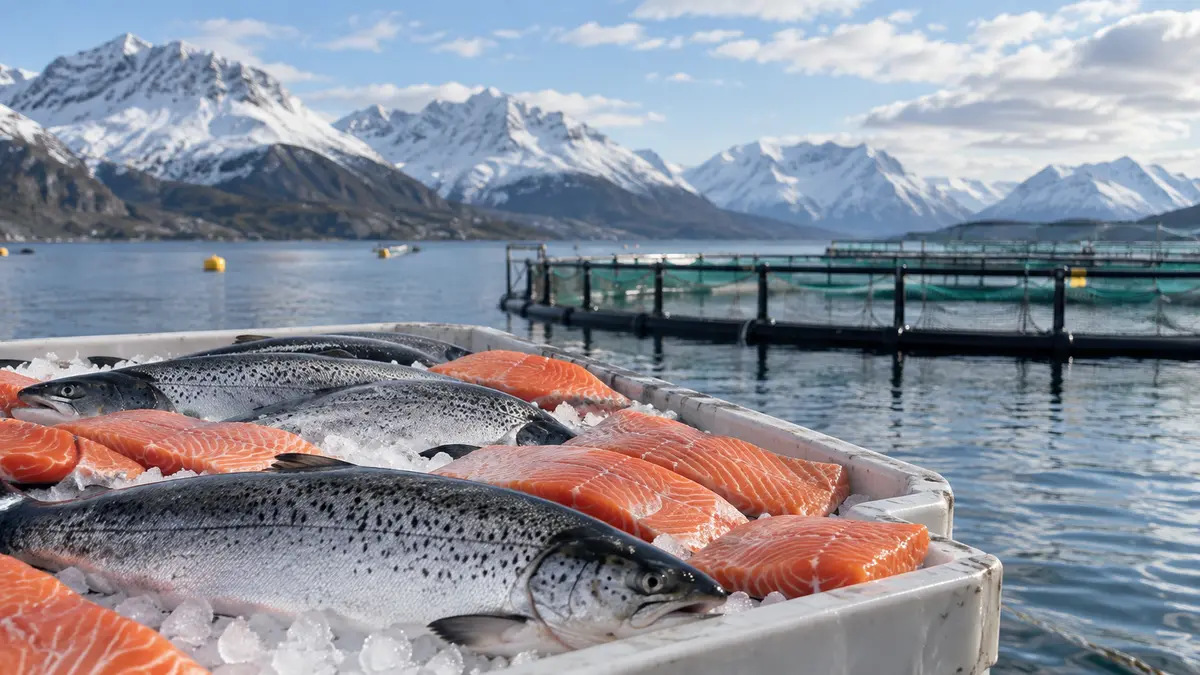
Summary: Russian salmon and trout farmer Inarctica increased its revenue for the first six months of 2026 by 38% to 13.8 billion rubles, the company said in a press release, with sales volumes up 57% to 13,200 tonnes and fish stocks in water bodies at 27,700 tonnes as of the end of June, 33% above the year-ago level.
The half-year numbers
Revenue for the first half grew 38% year on year against the backdrop of increasing sales volumes, although at a more restrained pace than the sales volumes themselves, said Andrei Baranov (Andrei Baranov), deputy chief executive of Inarctica, as quoted in the company release covered by Vedomosti on Aug. 10, 2026. The formulation matters: volume grew faster than revenue, which means the average selling price of the company's red fish was lower than a year earlier, and the top line expansion was bought with tonnes rather than with price.
The company noted that sales grew 57% and reached 13,200 tonnes against the backdrop of biomass growth and high demand for red fish. Fish stocks in water bodies at the end of June 2026 reached 27,700 tonnes, 33% above the indicator of a year earlier, Inarctica specified.
What drove the growth
Two engines are visible in the release. The first is biological: a larger biomass in the water converts into a larger harvestable volume, and the 57% sales increase is the realization of fish placed in previous cycles. The second is commercial: high demand for red fish on the domestic market absorbed the additional volume without the company having to export its way out of the harvest, in a year when wild salmon catches in Russia were under pressure and farmed supply carried a larger share of the red fish shelf.
Biomass as the forward indicator
The 27,700 tonnes of biomass in water at the end of June is the number that schedules the second half and the first half of 2027: in salmon farming, revenue follows biomass with a biological lag of one to two growing seasons. A 33% year-on-year biomass increase therefore pre-announces volume growth beyond the reported half, while the price side of the equation remains the variable the company does not control.
The caviar price backdrop
The red fish market around the release was mixed on the delicacy side. Earlier, on Aug. 4, it became known that pink salmon caviar had cheapened by 7% compared with the previous year, while other salmon caviar types grew more expensive: the price of sockeye caviar rose 17%, chum caviar added 14% and coho caviar 13%. For a farmer whose revenue line is whole fish and fillet, the caviar spread is a signal of species-level demand rather than a direct revenue driver, but it confirms that the red fish complex in 2026 is pricing species separately rather than moving as one basket.
What the growth means for the company
The half-year result converts Inarctica's biomass investment of previous cycles into a revenue curve: 13,200 tonnes sold in six months places the company's annualized sales above 26,000 tonnes, a scale at which fixed costs of marine farms and logistics are spread over a materially larger base than in 2025. The restrained price dynamic is the cost of that scale: selling 57% more volume for 38% more revenue implies accepting a lower average price, a rational trade in a market where wild supply is shrinking and farmed volume takes the shelf.
- Revenue H1 2026: 13.8 billion rubles, up 38% year on year.
- Sales volume: 13,200 tonnes, up 57%, on biomass growth and high red fish demand.
- Biomass in water at end-June 2026: 27,700 tonnes, up 33% year on year.
- Price dynamic: revenue growth slower than volume growth, per deputy CEO Andrei Baranov.
- Market backdrop: pink salmon caviar down 7% year on year; sockeye up 17%, chum up 14%, coho up 13%.
Company information
Inarctica is a Russian company engaged in fish farming both in natural water bodies and at specialized marine farms. Its production cycle includes the purchase of roe, rearing of fry, their transportation to Russia, grow-out to a market weight of 2-4 kg, followed by harvest and sale. Corporate website: https://inarctica.com.
Contact
Inarctica, Russia. Media and investor relations enquiries are handled through the corporate website https://inarctica.com.
Just Published

European housing prices and rents
Schneider–PTC: the industrial data integration test behind the deal
Avio USA starts work on its Virginia manufacturing site

One equity market, two currency measures

Russia’s draft budget raises spending and borrowing plans

Russia Sets the 2027 Minimum Wage at 28,935 Rubles, Up 6.8%, on the Way to 35,000 by 2030
Partner news digest
 Qatar LNG expansion: readiness, financing and the production test
 Pennon’s capital plan: turning finance into better water outcomes
 Italy’s diesel relief gap: taxes, price ceilings and implementation
 EU–China hybrid trade: from understanding to measurable implementation
 Schneider–PTC: the industrial data integration test behind the deal
 IKEA’s hybrid resale model: buyback, marketplace liquidity and furniture logistics
 Banking AI beyond the ranking: capability, execution and evidence of value
 Fishing labour beyond the product label: practical protection
 Rhenus and the Middle Corridor: terminals need coordinated connections
 Royal Mail restructuring: the test is reliable delivery
 Fuel Finder on Google Maps: when price transparency becomes useful competition
 Samsung’s memory profit surge: what the preliminary record explains
Leave a comment