
Korea Zinc and Washington to Jointly Invest US$6.8 Billion in a Critical Metals Refinery in Tennessee
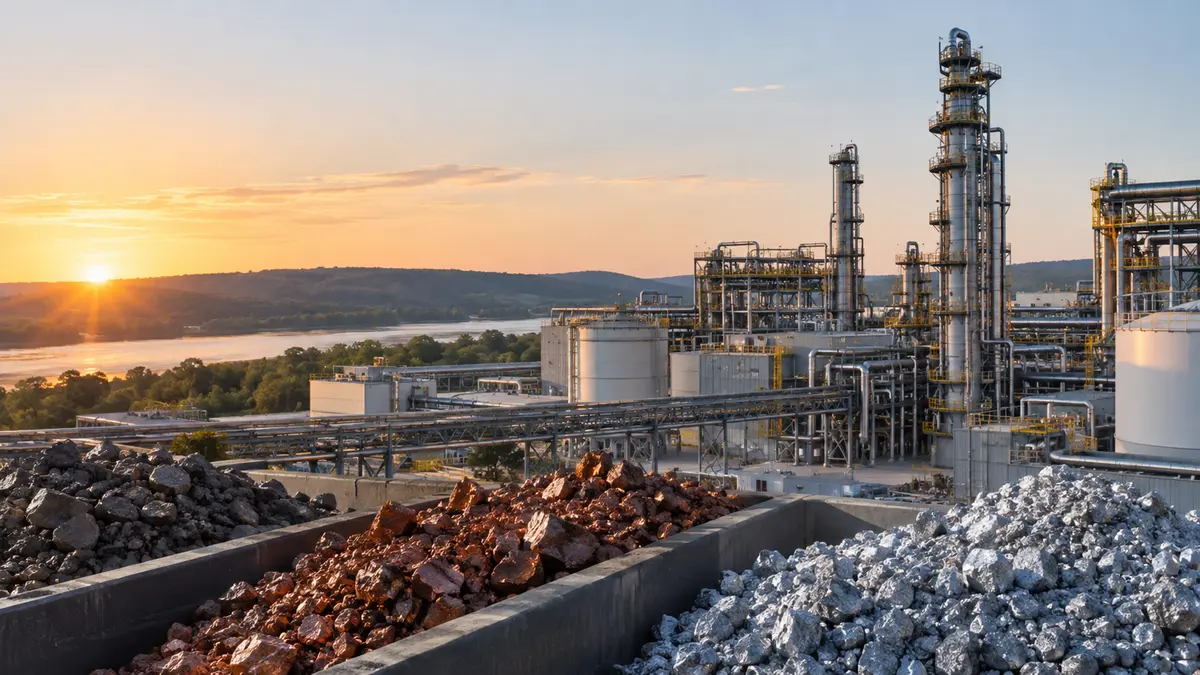
Summary: Korea Zinc Co. and the U.S. government are seeking to jointly invest around 10 trillion won (US$6.8 billion) in a critical metals refinery in the southeastern United States, the South Korean nonferrous metals producer said after its board finalized the joint-venture plan. The plant in Clarksville, Tennessee, named "U.S. Smelter," is to start construction next year and begin phased commercial operations from 2029.
The project
Korea Zinc said it signed a strategic partnership with the U.S. Departments of War and Commerce and plans a joint investment to construct the refinery in Clarksville. Washington pushed for the plant's construction and is expected to invest around 2 trillion won in the joint venture together with U.S. defense firms. The board approved the plan at its meeting on December 15. "We decided to build a comprehensive nonferrous metal refinery in the United States to strengthen our drive for future growth," the company said in a public notice.
Critical metals on the agenda
The refinery is intended as a U.S. foothold for the supply and production of critical metals, including antimony and germanium. The plan comes as the U.S. government steps up efforts to respond to Chinese export curbs on rare earths and critical metals.
How the site was chosen
After reviewing more than 60 candidate sites, the two sides selected Tennessee, citing a stable supply of the water and electricity smelting requires and the state's logistical accessibility. Korea Zinc plans to take over the site of an existing refinery owned by Nyrstar and rebuild its infrastructure using advanced processing technology; an agreement with Nyrstar on the takeover had already been reached. Construction is set to begin next year with site preparation, with commercial operations starting in phases from 2029.
The road to the joint venture
- August 2025: Chairman Choi Yoon-beom announced plans for a strategic metals partnership with the United States during his visit to the country, following President Lee Jae Myung's first summit with U.S. President Donald Trump.
- August 26, 2025: Korea Zinc signed a memorandum of understanding with U.S. defense giant Lockheed Martin on the supply and production of germanium; the signing was attended by Industry Minister Kim Jung-kwan and U.S. Commerce Secretary Howard Lutnick.
- The same month: an MOU with Lockheed Martin to invest around 140 billion won in a germanium-producing facility in South Korea.
- December 15, 2025: the board finalized the U.S. joint venture and the "U.S. Smelter" project.
Company information
Korea Zinc Co. is a South Korean nonferrous metals producer and the initiator of the U.S. Smelter critical metals refinery project in Tennessee. Corporate website: https://www.koreazinc.co.kr/en/.
Contact
Korea Zinc Co., Seoul, South Korea. Media and investor relations enquiries are handled through the corporate website https://www.koreazinc.co.kr/en/.
Just Published

European housing prices and rents
Schneider–PTC: the industrial data integration test behind the deal
Avio USA starts work on its Virginia manufacturing site

One equity market, two currency measures

Russia’s draft budget raises spending and borrowing plans

Russia Sets the 2027 Minimum Wage at 28,935 Rubles, Up 6.8%, on the Way to 35,000 by 2030
Partner news digest
 Qatar LNG expansion: readiness, financing and the production test
 Pennon’s capital plan: turning finance into better water outcomes
 Italy’s diesel relief gap: taxes, price ceilings and implementation
 EU–China hybrid trade: from understanding to measurable implementation
 Schneider–PTC: the industrial data integration test behind the deal
 IKEA’s hybrid resale model: buyback, marketplace liquidity and furniture logistics
 Banking AI beyond the ranking: capability, execution and evidence of value
 Fishing labour beyond the product label: practical protection
 Rhenus and the Middle Corridor: terminals need coordinated connections
 Royal Mail restructuring: the test is reliable delivery
 Fuel Finder on Google Maps: when price transparency becomes useful competition
 Samsung’s memory profit surge: what the preliminary record explains
Leave a comment